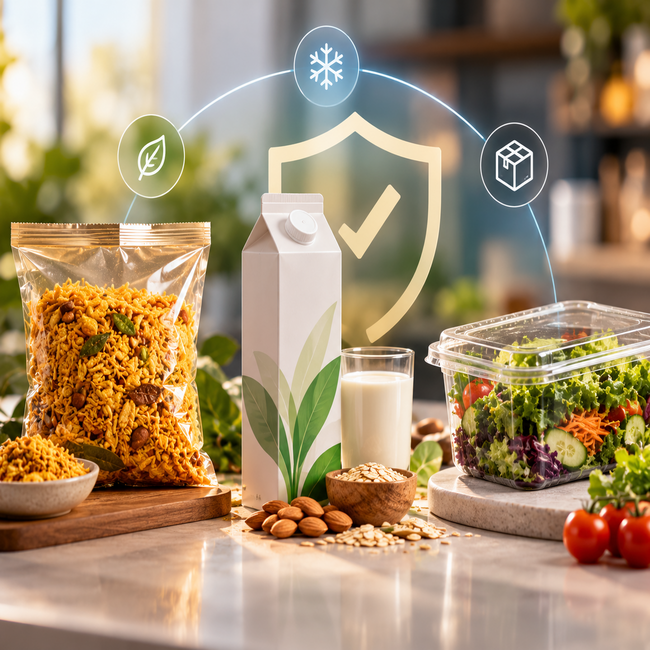

Packaging decisions influence far more than shelf life. They shape the quality customers experience, the convenience of consumption and the credibility a food brand earns with every purchase.
A food brand makes its promise long before a customer takes the first bite. The name on the pack, the description of the product and the memory of an earlier purchase all establish an expectation. But that promise is fulfilled only when the food is opened, prepared or consumed. At that moment, the customer judges what the business has delivered. Does the namkeen have the expected crunch? Has the product arrived in good condition? Does the beverage fit easily into the household’s routine? These apparently small encounters bring manufacturing, packaging and distribution into a single experience.
For business leaders, that connection deserves attention. A company can invest in ingredients, develop a distinctive flavour and build demand through marketing, yet the customer’s assessment still depends on the condition in which the product reaches them. Packaging helps protect the value created across those investments.
Viewed this way, freshness is a delivery commitment. Its credibility rests on a brand’s ability to preserve the intended quality through the journey from production to consumption. The perspectives shared by Jagdish Farshan, Alt Co. and Jasper Food reveal how different packaging approaches serve that commitment. Together, they offer a useful lens on a larger business question: how can a food brand make its quality dependable beyond the factory gate?
Consistency gives customers a reason to return
For a food brand, the first purchase creates an impression. The next purchase tests whether that impression can be relied upon. This is particularly relevant in a category such as namkeen, where texture and flavour are central to enjoyment. A familiar product carries a remembered experience, and each new pack is measured against it. Aakash Kandoi, CEO&MD, Jagdish Farshan, highlighted , “At Jagdish Farshan, we use advanced German, Italian and Japanese packaging machinery across our facilities, alongside Modified Atmosphere Packaging (MAP) for our namkeen range, to enhance the efficiency, precision and hygiene of the packaging process. MAP helps minimise exposure to air and supports prolonged freshness, while our automated systems reduce manual handling and help minimise exposure to moisture and external contaminants. Combined with our controlled production and storage processes, this helps retain the freshness, texture, flavour and overall quality of our products from the time they are packed until they reach the consumer. For us, technology-led packaging is ultimately about building consumer confidence. By minimising manual handling and maintaining standardised packaging processes, we are able to deliver consistent quality and taste in every pack.”
Modified Atmosphere Packaging changes the atmosphere inside a pack to suit the food being preserved. Its performance depends on the gas composition, the packaging material and the integrity of the seal. The technology must therefore work as part of a product-specific preservation system.
For the consumer, these technical choices translate into something much simpler: whether a favourite snack tastes and feels the way they expect. That predictability has strategic value. A customer who can confidently anticipate an experience has a stronger basis for choosing the same product again. Packaging can support that confidence by helping reduce the gap between how the product leaves the facility and how it is encountered later.
Aakash Kandoi’s reference to the brand’s heritage adds another dimension. For an established food business, technology can help carry a familiar experience through a wider distribution network. As a brand reaches customers farther from its production centres, consistency becomes a way of making its reputation tangible. The broader leadership question is therefore how to expand access while preserving what customers recognise and value.
Convenience is part of the quality experience
Preservation also influences how easily a product fits into everyday life. The ability to keep an unopened beverage available at home, for example, changes the practical experience of buying and using it. Alt Co.’s approach connects processing and packaging with this dimension of convenience. Sumair Sachdev, cofounder and COO, Alt Co., states, “By combining UHT flash-sterilization with multi-layer aseptic packaging (Tetrapak) , we eliminate the need for artificial preservatives while locking in fresh flavor and nutrients. This light- and oxygen-proof barrier enables ambient shelf stability, allowing us to deliver clean, highly nutritious plant milk while significantly lowering cold-chain carbon emissions across our supply chain”
UHT treatment and aseptic packaging perform complementary roles. The heat treatment establishes the required microbial stability, while aseptic filling and sealing protect the treated product from recontamination. In a properly controlled system, this combination can enable unopened products to be distributed and stored at ambient temperatures within their specified conditions and shelf life.
The CX connection extends to planning and availability. A shelf-stable unopened product can offer flexibility in household storage and reduce dependence on refrigerated distribution before opening. For a business, this can create opportunities to serve customers through a different distribution model; for a household, it can make the product easier to keep on hand.
Sachdev also describes lower cold-chain carbon emissions as an outcome of Alt Co.’s approach. This is a company-specific claim, but it illustrates how a processing and packaging decision can connect customer convenience with a wider operational objective.
Such convenience depends on clear instructions. Unopened shelf stability and storage after opening are different conditions. Explaining that distinction helps customers use the product as intended and makes communication part of the preservation system.
Quality must survive the journey
The point of production and the point of consumption are separated by time, distance and handling. Customers rarely see the systems that manage this gap. They experience the result.
For Jasper Food, protecting that result involves both packaging precision and discipline across the supply chain.
Shahid Khan, Plant Head, Jasper Food, further said, “At Jasper Food, freshness begins with how we protect the product. We use advanced European thermoforming packaging technology to create a precise, high-integrity seal that minimises exposure to air and external contaminants, helping preserve the product’s quality and extend its shelf life. This technology, combined with our stringent cold-chain and food-safety practices, gives our customers greater confidence that the quality packed at our facility is the quality they experience on their plate.”
The significant point in Shahid Khan’s account is the relationship between the seal and the system around it. He places packaging alongside cold-chain and food-safety practices, recognising that quality protection depends on connected operations. The customer receives one product and forms one judgement, regardless of how many departments contributed to the outcome.
This is where customer experience begins to take shape within manufacturing itself. A decision about seal integrity can influence the condition of the food on a plate. An operational choice becomes a customer-facing outcome, even when the customer never knows which technology was used.
Longer shelf life must create value for the customer
Across these examples, shelf life is an important capability. Its commercial value also depends on how much useful life remains when the product reaches the buyer. A product may have a long declared shelf life, yet the customer’s experience is shaped by the time available to store, prepare and consume it after purchase. This makes stock rotation, distribution speed and retailer handling relevant to the promise of freshness.
For leaders, it is a useful distinction: extending shelf life creates an opportunity; managing the journey determines how much of that opportunity reaches the customer.The same principle applies to sensory quality. A product’s ability to remain within its validated shelf life and its ability to deliver the expected eating experience are related considerations that require appropriate assessment. Packaging decisions should therefore be evaluated against the product’s actual requirements, including safety, flavour, texture and storage conditions.
Measuring the experience the pack delivers
The three accounts also suggest a broader way to judge packaging investment. Production efficiency and shelf-life performance matter, but leaders can connect them with evidence from the customer’s experience. Recurring feedback about loss of crunch, leakage, damaged seals or unclear storage instructions can help identify where expectations and delivery diverge. Such feedback is most useful when it is examined alongside packaging checks, shelf-life studies and distribution records.
This creates a practical connection between customer support and operational improvement. A complaint about texture, for example, can prompt investigation across several stages of the journey rather than an assumption that the issue belongs to packaging alone. The aim is to understand whether the quality designed into the product is being delivered consistently and where the system needs attention. For Jagdish Farshan, Alt Co. and Jasper Food, the technologies described differ because their products and preservation requirements differ. The shared strategic lesson is that customer trust is supported by coordinated decisions across processing, protection, handling and communication.
The customer may never see the investment behind the pack, but they experience its value every time the food delivers the quality they came back for.
Disclaimer: All data points and statistics are attributed to published research studies and verified market research. All quotes are either sourced directly or attributed to public statements.
Related Articles