
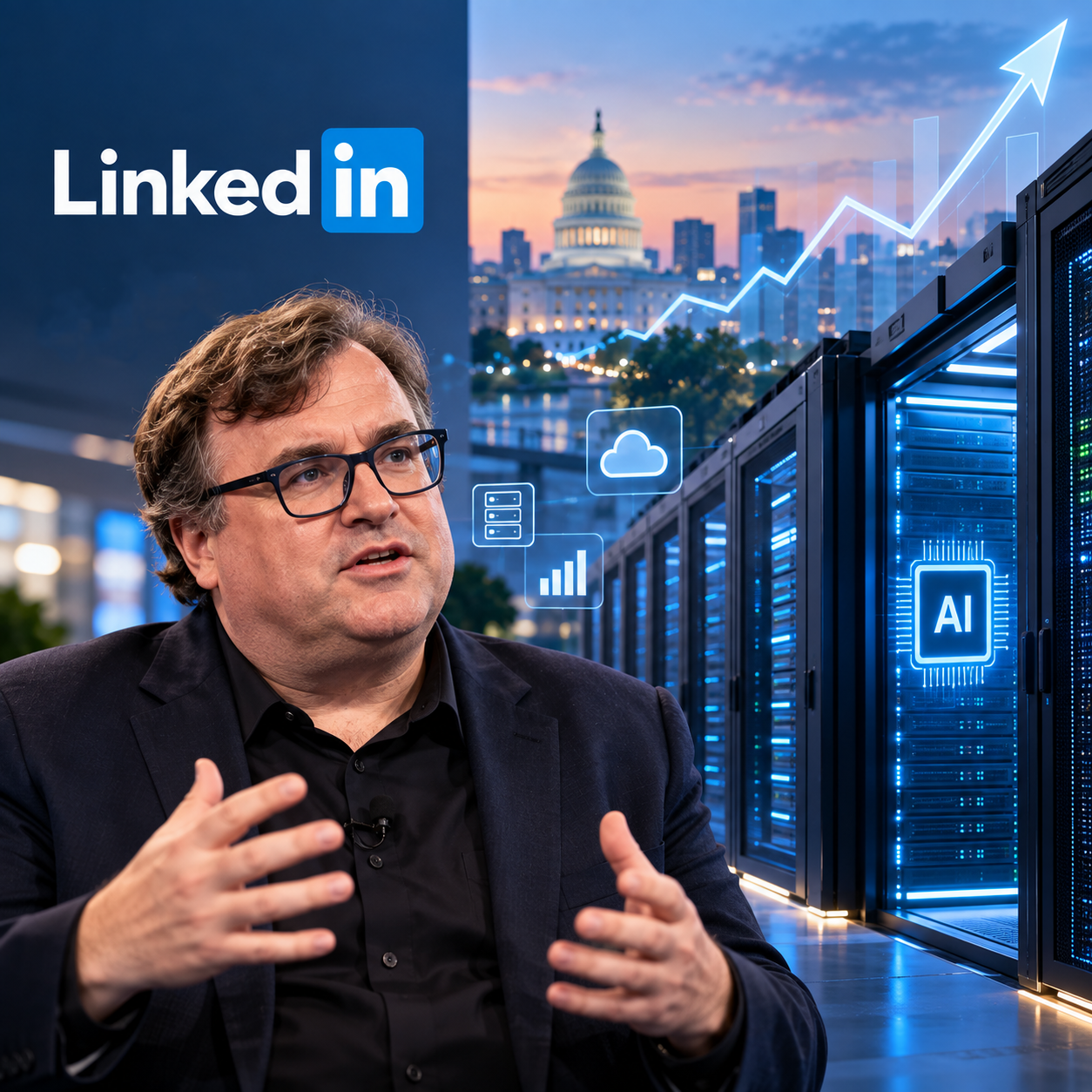

LinkedIn co-founder Reid Hoffman has defended the rapid expansion of artificial intelligence data centres in the United States, arguing that investment in AI infrastructure is helping support the economy at a time when concerns around the scale and sustainability of spending continue to grow.
Hoffman said the wave of capital flowing into AI data centres is contributing to US economic activity and helping keep the country out of recession. His comments come as technology companies commit billions of dollars to the computing infrastructure needed to train and operate increasingly powerful AI models.
The entrepreneur and investor pushed back against comparisons between the current AI investment cycle and the dot-com bubble. While acknowledging that individual companies and investments may fail, Hoffman argued that AI is producing real-world applications and productivity gains that distinguish the technology from purely speculative investment.
Data centres have become a central part of the AI race as companies require large quantities of computing power to train models and serve growing numbers of users. Technology groups including Microsoft, Google, Amazon and Meta have been expanding their infrastructure footprints, while AI companies are seeking additional computing capacity to support new generations of models.
The scale of spending has also prompted questions over whether demand will grow quickly enough to justify the investment. Investors and economists have been examining the potential for overcapacity, particularly as companies commit large sums to chips, servers, power infrastructure and data centre construction before the long-term economics of generative AI are fully established.
Hoffman argued that the infrastructure being created could continue to have value even if parts of the current AI market undergo a correction. Data centres and computing resources can support a range of AI applications as adoption expands across businesses and consumer services.
The infrastructure boom is also creating a wider economic impact beyond technology companies. Building and operating large data centres requires construction, electrical equipment, semiconductor hardware, energy capacity and specialised workers, linking AI investment to multiple parts of the economy.
At the same time, the expansion has brought concerns around electricity consumption, water use and pressure on local power grids. These constraints are becoming increasingly relevant as companies seek locations capable of supporting larger clusters of AI hardware.
Hoffman’s comments add to the debate over whether the current AI investment cycle represents durable infrastructure development or a period of excessive spending.
While the long-term returns on the latest wave of AI infrastructure investment remain uncertain, Hoffman’s argument is that the spending is already having a measurable role in supporting economic activity as companies continue building the physical infrastructure behind artificial intelligence.
Disclaimer: This article may include information derived from interviews, press releases, public statements, research, company communications and other publicly available or third-party sources. Such material may be summarised, paraphrased or contextualised for journalistic and editorial purposes. All rights in third-party content remain with their respective owners.