
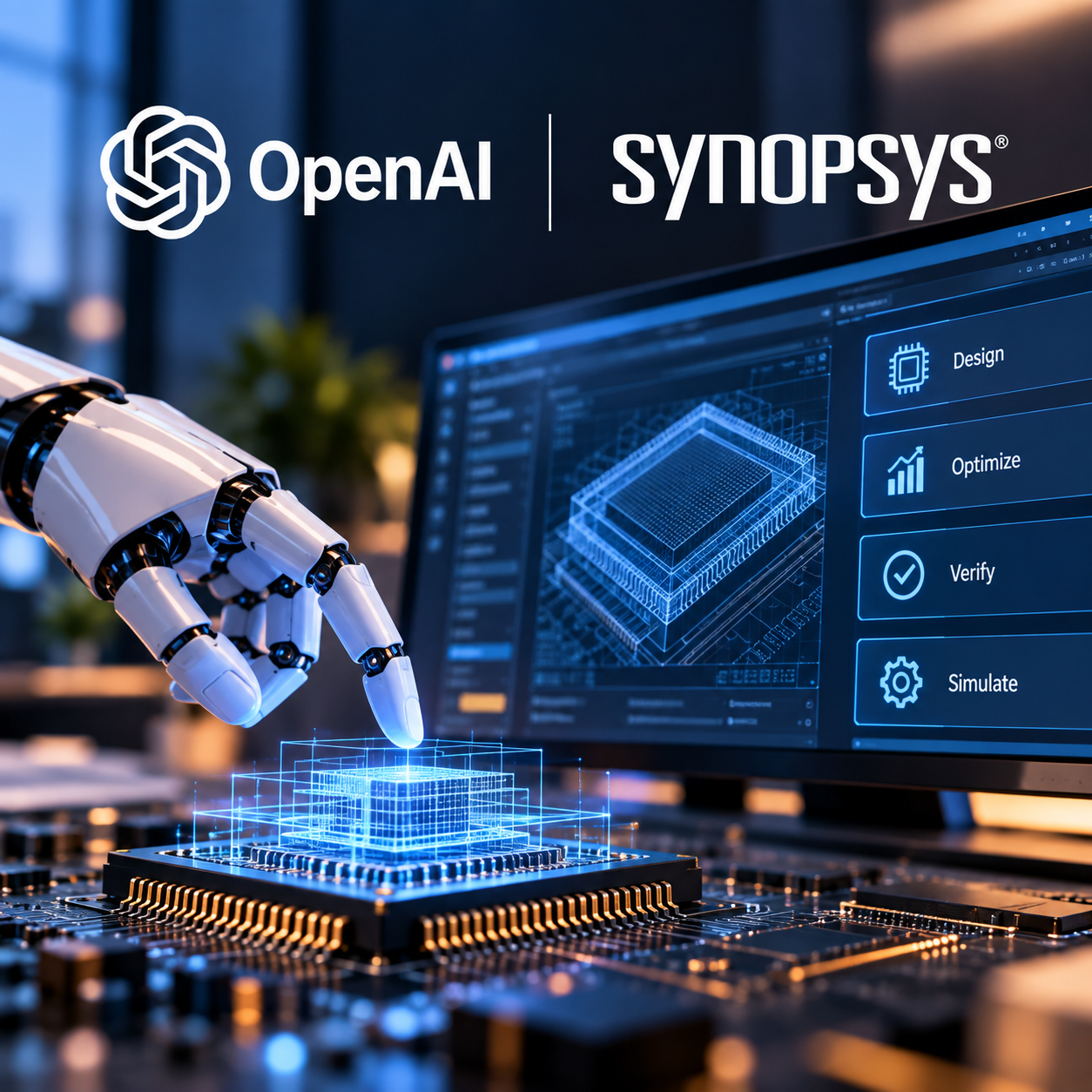

Synopsys and OpenAI have entered a multi-year partnership to develop GPT-Synopsys, a specialised artificial intelligence model designed to work directly with chip design tools and assist engineers across semiconductor development workflows.
Under the agreement, OpenAI will license Synopsys' electronic design automation tools to develop the model, while the two companies will collaborate on research, product development and bringing the technology to customers. The commercial arrangement also includes a shared revenue framework.
GPT-Synopsys will combine OpenAI's AI models with Synopsys' electronic design automation technology and semiconductor expertise. Instead of functioning only as an AI assistant that provides recommendations, the model is being developed to operate Synopsys tools, interpret their outputs and repeatedly optimise chip designs.
The companies said engineers will be able to assign objectives covering areas such as power, performance and area optimisation, timing and verification. AI agents will then run the relevant tools, assess results and make changes before presenting verified outcomes for engineers to review.
The model will operate on OpenAI-hosted infrastructure and is expected to integrate with Synopsys.ai and Synopsys Autopilot, the company's agentic AI platform. Early technology engagements with semiconductor customers are already underway.
The partnership also introduces a commercial model tied to the technology's adoption. OpenAI will pay Synopsys a subscription fee while GPT-Synopsys is trained to use its tools. Once customers begin using the product, the companies will share revenue. Synopsys CEO Sassine Ghazi said the arrangement has been structured as an additional revenue opportunity rather than a replacement for the company's existing software business.
Synopsys has also emphasised that conventional engineering tools will remain part of the process. AI-generated designs will still need to undergo established verification processes to determine whether they meet the physical and technical requirements necessary for manufacturing.
Customer-specific design information will not be used to train the model, according to the companies. GPT-Synopsys is expected to include encryption, access controls, configurable data-retention settings and audit capabilities for enterprise users.
The announcement comes as chipmakers and semiconductor software companies increasingly explore generative and agentic AI to reduce the time required for complex engineering tasks. Chip development can involve billions of transistors and multiple stages of design, optimisation and verification.
For Synopsys and OpenAI, GPT-Synopsys extends AI from assisting engineers with information towards directly operating specialised engineering software, while retaining human review and conventional verification before designs move closer to manufacturing.
Disclaimer: This article may include information derived from interviews, press releases, public statements, research, company communications and other publicly available or third-party sources. Such material may be summarised, paraphrased or contextualised for journalistic and editorial purposes. All rights in third-party content remain with their respective owners.