
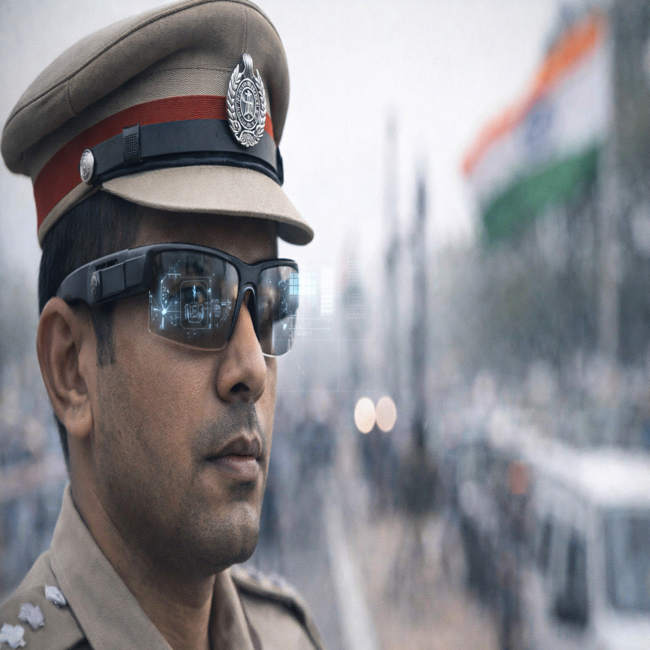

Delhi Police is set to deploy artificial intelligence powered smart glasses as part of its security arrangements for the upcoming Republic Day celebrations, marking another step in the integration of advanced technology into public safety operations. The initiative is aimed at enhancing real-time surveillance, improving situational awareness and supporting faster decision making during one of the country’s most high-profile national events.
The Republic Day parade involves extensive security planning, with large crowds, high-profile attendees and complex logistics. To manage these challenges, Delhi Police has been steadily adopting technology-driven solutions. The introduction of AI-enabled smart glasses is intended to supplement existing surveillance systems rather than replace traditional policing methods.
According to officials, the smart glasses are equipped with cameras and AI software capable of capturing live visuals and processing them in real time. The devices can assist officers by providing instant alerts, facial recognition support and access to centralised databases. This allows personnel on the ground to identify potential threats more efficiently while maintaining mobility.
The use of wearable technology reflects a broader shift in law enforcement strategies. As cities grow and public events become more complex, police forces are increasingly relying on technology to augment human capabilities. Smart wearables offer hands-free access to information, enabling officers to stay alert without diverting attention.
During Republic Day, security agencies must coordinate across multiple zones, checkpoints and routes. AI-powered smart glasses can help streamline communication by relaying live updates to command centres. This real-time connectivity is expected to support quicker response times and more informed deployment of resources.
Facial recognition is one of the key capabilities associated with such devices. By comparing live visuals against databases of persons of interest, the system can flag matches for further verification. Officials have emphasised that the technology will be used within established legal and operational frameworks, with oversight to prevent misuse.
The deployment of smart glasses is part of Delhi Police’s broader digital transformation efforts. In recent years, the force has adopted technologies such as AI-driven CCTV analytics, drone surveillance and data integration platforms. These tools are aimed at improving crime prevention, investigation and crowd management.
Republic Day presents unique security challenges due to the scale and visibility of the event. In addition to managing crowds, police must ensure the safety of dignitaries and critical infrastructure. Technology-driven surveillance adds an additional layer of monitoring that complements physical presence.
Experts note that wearable AI devices can improve efficiency but also require careful implementation. Training officers to use the technology effectively is essential to avoid operational disruptions. Delhi Police has indicated that personnel selected to use the smart glasses have undergone orientation to familiarise them with the device’s features and protocols.
The move also highlights the growing role of AI in public sector applications. Governments and law enforcement agencies worldwide are exploring how artificial intelligence can enhance public safety while balancing privacy concerns. Transparency and accountability remain central to public acceptance of such technologies.
Privacy advocates have raised questions globally about facial recognition and surveillance tools. Authorities have responded by emphasising the importance of regulated use, data protection and adherence to legal guidelines. Delhi Police officials have reiterated that the deployment is focused on security and event management rather than continuous surveillance.
From an operational standpoint, smart glasses can reduce reliance on handheld devices, allowing officers to keep their hands free. This can be particularly useful in crowded or high-pressure environments where quick movement and situational awareness are critical.
The adoption of AI wearables also reflects India’s broader push toward smart policing. Several states have been piloting technology-driven initiatives to modernise law enforcement. These efforts aim to improve efficiency, transparency and public trust.
For Delhi Police, Republic Day serves as an opportunity to test new technologies in a controlled yet demanding environment. Insights gained from this deployment could inform future use of smart wearables in routine policing and large-scale events.
Technology vendors working with law enforcement are increasingly tailoring solutions to local needs. AI-powered smart glasses used in this deployment are designed to integrate with existing systems, reducing the need for standalone infrastructure.
While technology can enhance capabilities, officials have stressed that it does not replace human judgment. Decision making remains with officers and supervisors, with AI tools serving as aids rather than authorities.
As public events continue to grow in scale, the use of advanced surveillance tools is likely to expand. Balancing security needs with civil liberties will remain an ongoing challenge for policymakers and law enforcement agencies.
Delhi Police’s move signals confidence in the role of AI as a support system for modern policing. By adopting smart glasses for Republic Day security, the force aims to demonstrate how technology can enhance preparedness and responsiveness.
The deployment is expected to be closely monitored, with performance and outcomes evaluated after the event. Feedback from officers and commanders will play a role in determining future adoption.
As India increasingly embraces digital governance and smart city initiatives, technology-driven policing is becoming a key component of public safety strategies. The use of AI-powered smart glasses during Republic Day reflects this evolving approach.
The initiative underscores a broader trend of integrating artificial intelligence into frontline operations. How effectively these tools are deployed and governed will shape public perception and trust.
With Republic Day approaching, Delhi Police’s preparations highlight the intersection of tradition and technology. The introduction of AI-powered smart glasses represents an effort to ensure safety while adapting to the demands of a modern, connected society.