
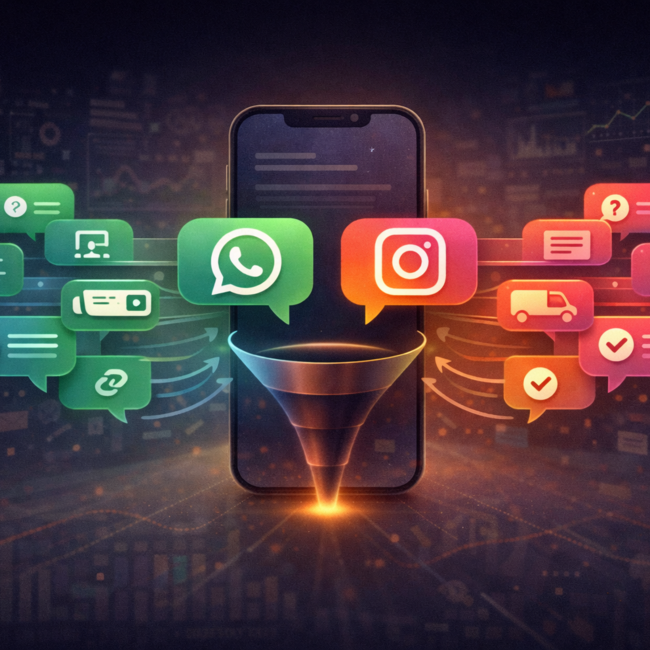

A new kind of sales funnel is quietly taking shape far from public websites and landing pages. From WhatsApp threads to Instagram DMs and Telegram groups, brands and creators are increasingly converting audiences inside private conversations. These closed-loop journeys, often referred to as “shadow funnels,” are becoming a powerful growth engine for Indian marketers, even though they remain largely invisible to traditional analytics.
The shift is already producing striking outcomes. D2C entrepreneur and investor Arjun Vaidya recently shared that he met a founder running a ₹30 crore annual business entirely through WhatsApp conversations. There was no website or app involved. Social media ads directed interested customers straight into chat, where queries were handled and purchases closed. The example resonated widely across the startup ecosystem because it reflected a broader reality. Commerce is moving into private, conversational spaces.
From Kirana Chats to Scaled D2C Funnels
In India, chat-based commerce has familiar roots. Long before ecommerce platforms became mainstream, neighbourhood kirana stores were already taking orders through WhatsApp messages. Customers sent grocery lists and received deliveries based on trust and familiarity. What has changed is scale.
With WhatsApp reaching over 500 million users in India and millions of businesses active on the platform, messaging apps have become a default layer of daily life. Consumers already spend hours inside these apps, making them a natural environment for discovery, evaluation, and purchase.
The engagement advantage is significant. WhatsApp messages often achieve open rates close to 90 percent, far exceeding email or app notifications. Response times are also faster, and the conversational format lowers friction. Instead of navigating forms or product pages, users ask questions directly and receive immediate answers.
Several high-growth startups began in exactly this way. Dunzo initially operated as a WhatsApp-based concierge service. Zepto tested order fulfilment through chat in its early days. Meesho built a reseller-driven commerce model where products circulated through WhatsApp groups. These businesses eventually scaled into full platforms, but their early traction came from private conversations.
Today, thousands of smaller D2C brands continue to operate primarily through chat. For them, the funnel is not hidden. It is simply informal. Discovery happens on Instagram or YouTube. Interest turns into a DM. Conversion happens through a payment link or manual confirmation. Loyalty builds through ongoing chat engagement.
Instagram DMs as Checkout Counters
Instagram direct messages have emerged as another critical channel for shadow funnels, especially in fashion, beauty, fitness, and lifestyle categories. Shoppers often see a reel or story and immediately message the brand or creator with a simple question. Price, availability, delivery timelines, or size details are clarified inside the chat. The purchase often follows without the customer ever visiting a website.
A Meta India study found that a large majority of Indian consumers use WhatsApp or Instagram at multiple stages of their purchase journey. For many, these platforms now replace browsing, reviews, and even checkout.
Myntra has publicly acknowledged the commercial impact of this shift. The company has stated that social commerce, driven largely by creators and DM-led interactions, now contributes close to 10 percent of its monthly revenue. Deepash Jain, Vice President at Myntra, has said that this channel did not exist at scale a year earlier but is now material enough to reshape marketing investments. According to Jain, the ability to attribute creator-driven conversations to transactions has unlocked new confidence in DM-led selling.
For smaller brands, the effect can be even more dramatic. Rimjim Deka, founder of fashion startup Littlebox India, has shared that creator-linked sales transformed her business trajectory. Within six months, revenue driven by creators went from zero to ₹50 lakh per month. In many cases, the conversion happened not on a website but inside conversations triggered by creator content. According to Deka, consumers trust creators in a way they do not trust ads, especially when the interaction feels personal and unscripted.
Measuring What Cannot Be Seen
The biggest challenge with shadow funnels is measurement. Traditional attribution systems rely on cookies, pixels, and referral paths that do not function inside private chats. When a product link is forwarded on WhatsApp or a purchase happens through DM, the transaction often appears as direct traffic or remains untracked.
Marketers have responded by redesigning measurement itself. Brands using WhatsApp Business APIs now integrate chats with CRMs, assigning lead IDs and tracking outcomes manually or through automation. Conversion is measured through chat-to-order ratios, response times, and repeat inquiries rather than page visits.
Some brands use unique payment links or coupon codes inside chats to attribute sales. Others rely on Instagram’s native checkout features, which allow transactions to be tracked without leaving the app. According to industry estimates, click-to-WhatsApp ads in India deliver conversion rates that are three to five times higher than ads sending users to websites. The reason is simple. A conversation resolves doubts faster than a landing page.
Kishor Fogla, founder of marketing consultancy Yellow Slice, has said that brands adopting conversational funnels are seeing meaningful improvements in ROI. He notes that acquisition costs can drop sharply while repeat purchases increase, largely because chat builds familiarity and reduces friction.
Enterprise data reflects this trend. Research by Bain and Meta indicates that a majority of large Indian businesses now engage at least half their customers through conversational platforms and plan to increase investment in these channels over the next few years.
Privacy, Consent, and the Ethics of Closed Funnels
Private chat funnels also raise important questions around privacy and trust. Messaging platforms are personal spaces, and users expect brands to behave differently there than in public feeds. Unsolicited messages, excessive promotions, or poorly timed follow-ups can quickly feel intrusive.
WhatsApp enforces strict consent requirements, and businesses risk being blocked or banned if users report spam. Telegram and Signal lack formal marketing tools, making community-led engagement essential rather than broadcast promotion.
Arjun Vaidya has noted that as more brands enter WhatsApp, spam risk increases. Many users now archive business chats by default. The effectiveness of shadow funnels depends on restraint. Brands that treat chat like a personal relationship rather than a mailing list tend to perform better.
At the same time, closed chats can offer privacy advantages. Conversations are one-on-one, not publicly visible, and often encrypted. Users may prefer this to being tracked across websites by retargeting ads. When done with transparency and consent, chat-based commerce can feel more respectful than traditional digital advertising.
India’s evolving data protection framework will likely shape how these funnels mature. Explicit consent, limited data usage, and secure handling of chat information will become increasingly important as more commerce moves into private spaces.
Every Chat Is Becoming a Store
Despite the challenges, the momentum behind shadow funnels is unmistakable. Consumers value speed, convenience, and human interaction. Brands value higher conversion and stronger loyalty.
Indian electronics brand boAt has stated that conversational platforms are now central to how it initiates and converts customer interactions. WhatsApp and Instagram serve as entry points for real-time engagement, supported by chatbots and trained sales teams.
Marketing leaders increasingly see chat strategies as fundamental rather than experimental. Vaidya has predicted that every D2C brand will need a WhatsApp strategy in the same way they once needed a website or SEO plan.
The marketing funnel is no longer linear. Discovery, consideration, and purchase collapse into a single conversation. These shadow funnels may be hidden from dashboards, but they are driving real revenue.
For marketers, the task ahead is not to eliminate shadow funnels but to understand them. Success will depend on balancing personalization with respect, automation with humanity, and growth with trust. In a market like India, where commerce has always been relational, private chats are not an anomaly. They are a return to form, now scaled by technology.
The brands that learn to sell through conversations rather than campaigns will define the next chapter of digital marketing.
Disclaimer: All data points and statistics are attributed to published research studies and verified market research. All quotes are either sourced directly or attributed to public statements.