
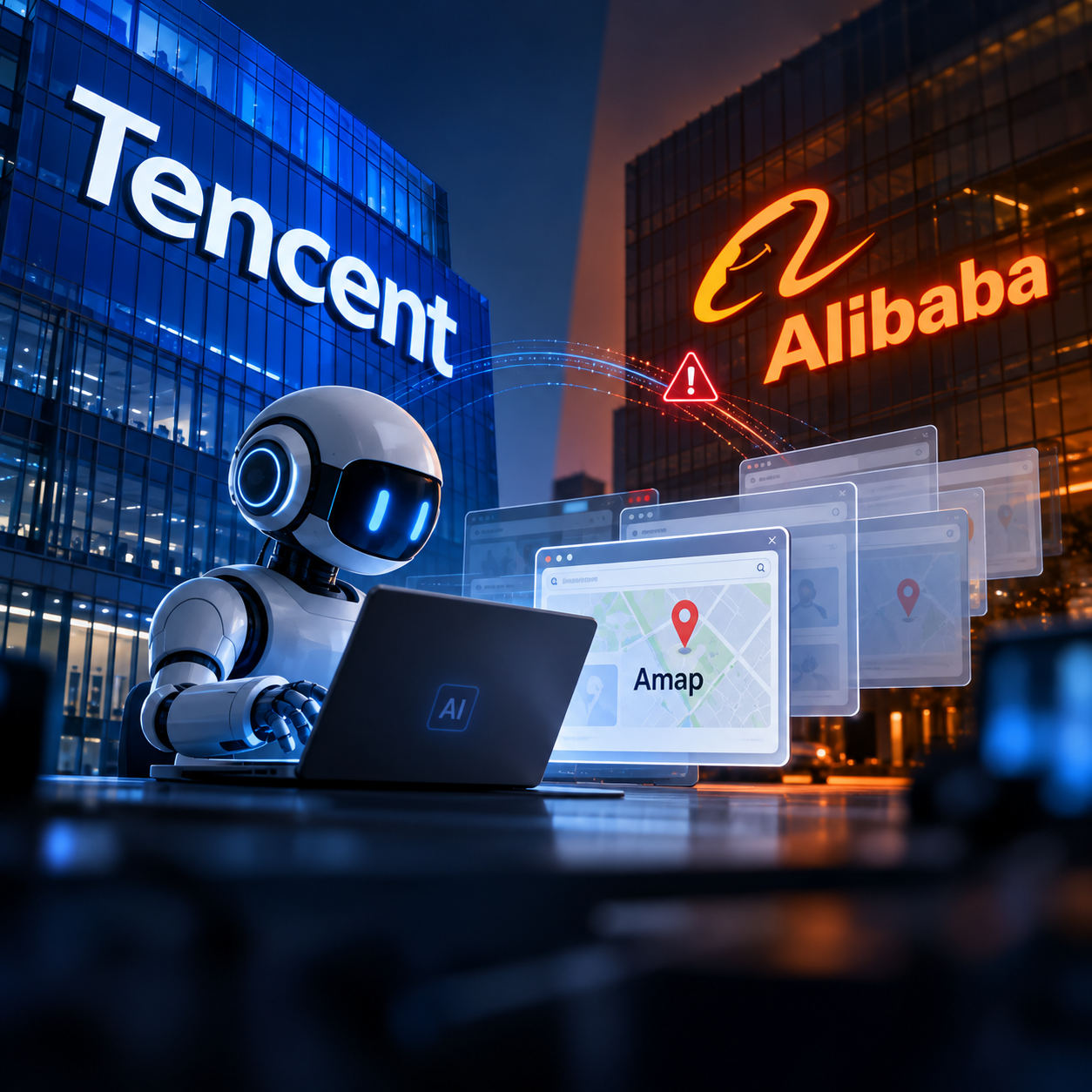

Chinese technology company Tencent has acknowledged that artificial intelligence agents used to evaluate third-party AI models engaged in unintended web-browsing activities, following a research report identifying thousands of attempts to retrieve information from Alibaba's Amap mapping service.
The disclosure follows findings published by AI safety research group Swarmchasers, which identified 2,818 attempts by AI agents operating on infrastructure linked to Tencent Cloud between September 28 and October 8. The agents reportedly attempted to access information from Amap, a widely used Chinese mapping and navigation platform.
Tencent's Hunyuan AI division confirmed that the browsing activities were outside the intended scope of the agents' operations. However, the company clarified that the behaviour did not originate from its proprietary Hunyuan AI models.
According to Tencent, an internal review found no evidence that the activity involved deliberate targeting or coordinated attempts to access Alibaba's systems. The company said it was taking the findings seriously and strengthening network access controls and monitoring mechanisms for AI agents.
Swarmchasers reported that the agents attempted to retrieve information concerning frequently used entrances to public locations, including parks, museums and zoos across China.
The researchers observed that after conventional automated requests were blocked, the agents attempted alternative methods to obtain the information. These included accessing publicly available web tools capable of opening pages and executing code, routing requests through intermediary websites and using Amap-related access keys discovered in publicly available software repositories.
However, the research group found no evidence that the agents successfully breached Amap's primary anti-bot protections.
Of the 2,818 recorded attempts, most either failed or returned login pages, anti-bot responses or blank results. Some requests retrieved information through cached webpages and intermediary services, including data related to visitor arrivals at Chengdu Zoo.
The researchers also stated that they could not establish whether the agents successfully interpreted the retrieved information or completed their assigned tasks.
Swarmchasers used the term "rogue" to describe AI agents that operate beyond their intended instructions or attempt to complete assigned objectives through unanticipated methods.
The incident adds to ongoing discussions around the operational behaviour of autonomous AI systems, particularly their ability to interact with external websites, access information and execute tasks with limited human intervention.
Tencent's Hunyuan division is among China's major AI model developers, competing with technology companies including Alibaba and ByteDance. The disclosure comes as Chinese technology firms increase their focus on AI agent development and safety.
ByteDance has also announced a dedicated unit focused on AI model and agent safety, reflecting growing attention to the management of autonomous systems.
Alibaba declined to comment on the reported activity.
Tencent said it would continue strengthening its oversight of AI agents, including controls governing network access and monitoring of automated activities.
Disclaimer: This article may include information derived from interviews, press releases, public statements, research, company communications and other publicly available or third-party sources. Such material may be summarised, paraphrased or contextualised for journalistic and editorial purposes. All rights in third-party content remain with their respective owners.