
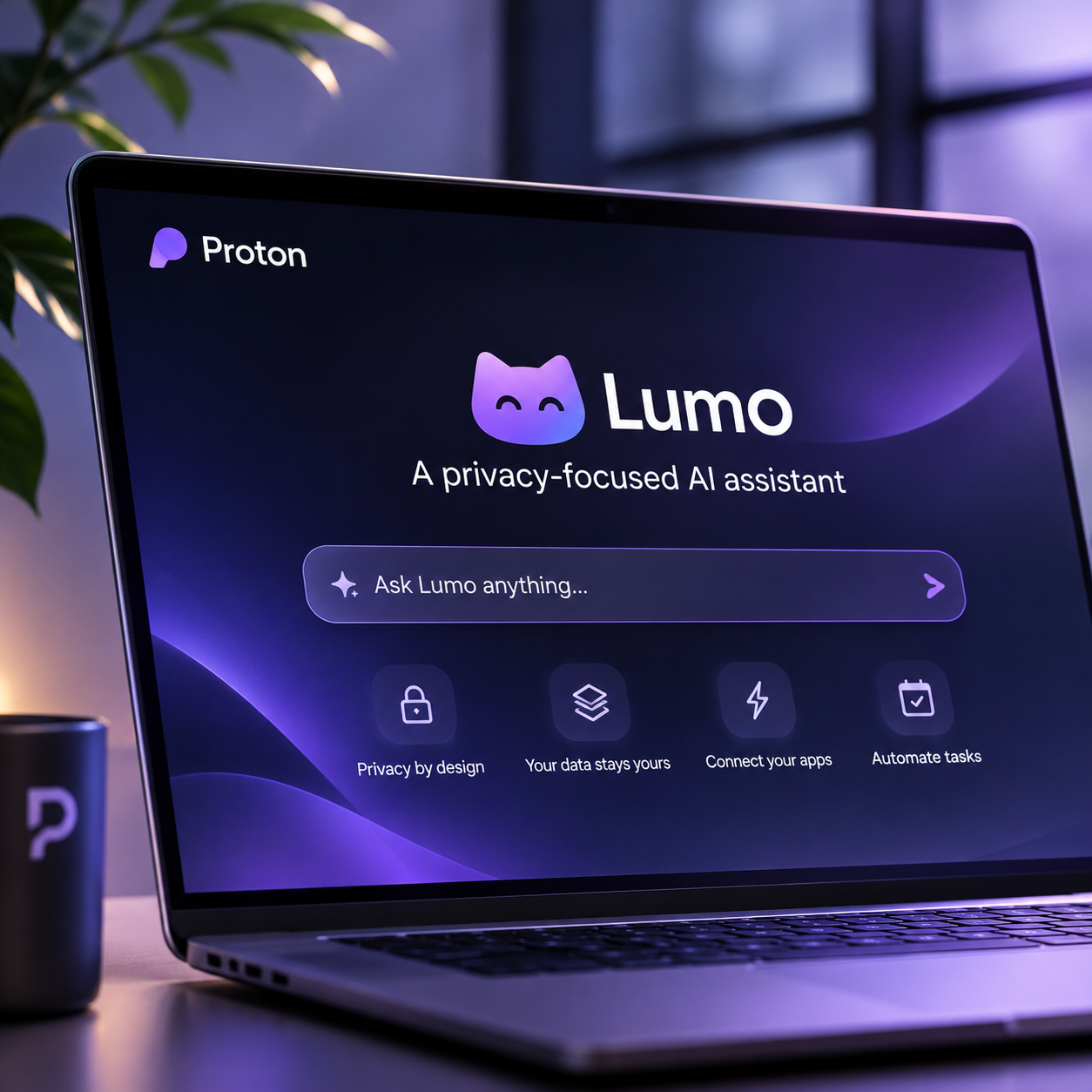

Swiss technology company Proton has launched Lumo Desktop, a privacy-focused artificial intelligence application for Windows, macOS and Linux, expanding its AI assistant beyond conversational interactions to tasks involving personal files, connected applications and automated workflows.
Announced on November 17, the desktop application is positioned as an alternative to AI assistants such as OpenAI's ChatGPT and Anthropic's Claude, with a focus on user control over data access and automated actions.
The launch comes as AI companies increasingly introduce agents capable of performing tasks across applications, raising questions about how much information these systems can access and what permissions they should require.
Lumo Desktop allows users to connect files, folders and applications through a range of integrations. These include local file-system access, shell execution and browser content retrieval, alongside connections to Proton Mail and third-party services such as Dropbox, Jira and Confluence.
The application also supports local and remote Model Context Protocol (MCP) servers, enabling AI agents to interact with external tools and information sources.
A central feature of the platform is its permission management system. Users can decide which actions Lumo may perform automatically, which require explicit approval and which should be blocked entirely.
Individual tools can also be disabled during conversations, allowing users to restrict access without disconnecting the entire application.
Proton has introduced scheduled tasks within the desktop application, enabling users to automate recurring activities. Each task can operate under separate permissions, allowing different levels of approval depending on the activity involved.
The company said conversations and information accessed through connected applications are not used to train AI models or deliver personalised advertising.
Proton also claims that its encryption architecture prevents the company from reading users' stored chat histories. It says it does not maintain server-side conversation logs, while the limited information it retains is protected under Swiss privacy legislation.
According to Proton, user data is hosted on European infrastructure, which the company positions as an additional privacy consideration for customers concerned about international data access.
The launch also introduces support for Skills, allowing users to save instructions, templates and reference documents for repeated use across conversations.
An earlier customisation feature, known as Custom Lumos, will be migrated to the new Skills format.
Separately, Proton announced that its first Nvidia B300 computing cluster, built using Open Compute Project standards, is becoming operational in Switzerland.
The infrastructure investment forms part of the company's efforts to support its AI services through its own computing environment.
Proton already provides privacy-oriented email, cloud storage, password management and productivity services. The desktop launch extends that approach to AI-assisted workflows involving local applications and personal information.
While Proton has outlined its privacy safeguards and permission controls, the announcement does not establish how Lumo's performance compares with competing desktop AI assistants.
Disclaimer: This article may include information derived from interviews, press releases, public statements, research, company communications and other publicly available or third-party sources. Such material may be summarised, paraphrased or contextualised for journalistic and editorial purposes. All rights in third-party content remain with their respective owners.