

ai News
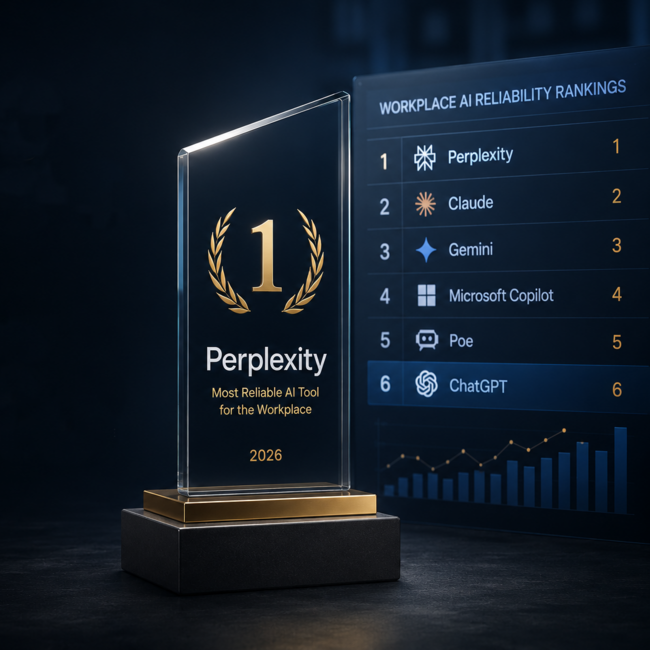
Perplexity Tops AI Reliability Rankings as ChatGPT Drops in Workplace Report
" Perplexity has ranked highest in a workplace AI reliability report, while ChatGPT reportedly slipped to sixth position. "
- by Martech Desk
- May 28, 2026
Perplexity has emerged as the top-ranked artificial intelligence platform in a new workplace reliability report, while ChatGPT reportedly slipped to sixth position amid intensifying competition in the enterprise AI market.
The report evaluated leading AI tools based on factors including accuracy, reliability, consistency, workplace usability, and performance across professional tasks. Industry analysts say the findings reflect how businesses are increasingly scrutinising AI systems for enterprise-grade dependability rather than only consumer popularity.
Perplexity’s performance in the rankings highlights the growing importance of search-driven AI systems capable of delivering sourced responses and structured information retrieval. The platform has gained visibility in recent months for its conversational search model and focus on citation-backed outputs.
ChatGPT, which remains one of the most widely used generative AI platforms globally, reportedly ranked lower in the workplace-focused assessment. Analysts note that while ChatGPT continues to dominate consumer awareness and broad AI adoption, enterprise users are increasingly evaluating specialised performance metrics including factual reliability, workflow integration, and consistency under professional use cases.
The report reflects broader shifts within the AI industry as businesses move from experimentation toward operational deployment of generative AI systems. Enterprises are increasingly prioritising tools that can support research, content generation, summarisation, coding, customer service, and knowledge management with minimal factual inaccuracies.
Industry experts say reliability has become a critical issue in enterprise AI adoption because organisations require systems capable of producing predictable and verifiable outputs. Concerns around hallucinations, misinformation, and inconsistent responses continue to shape purchasing decisions among enterprise users.
Perplexity’s search-oriented model has been positioned as an alternative to conventional chatbot-style AI systems by emphasising real-time information retrieval and source attribution. Analysts believe such approaches may resonate more strongly with professional users seeking research accuracy and transparency.
The rankings also highlight the rapidly evolving competitive landscape within the generative AI market. Technology companies are increasingly differentiating their products through enterprise-focused features, security controls, workflow integration, and domain-specific optimisation.
AI adoption within workplaces has accelerated significantly over the past two years as companies integrate generative AI into productivity tools, enterprise software, marketing systems, analytics platforms, and customer support operations. Businesses are now evaluating which AI models can support scalable deployment without compromising operational reliability.
Industry observers note that workplace AI performance is measured differently from consumer engagement metrics. Enterprise environments often require higher standards around compliance, auditability, factual accuracy, and integration with existing business systems.
Technology firms are increasingly racing to position their AI platforms as trusted enterprise solutions capable of handling professional workloads. Companies across sectors including finance, healthcare, consulting, retail, education, and media are actively experimenting with generative AI applications.
The report also reflects how user expectations around AI systems are evolving. Early enthusiasm around conversational AI is gradually giving way to more practical evaluations tied to measurable business outcomes and operational efficiency.
At the same time, analysts caution that AI rankings may vary depending on testing methodology, use cases, and evaluation criteria. Different platforms may perform better across research tasks, coding, creativity, summarisation, or real-time information retrieval depending on system architecture and training approaches.
Perplexity’s growing visibility comes as AI search products increasingly challenge traditional search engines and conversational assistants. Several technology firms are exploring hybrid models that combine search, retrieval, and conversational AI within unified interfaces.
The generative AI sector continues witnessing rapid innovation as companies launch new multimodal systems, enterprise integrations, and productivity-focused tools. Competition has intensified significantly since the mainstream adoption of AI chatbots accelerated global investment in AI infrastructure and software development.
Industry experts believe reliability, transparency, and enterprise readiness will increasingly shape long-term adoption patterns within workplace AI ecosystems. As businesses continue integrating AI into operational workflows, platforms capable of balancing speed, usability, and factual consistency are expected to gain stronger enterprise traction across industries and global technology markets in the years ahead.