
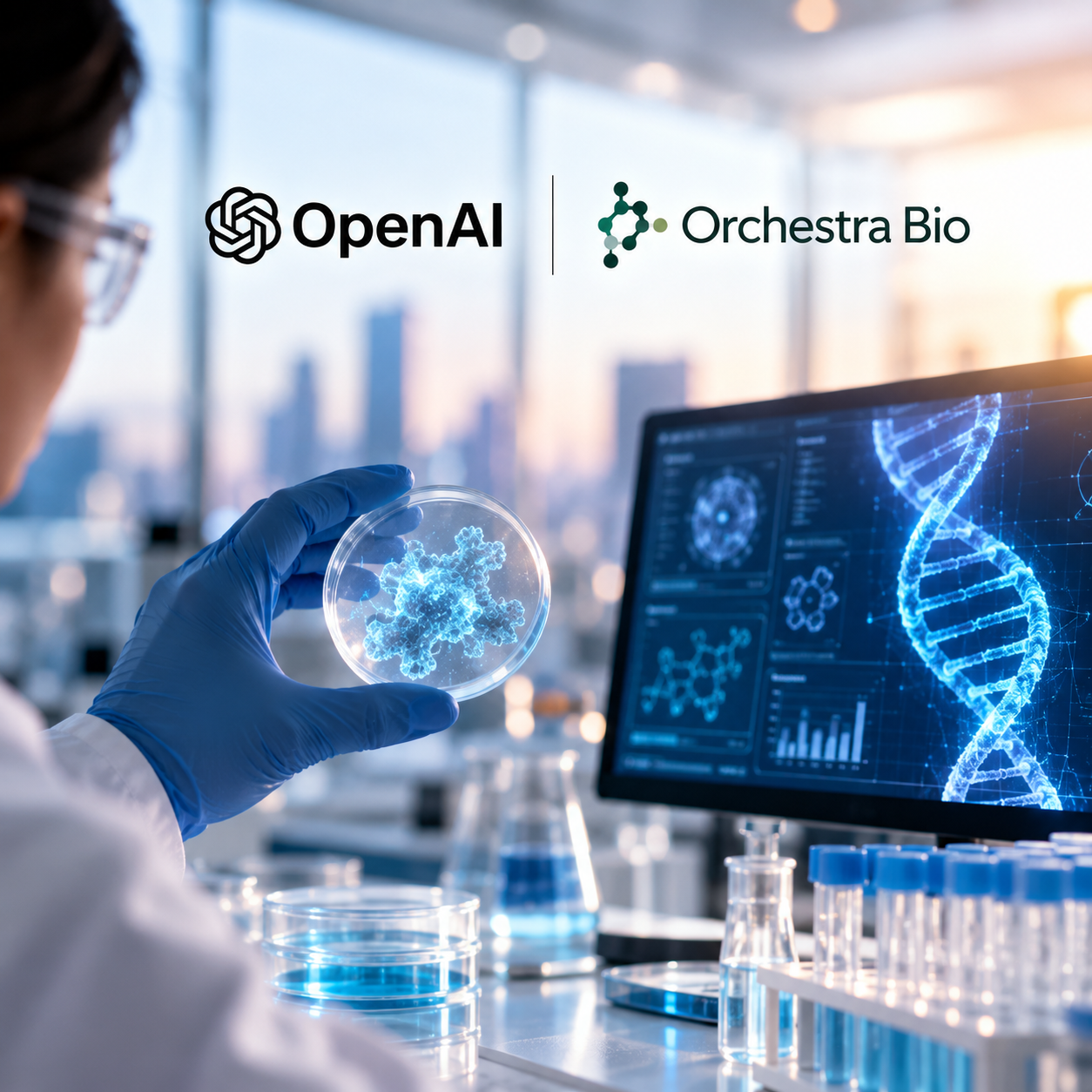

OpenAI has acquired Orchestra Bio, an artificial intelligence-powered biotechnology software startup, as part of its efforts to expand AI applications across pharmaceutical research and drug development.
Announced on October 20, 2026, the acquisition will bring Orchestra Bio's team and technology into OpenAI's Rosalind platform, which provides AI models and tools designed for life sciences research.
The financial terms of the transaction were not disclosed. Orchestra Bio, founded approximately four years ago, had reportedly raised around $20 million by 2025 from investors including Andreessen Horowitz, Atria and 8VC.
Orchestra Bio develops AI agents that help biotechnology companies coordinate operational activities involved in developing medicines. Its platform supports tasks such as monitoring research programmes, tracking financial information and managing scheduling requirements associated with clinical trials.
According to OpenAI, the acquisition is intended to connect scientific research with the operational processes required to move potential treatments through development.
Drug development involves coordination between research teams, manufacturing facilities, clinical trial operators and external partners. Delays in one activity can affect several others, making programme management an important part of pharmaceutical operations.
OpenAI said developing a new medicine typically takes approximately 10 to 15 years in the United States, from identifying a potential drug target to securing regulatory approval.
The company plans to combine Orchestra Bio's operational capabilities with Rosalind, its AI offering for life sciences researchers.
The Rosalind portfolio includes GPT-Rosalind, a model designed to support scientific reasoning across biology and chemistry, and Rosalind Workbench, which connects AI capabilities with research tools and data.
The integration is expected to support the development of AI agents that can coordinate research activities, identify dependencies between tasks and help teams assess potential responses to operational challenges.
For example, a manufacturing delay could affect the timing of a clinical trial. Orchestra Bio's technology is designed to identify related activities, gather relevant information and present options for researchers and programme managers to evaluate.
OpenAI said scientists would continue to make decisions while AI agents assist with monitoring, analysis and coordination.
The acquisition also builds on OpenAI's existing relationships with pharmaceutical companies, including Moderna and Novo Nordisk.
Its collaboration with Novo Nordisk focuses on applying AI to research and development activities and business operations, while its work with Moderna includes using AI to support scientific workflows and experimental processes.
The transaction extends OpenAI's activities beyond providing research-focused AI models into software intended to support the management of pharmaceutical development programmes.
However, OpenAI has not announced a timeline for integrating Orchestra Bio's technology into Rosalind or disclosed specific commercial targets for the acquisition.
The company has also not provided evidence that the integration has reduced drug development timelines or resulted in new regulatory approvals.
Disclaimer: This article may include information derived from interviews, press releases, public statements, research, company communications and other publicly available or third-party sources. Such material may be summarised, paraphrased or contextualised for journalistic and editorial purposes. All rights in third-party content remain with their respective owners.