
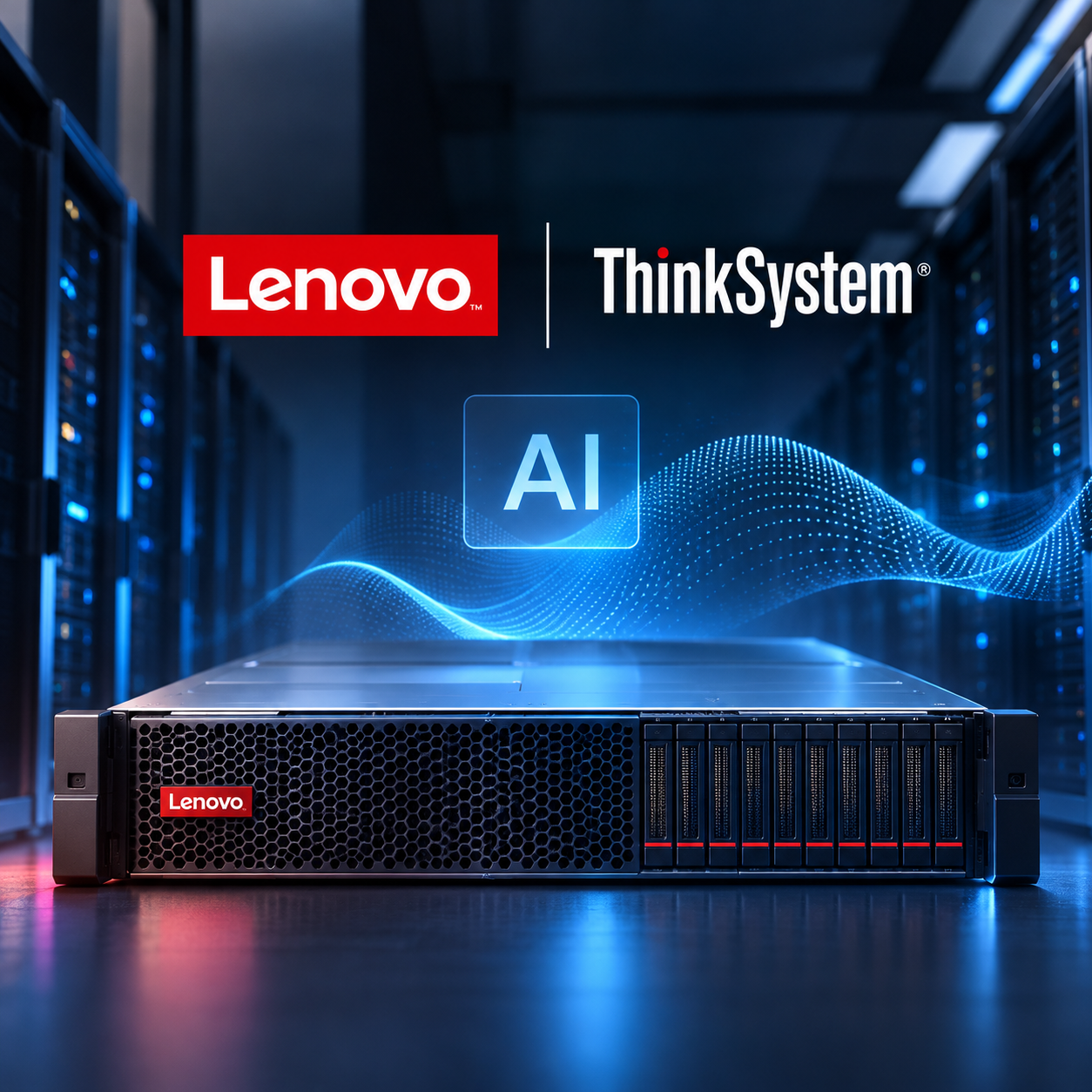

The new infrastructure portfolio combines AMD EPYC processors, liquid cooling, storage systems and expanded services to support enterprise AI and data centre workloads.
Lenovo has expanded its enterprise infrastructure portfolio with new ThinkSystem servers designed to support artificial intelligence (AI) and high-performance computing (HPC) workloads. The launch brings together sixth-generation AMD EPYC 9006 processors, Lenovo Neptune liquid cooling technology, high-performance storage and additional services for enterprise and large-scale AI infrastructure deployments.
The new offerings are aimed at organisations seeking to manage increasingly complex computing requirements across on-premises data centres, hybrid environments and colocation facilities.
Among the newly introduced systems is the Lenovo ThinkSystem SC755, a dual-socket server equipped with Neptune liquid cooling. According to the company, the system can remove up to 100 per cent of generated heat through water cooling and deliver up to 40 per cent higher sustained performance compared with similar air-cooled systems.
The SC755 also incorporates Lenovo Dynamic Partitioning, allowing organisations to adjust computing resources between single-socket and dual-socket configurations based on workload requirements.
Lenovo has also introduced the ThinkSystem SR755, designed for applications including large-scale virtualisation, engineering, financial modelling, electronic design automation and agentic AI infrastructure. The server focuses on computing density, memory bandwidth and energy efficiency.
Alongside the servers, Lenovo announced the ThinkSystem DE6800 and DE6500 storage systems, developed for data-intensive applications requiring high throughput and low latency. The company has also validated Cornelis CN5000 networking technology to support data movement across AI and HPC environments.
Scott Patti, Vice President, Infrastructure Solutions Group at Lenovo, said organisations are increasingly focused on obtaining greater computing performance while managing power consumption and cooling requirements.
The company is also expanding its Hybrid AI Factory Services, including GPU deployment, configuration and optimisation capabilities. These services will support enterprise AI environments using technologies such as Red Hat AI Enterprise, NVIDIA AI Enterprise and NVIDIA Run:ai.
Lenovo's expanded services also cover large-scale AI infrastructure deployments through its Gigafactory Services portfolio. These include specialised deployment and cluster validation capabilities supported by NVIDIA Infrastructure Services expertise.
Additionally, Lenovo is working with Digital Realty to provide organisations access to colocation facilities. Customers will be able to evaluate infrastructure requirements through the Digital Realty Innovation Lab and explore flexible deployment and financing options through Lenovo TruScale Infrastructure as a Service.
Dan McNamara, Senior Vice President and General Manager, Compute and Enterprise AI at AMD, said the new platforms are intended to support demanding workloads ranging from scientific research to AI inference and agentic AI.
The launch comes as enterprises assess the computing, cooling and storage requirements associated with expanding AI adoption.
Lenovo has not disclosed pricing or detailed regional availability for the newly announced systems. The company's performance claims also remain subject to validation under individual customer workloads.
Disclaimer: This article may include information derived from interviews, press releases, public statements, research, company communications and other publicly available or third-party sources. Such material may be summarised, paraphrased or contextualised for journalistic and editorial purposes. All rights in third-party content remain with their respective owners.