
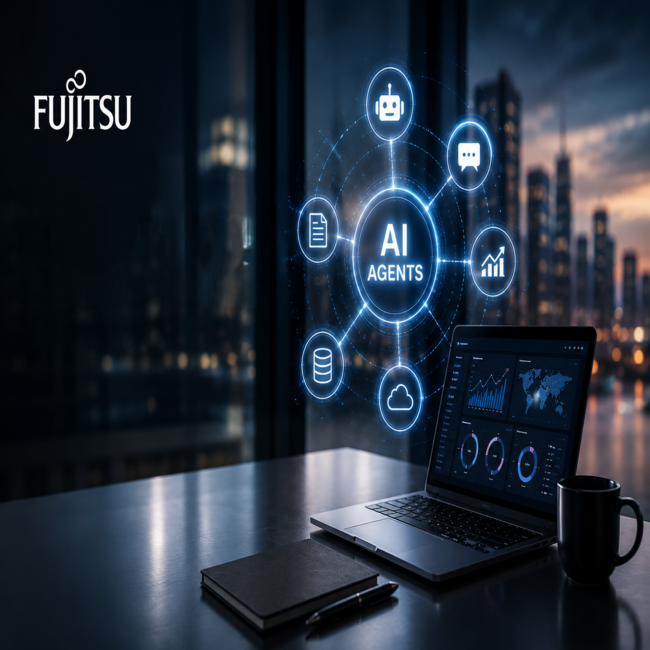

Fujitsu has announced the development of a self-evolving multi-AI agent technology designed to help enterprises automate operations through collaborative artificial intelligence systems that continuously learn from real-world business activities.
According to the company, the new technology enables multiple AI agents to work together as coordinated teams while adapting to operational changes, policy updates, human feedback, and evolving business requirements. The development reflects growing industry interest in AI agent ecosystems capable of handling complex enterprise workflows with limited manual intervention.
Fujitsu said the system is designed to support dynamic enterprise environments where business rules, operational priorities, and customer demands frequently change. Unlike static automation tools, the company’s multi-agent framework can reportedly refine its performance continuously through repeated operational interactions and feedback loops.
Industry analysts say AI agents are becoming one of the fastest-growing segments within enterprise artificial intelligence as organisations attempt to move beyond basic chatbot functionality toward more autonomous workflow management systems.
The technology reportedly allows multiple AI agents to collaborate across tasks while sharing contextual understanding and operational data. Fujitsu stated that the framework includes mechanisms intended to improve safety, governance, and reliability as AI systems evolve through usage.
Enterprise technology firms globally are increasingly exploring AI agents capable of automating scheduling, customer service, supply chain management, IT operations, analytics, and administrative processes. Businesses are also seeking systems that can adapt more effectively to operational variability without requiring constant reprogramming.
Fujitsu said the platform can learn from day-to-day execution results, human corrections, revised specifications, and changing policies. This continuous learning capability is expected to help enterprises reduce operational inefficiencies while improving process adaptability over time.
Technology experts note that self-evolving AI systems represent a major shift from traditional automation software, which typically relies on predefined instructions and static workflows. Multi-agent AI systems are increasingly being viewed as more flexible for handling unpredictable enterprise environments.
The development also reflects broader industry momentum around agentic AI, where intelligent systems can independently perform tasks, coordinate actions, and make limited operational decisions. Major technology companies and enterprise software providers have accelerated investments in AI agent frameworks over the past year.
Industry observers say businesses are increasingly prioritising AI systems capable of integrating across departments and handling interconnected workflows. Multi-agent architectures are considered particularly useful in environments involving large volumes of operational data and rapidly changing conditions.
Fujitsu has expanded its enterprise AI initiatives across automation, AI infrastructure, advanced computing, and digital transformation services. The company has also been positioning AI as a central component of its broader technology strategy focused on operational resilience and business transformation.
Analysts believe collaborative AI agent systems could significantly reshape enterprise productivity models over the coming years by reducing repetitive administrative workloads and improving process responsiveness. However, experts also continue raising concerns around governance, accountability, data privacy, and operational transparency in autonomous AI systems.
The introduction of self-evolving AI technologies comes amid increasing enterprise pressure to improve efficiency while managing rising operational complexity. Companies across manufacturing, logistics, financial services, retail, and healthcare are accelerating investments in automation and AI-driven operational infrastructure.
Technology firms globally are now competing to develop enterprise AI ecosystems capable of supporting large-scale deployment while maintaining reliability and compliance standards. Businesses increasingly expect AI systems to provide measurable operational value rather than experimental functionality.
Fujitsu said the technology is intended to support long-term enterprise adaptability by allowing AI systems to respond more efficiently to changing business environments. Industry analysts believe such adaptive frameworks could become increasingly important as enterprises integrate AI deeper into daily operations.
The company’s announcement highlights how enterprise AI is evolving from standalone automation tools toward interconnected systems capable of collaborative learning and operational decision support. Analysts expect multi-agent AI ecosystems to play a larger role in enterprise transformation strategies as organisations continue investing in intelligent automation, adaptive workflows, and AI-driven operational infrastructure across global industries in the years ahead.