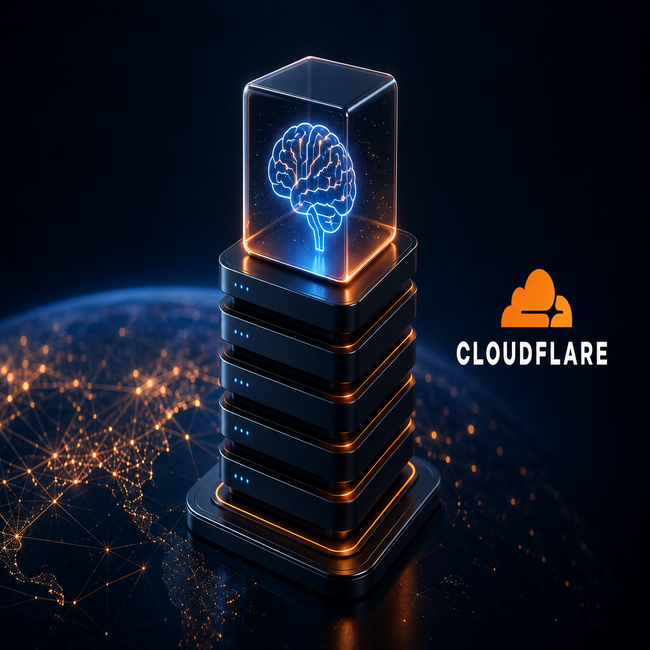
Cloudflare has introduced a new AI agent platform stack designed to help developers build, deploy, and scale autonomous AI-powered applications across the internet, marking the company’s latest expansion into the rapidly growing agentic AI market.
The company announced the launch during its developer-focused initiatives this month, positioning the platform as infrastructure for what it describes as “AI agents” capable of independently completing tasks, interacting with systems, and making decisions using large language models and automation tools.
According to Cloudflare, the stack combines multiple services within its existing developer ecosystem, including Workers, Durable Objects, Vectorize, R2 storage, AI Gateway, and browser automation tools. The company said the integrated setup is intended to simplify the process of building AI-powered applications that can maintain memory, retrieve data, execute workflows, and interact with external systems in real time.
The launch reflects growing interest across the technology industry in agentic AI systems, which are increasingly being positioned as the next stage of generative AI development beyond chatbots and standalone assistants. Technology firms and startups are investing heavily in AI systems capable of handling multi-step tasks with limited human intervention.
Cloudflare said developers can use the stack to create agents that perform customer support operations, web research, document analysis, workflow automation, and software development tasks. The company added that the infrastructure is designed to operate globally through Cloudflare’s distributed edge network, reducing latency and improving response times for AI-driven applications.
One of the central components of the platform is Durable Objects, which allows AI agents to maintain persistent memory and state across sessions. Vectorize, Cloudflare’s vector database solution, enables semantic search and retrieval functions that support retrieval-augmented generation workflows commonly used in enterprise AI applications.
The stack also integrates browser automation capabilities that allow agents to navigate websites, interact with interfaces, and complete actions programmatically. Combined with AI Gateway monitoring tools, developers can manage model requests, usage tracking, and operational performance across applications.
Cloudflare said the platform is model-agnostic, enabling developers to integrate models from providers including OpenAI, Anthropic, Meta, Google, and open-source alternatives. The company stated that flexibility remains important as businesses increasingly experiment with multiple AI models depending on cost, performance, and use-case requirements.
The announcement comes as infrastructure providers compete aggressively to position themselves within the expanding AI ecosystem. Companies including Microsoft, Amazon Web Services, Google Cloud, and Nvidia have also launched tools and frameworks aimed at supporting enterprise AI deployment and autonomous agent development.
Industry analysts say agentic AI is emerging as one of the most closely watched segments within artificial intelligence due to its potential to automate complex digital workflows across industries. Businesses are exploring ways to deploy AI agents for internal operations, software engineering, customer engagement, cybersecurity monitoring, and enterprise productivity tasks.
Cloudflare has steadily expanded its AI-related offerings over the past two years, including tools for inference, model deployment, vector search, and AI traffic management. The company has increasingly positioned its global edge network as infrastructure capable of supporting AI workloads closer to end users.
Executives at Cloudflare said the goal of the new stack is to reduce operational complexity for developers while allowing AI applications to scale more efficiently across distributed environments. The company also emphasised security and governance controls as enterprises continue evaluating risks associated with autonomous AI systems.
The launch highlights how infrastructure companies are adapting to rising enterprise demand for AI-native internet services and automation tools. As competition in the AI infrastructure market accelerates, developers are increasingly looking for platforms that combine model flexibility, scalable deployment, storage, orchestration, and workflow management within unified environments built for production-ready AI applications worldwide.