
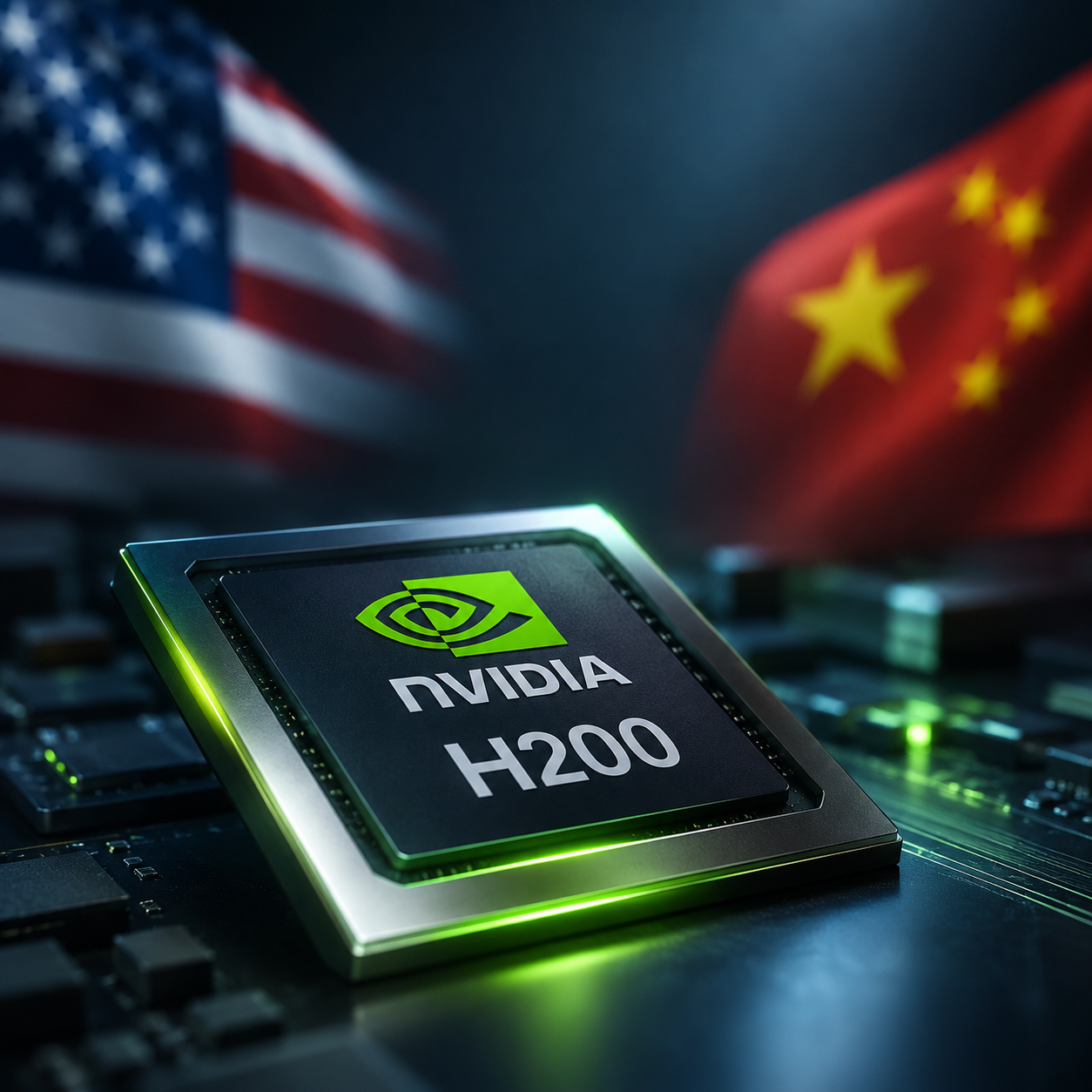

Procurement records show Northwestern Polytechnical University purchased two Nvidia H200 processors through a domestic supplier, raising questions about enforcement of US chip export controls.
A Chinese university with links to the People's Liberation Army (PLA) has purchased Nvidia's advanced H200 artificial intelligence chips despite being subject to US export restrictions, according to procurement records reviewed by Reuters. The transaction has raised questions about how Chinese institutions continue to access restricted American semiconductor technology through domestic suppliers.
Northwestern Polytechnical University, based in Xi'an, purchased two Nvidia H200 processors in October 2026 for 874,700 yuan, approximately $123,000. The chips were acquired through Chinese technology supplier Shaanxi Bosuan Network Technology rather than directly from Nvidia.
The university belongs to China's "Seven Sons of National Defense", a group of institutions associated with the country's defence research sector. Its research activities include military aircraft, missiles and satellite technologies.
The US Commerce Department placed Northwestern Polytechnical University on its Entity List in 2001 over concerns regarding missile proliferation and military research. Restrictions were strengthened in 2019, making export licences for controlled American technologies subject to denial in most circumstances.
Nvidia's H200 processors are designed for advanced AI computing, including training and running large-scale artificial intelligence models. Their export to China requires US government approval.
Beyond purchasing the processors, Northwestern Polytechnical University also obtained access to restricted Nvidia chips through computing services rented from domestic suppliers.
Procurement records showed that the university's cybersecurity school awarded two seven-month contracts in January for access to servers containing eight H200 processors each. The contracts, valued at 441,700 yuan and 441,000 yuan, supported AI model fine-tuning and reinforcement learning.
The university also rented computing capacity using Nvidia A100 and A800 processors, which are subject to US export restrictions.
Reuters examined 26 Chinese procurement and corporate records from 2026, identifying several universities and research institutions purchasing restricted Nvidia processors or renting computing services powered by them.
Among other transactions, Shenzhen University purchased three Nvidia H100 processors for 769,800 yuan in September. Wuhan University of Technology acquired a server containing an H100 processor and separately purchased four A100 chips.
Beihang University, another institution associated with China's defence sector, purchased four A800 processors in April.
The findings come as Washington continues reviewing restrictions on advanced semiconductor exports to China.
The Trump administration began allowing certain H200 exports to China on a case-by-case basis in January 2026. However, those changes did not remove restrictions applying to institutions on the US Entity List.
US lawmakers from both major political parties have called for stronger monitoring of advanced AI chip exports, including tracking requirements and additional congressional oversight.
Nvidia CEO Jensen Huang has previously argued that continued American chip sales to China could help maintain US technological leadership.
The procurement records highlight challenges in monitoring restricted semiconductor technology distributed through intermediaries. However, the available documents do not establish how the processors originally entered China or whether Nvidia directly participated in the transactions.
Disclaimer: This article may include information derived from interviews, press releases, public statements, research, company communications and other publicly available or third-party sources. Such material may be summarised, paraphrased or contextualised for journalistic and editorial purposes. All rights in third-party content remain with their respective owners.