

OpenAI Chief Economist Ronnie Chatterji highlights adaptability, analytical rigour, collaboration and independent thinking as key skills for AI economic research.

Anthropic CEO Dario Amodei predicts AI could help cure or prevent most diseases within five to 10 years, while biological data and clinical validation remain key hurdles.

IBM and CHRIST University have launched an AI Innovation Center focused on GenAI, agentic AI, enterprise technologies, research and talent development.

Sophelio has launched a NeurIPS 2026 challenge asking AI researchers to reconstruct magnetic structures inside fusion systems without magnetic sensor data.

Google chief scientist Jeff Dean has left after 27 years to co-found Discovery Loop, an AI startup focused on automating machine learning and scientific research.
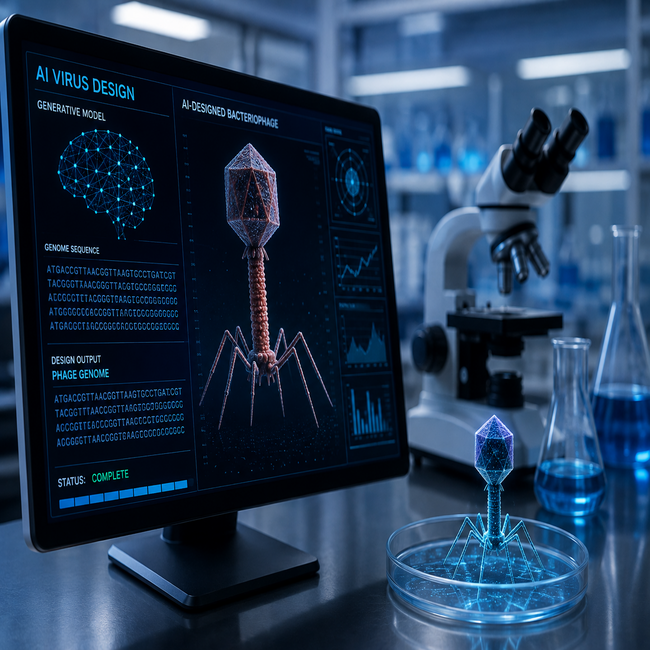
Scientists have used AI to design functional bacteria-killing viruses, highlighting potential applications in phage therapy while prompting fresh biosecurity discussions.

Tamil Nadu has announced Arivagam, India's first AI and Innovation City, to strengthen AI research, startups, digital infrastructure and deep-tech investment.

India and Indonesia are strengthening cooperation in artificial intelligence to accelerate digital transformation, innovation and technology collaboration across key sectors.

YouTuber Hank Green says his reliance on AI became unhealthy, apologising to fans and pledging to reduce AI use in future content creation.

TCS has launched Eastern India's first AI Excellence Centre at HITK in Kolkata to strengthen AI education, research and industry-academia collaboration.

Anthropic has launched Claude Opus 5, a new enterprise AI model offering improved coding, reasoning and knowledge capabilities while reducing operational costs.

Dentsu is piloting an AI avatar platform that enables students to co-create with multiple AI models while prioritizing privacy, creativity and human-led learning.

UNESCO and LG AI Research have launched a free global AI ethics course on Coursera to help professionals apply responsible AI principles in practice.

A new Kana survey finds 70% of enterprises already use AI marketing agents, while governance, ownership and data readiness remain key challenges.

Japanese scientists have developed an AI designed self-healing hydrogel with exceptional underwater adhesion, opening new possibilities for medicine, robotics and advanced materials.

L'Oréal says AI has reduced beauty product development time by 75%, accelerating research, formulation and innovation across its global beauty portfolio.

Puducherry has begun plans to establish an AI Centre of Excellence focused on healthcare, research, skilling and AI adoption under the IndiaAI Mission.

Anthropic has launched Claude Science, an AI workbench designed to help researchers accelerate scientific discovery through integrated AI tools and workflows.

Anthropic has opened a Seoul office and announced new partnerships to strengthen its presence in South Korea's rapidly growing AI ecosystem.

OpenAI has added AI pioneer Noam Shazeer, marking one of the industry's most significant talent moves as competition for top AI researchers intensifies.

KPMG has withdrawn an AI-related study after reports revealed fabricated citations and hallucinated sources, reigniting concerns about AI reliability in research.

Canva has integrated with Perplexity to help users transform AI-generated research into editable creative assets and marketing content.

OpenAI is offering salaries up to ₹3.7 crore for researchers focused on risks linked to self-improving AI systems.

An Oxford study finds that AI models with higher “temperature” settings tend to produce more errors, highlighting a trade off between creativity and accuracy.

IIT Mandi has developed an AI system that can predict landslides up to three hours in advance.

Google researchers introduce PaperOrchestra, a multi agent AI system designed to automate research paper writing and streamline academic workflows.

Meta introduces an AI model capable of predicting brain activity, marking progress in neuroscience and machine learning research.

Google is exploring AI memory compression techniques to improve efficiency, reduce costs and enhance scalability of AI systems.

Jubilant Bhartia Foundation and McGill University partner to establish an AI Centre of Excellence in India focused on research, education and responsible innovation.

OpenAI will make London its largest research hub outside the US, expanding its European AI presence.
AI startup Flapping Airplanes is experimenting with radically different approaches to artificial intelligence as it searches for new breakthroughs beyond mainstream models.

Researchers are using AI to study flapping flight systems, highlighting how research-driven AI approaches are shaping new directions in aviation and engineering.

Meta’s new AI lab has delivered its first internal models, signalling progress in the company’s push to strengthen AI research, product integration and infrastructure capabilities.

OpenAI has invested in Merge Labs, signalling interest in brain computer interfaces as part of its long-term artificial intelligence research strategy.

Nvidia and Eli Lilly have announced a $1 billion investment to set up a joint AI research lab focused on accelerating drug discovery.

AI research firm DeepSeek has proposed a new mathematical framework to improve the stability and scalability of large language models.

Researchers have developed self-healing AI systems that can identify and repair internal failures, reducing errors linked to digital aphasia in neural networks.

Alibaba introduces a new AI model designed to generate photo realistic human visuals, addressing long standing challenges around realism and digital trust.
Gujarat approves a ₹300 crore Indian AI research organisation at GIFT City to support innovation, talent development and applied AI research.

Wipro forms a strategic research partnership with IISc to accelerate innovation in artificial intelligence, quantum technologies and frontier computing.

Chaya Nayak, former Meta Director, joins OpenAI in a key leadership role, marking a major talent shift as AI governance and ethics gain global importance.

Meta is building a new AI team focused on superintelligence, with CEO Mark Zuckerberg reportedly offering nine-figure pay packages to top talent.
