
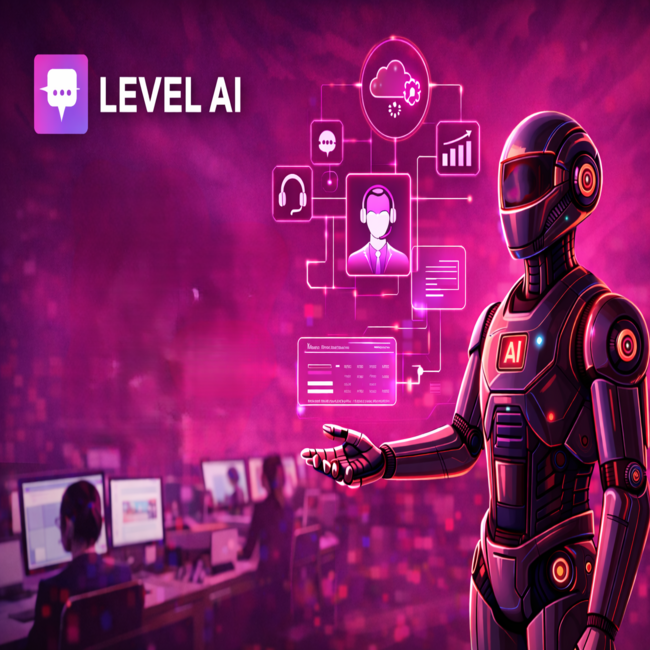

Level AI has announced a major expansion of its AI powered virtual agent capabilities, aimed at enhancing automation and intelligence across enterprise contact centers. The company said the upgrade is designed to improve customer engagement, streamline agent workflows and deliver more accurate, real time support interactions.
The expansion reflects accelerating adoption of artificial intelligence within customer experience operations, where organisations are seeking scalable solutions to manage high volumes of queries while maintaining service quality. By strengthening its virtual agent platform, Level AI is positioning itself to address evolving enterprise demand for end to end automation.
According to the company, the updated virtual agent capabilities combine conversational AI, advanced analytics and workflow integration to handle both inbound and outbound interactions. The system is built to interpret customer intent, provide contextual responses and escalate complex issues to human agents when necessary.
Contact centers have increasingly turned to AI driven tools to reduce wait times and improve resolution rates. Virtual agents can manage repetitive tasks such as order status checks, appointment scheduling and basic troubleshooting, enabling human representatives to focus on higher value conversations.
Level AI indicated that the expansion enhances the platform’s ability to understand nuanced language patterns and adapt responses based on historical interaction data. Improved natural language processing models are expected to increase accuracy in identifying customer needs across channels including voice, chat and email.
Industry analysts note that enterprises are moving beyond basic chatbots toward more sophisticated virtual agents capable of executing multi step workflows. Integration with customer relationship management systems and backend databases is critical to delivering seamless experiences.
The company’s platform reportedly offers real time coaching and insights for human agents as well. By analysing ongoing conversations, the system can suggest next best actions, highlight compliance requirements and provide sentiment analysis. This hybrid approach supports collaboration between AI systems and frontline teams.
From a martech perspective, the development underscores the convergence of AI driven analytics and customer engagement strategies. Personalised support experiences can influence brand perception and loyalty, making automation investments strategically significant.
The expansion also addresses scalability challenges faced by enterprises during peak demand periods. Virtual agents can operate continuously without capacity constraints, offering consistent responses and reducing operational strain.
Data security and compliance remain central considerations in deploying AI within customer service environments. Level AI has emphasised adherence to enterprise grade security standards and regulatory frameworks, particularly in sectors such as finance and healthcare.
As generative AI technologies mature, virtual agents are expected to deliver more natural and context aware interactions. Enhanced training models can draw from structured and unstructured data to refine conversational capabilities.
Enterprises are increasingly measuring success through metrics such as first contact resolution, average handling time and customer satisfaction scores. AI driven automation can contribute to improvements across these indicators when implemented effectively.
The contact center technology market has grown rapidly, driven by digital transformation and remote workforce trends. Cloud based solutions have enabled faster deployment of AI powered tools, reducing reliance on legacy infrastructure.
Level AI’s announcement positions the company within a competitive ecosystem that includes established customer experience platforms and emerging AI startups. Differentiation often hinges on integration flexibility, performance accuracy and ease of deployment.
The enhanced virtual agent capabilities may also support multilingual interactions, enabling enterprises to expand global support coverage. Language adaptability has become an important feature in serving diverse customer bases.
Analysts suggest that the future of contact center operations will involve deeper collaboration between AI systems and human agents. Rather than replacing staff, intelligent automation is increasingly framed as augmenting human expertise and improving efficiency.
The broader enterprise AI landscape indicates sustained investment in customer facing automation. As digital channels proliferate, organisations require unified platforms that consolidate data and orchestrate consistent responses.
Level AI’s expansion of its virtual agent offering reflects this shift toward intelligent, integrated customer support ecosystems. By combining conversational AI with analytics and workflow automation, the company aims to deliver measurable performance improvements.
The effectiveness of the new capabilities will depend on adoption rates and integration outcomes across client environments. Enterprises evaluating AI solutions typically prioritise reliability, security and demonstrable return on investment.
As customer expectations continue to evolve, technology providers are under pressure to deliver responsive and personalised service tools. The latest update from Level AI illustrates how virtual agent platforms are adapting to meet these demands.
In an increasingly competitive digital landscape, companies that successfully integrate AI driven automation into contact center operations may gain operational efficiencies and stronger customer relationships. Level AI’s expanded virtual agent capabilities represent another step in that ongoing transformation.