
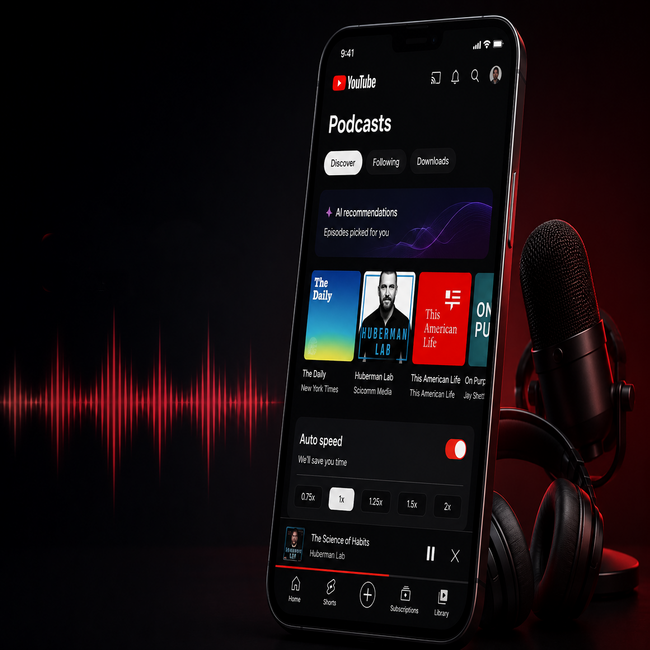

The updates are designed to improve podcast discovery and listening experiences for users while giving creators additional opportunities to reach audiences. The move comes as competition intensifies among platforms seeking to attract podcast listeners through personalization, creator tools and enhanced user experiences.
Among the most notable additions is an AI-driven recommendation feature that helps users discover podcast content based on their viewing and listening habits. The tool uses machine learning to surface podcast episodes that align with individual interests, aiming to simplify content discovery across YouTube's expanding podcast ecosystem.
Podcasting has become a major focus area for YouTube in recent years. The platform has steadily increased investments in creator support, audience engagement features and podcast-specific tools as it competes with dedicated audio platforms and streaming services. Industry analysts note that YouTube has emerged as one of the largest podcast consumption platforms globally, driven by its video-first approach and extensive creator network.
The company is also introducing automatic playback speed adjustments, allowing listeners to consume podcast content more efficiently without manually changing settings. The feature is designed to improve accessibility and convenience for users who regularly consume long-form audio and video content.
According to YouTube, the updates are intended to make podcast listening more intuitive while helping audiences find relevant content more quickly. Personalization has become a key battleground across digital media platforms, with AI increasingly being used to tailor recommendations and improve engagement.
The latest rollout reflects a broader industry trend toward AI-assisted content discovery. Streaming platforms, social media companies and digital publishers are investing heavily in recommendation technologies to increase user retention and content consumption. AI-driven personalization has become a central component of growth strategies across the creator economy.
For podcast creators, improved discovery tools could increase visibility in an increasingly crowded marketplace. As more creators enter the podcast space, platforms are exploring ways to connect audiences with content that aligns closely with their interests. Enhanced recommendation systems are viewed as one method of improving audience reach without requiring significant changes to content production strategies.
The podcast industry has experienced steady growth over the past several years, supported by increasing consumer demand for on-demand audio content. Businesses and advertisers have also shown growing interest in podcasts as a channel for audience engagement, contributing to higher investment levels across the sector.
YouTube's podcast expansion aligns with broader efforts by technology companies to integrate AI into everyday user experiences. Beyond content recommendations, AI is increasingly being used for search, content moderation, transcription, translation and creator support functions. These applications are reshaping how users discover and interact with digital content across platforms.
The introduction of AI-powered podcast recommendations also highlights the growing role of artificial intelligence in media consumption. Rather than relying solely on manual searches or curated lists, users are increasingly engaging with content surfaced through predictive algorithms that analyze preferences and behavior patterns.
As podcast consumption continues to rise, platforms are under pressure to improve both discovery and usability. Features such as automated speed controls and personalized recommendations are becoming important differentiators in a competitive market where user attention remains a valuable resource.
The latest updates underscore YouTube's ambition to strengthen its podcast ecosystem while leveraging AI to improve audience engagement. As digital audio platforms continue to evolve, personalization technologies are expected to play a larger role in determining how creators connect with listeners and how users discover new content across increasingly crowded media environments and platforms globally.