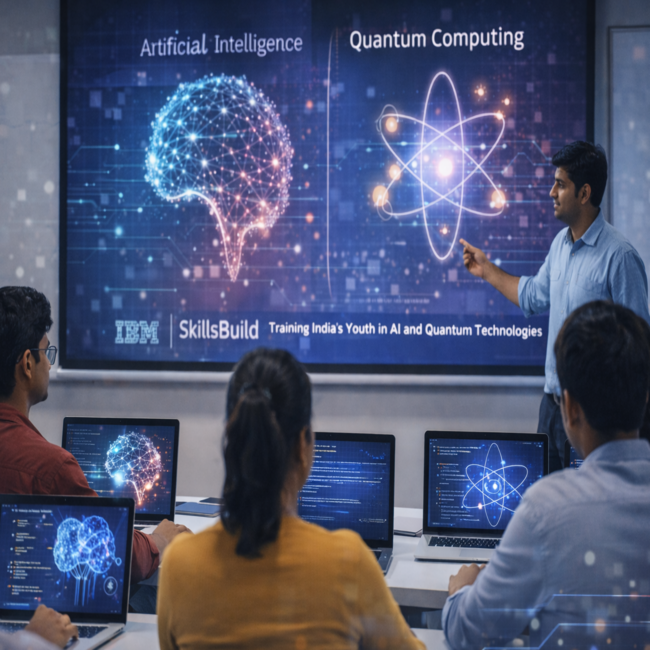
Indian Space Research Organisation chairman S Somanath has proposed Mysuru as a potential national hub for deep technology, with a specific focus on artificial intelligence and quantum computing. The proposal reflects a broader vision to decentralise India’s deep tech ecosystem and build regional centres capable of supporting advanced research, innovation, and talent development.
Speaking on the importance of strengthening India’s technology backbone, Somanath highlighted Mysuru’s academic heritage, research institutions, and emerging innovation ecosystem as key factors that could support its evolution into a deep tech hub. The proposal aligns with India’s growing emphasis on next-generation technologies as critical drivers of economic growth, strategic autonomy, and global competitiveness.
Deep tech areas such as artificial intelligence and quantum computing are increasingly viewed as foundational technologies that will shape future industries, from defence and space to healthcare, finance, and manufacturing. By identifying Mysuru as a potential focal point, the proposal signals an intent to move beyond established metropolitan centres and distribute innovation capacity more evenly across the country.
Mysuru’s proximity to Bengaluru, one of India’s largest technology clusters, is seen as a strategic advantage. The city benefits from access to talent, industry expertise, and research networks while offering a less congested environment for long-term infrastructure development. This combination positions Mysuru as a viable location for large-scale research facilities, testing centres, and academic collaboration.
Somanath emphasised that building a national deep tech hub requires more than physical infrastructure. It involves creating an ecosystem where academia, industry, startups, and government institutions can collaborate effectively. For AI and quantum technologies, such collaboration is essential due to the complexity and interdisciplinary nature of research and development.
The proposal comes at a time when India is accelerating efforts to strengthen its position in emerging technologies. Government initiatives and policy frameworks are increasingly focused on supporting AI research, quantum missions, and advanced computing. Establishing regional hubs could help translate policy intent into tangible outcomes by creating localised centres of excellence.
Quantum computing, in particular, is gaining attention as a strategic capability with long-term implications for cybersecurity, cryptography, and high-performance computing. Developing expertise in this field requires sustained investment in research, specialised talent, and experimental infrastructure. By pairing quantum research with AI development, a deep tech hub could foster cross-disciplinary innovation.
From an industry perspective, the development of a national deep tech hub could attract startups, global technology companies, and research organisations seeking to participate in India’s growing innovation ecosystem. Concentrated hubs often act as magnets for investment and talent, creating a virtuous cycle of growth and capability building.
For the marketing and technology ecosystem, advances in AI and quantum computing have downstream implications. AI continues to transform how brands engage with consumers through personalisation, analytics, and automation. While quantum computing remains at an earlier stage, its future applications could reshape data processing and optimisation, influencing how technology platforms operate at scale.
The proposal also highlights the role of leadership from scientific institutions in shaping national technology agendas. As head of ISRO, Somanath brings a perspective rooted in long-term planning and mission-driven execution. His vision underscores the importance of aligning scientific ambition with national development goals.
Mysuru’s educational institutions and research culture are expected to play a central role if the proposal gains traction. Universities and research centres are critical to developing the skilled workforce required for deep tech sectors. Strengthening ties between academia and industry would be essential to ensure that research outcomes translate into practical applications.
The development of a deep tech hub would also require supportive policy measures, including funding mechanisms, regulatory clarity, and incentives for private sector participation. Experts note that sustained success depends on continuity and coordination across multiple stakeholders rather than isolated initiatives.
India’s deep tech ambitions are unfolding against a backdrop of global competition. Countries worldwide are investing heavily in AI and quantum technologies, recognising their potential to reshape economic and strategic landscapes. Establishing national hubs is one way to build critical mass and remain competitive in this environment.
While the proposal positions Mysuru as a candidate for a national hub, further discussions and feasibility assessments would be required to determine scope, investment needs, and implementation timelines. Infrastructure development, talent attraction, and ecosystem building are long-term efforts that demand consistent commitment.
Observers note that decentralised innovation hubs can also contribute to regional economic development by creating high-value jobs and fostering local entrepreneurship. For Mysuru, becoming a deep tech hub could enhance its profile beyond tourism and education, positioning it as a centre for advanced technological research.
The proposal reflects a broader shift in India’s technology strategy, where deep tech is increasingly viewed as essential to future resilience and growth. By advocating for Mysuru as a national hub for AI and quantum computing, Somanath has added momentum to discussions around how and where India should build its next generation of innovation infrastructure.
As policymakers, industry leaders, and academic institutions engage with this vision, the focus will be on translating intent into action. If realised, a deep tech hub in Mysuru could play a significant role in shaping India’s AI and quantum capabilities over the coming decades.
Related Articles