
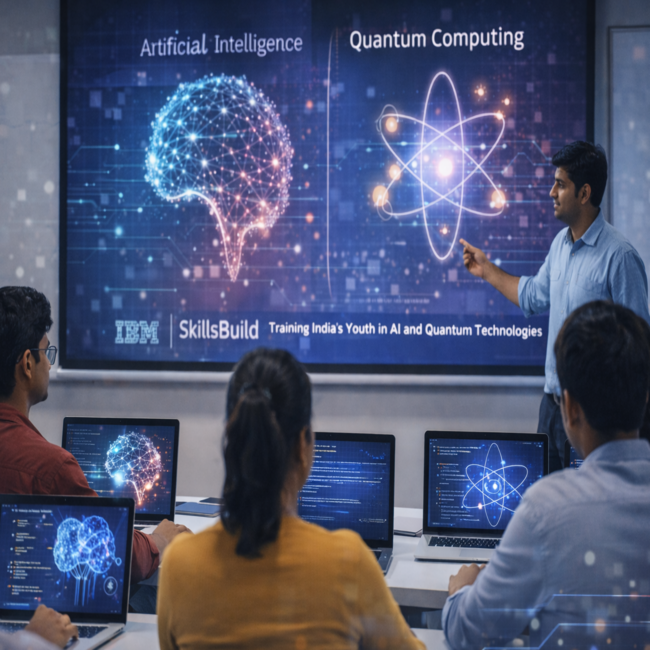

IBM has announced a large scale initiative to train five million Indian youth in advanced digital technologies including artificial intelligence, cybersecurity and quantum computing by 2030. The commitment forms part of the company’s broader global goal to equip 30 million people worldwide with future ready skills over the same period. The announcement underscores IBM’s focus on workforce development as demand for expertise in emerging technologies continues to grow.
The initiative will be delivered primarily through IBM SkillsBuild, the company’s free digital education platform. SkillsBuild offers access to a wide range of learning resources covering areas such as AI, data science, cloud computing, cybersecurity, sustainability and workplace readiness. The platform is designed to support learners at different stages, including students, job seekers and professionals looking to reskill or upskill.
IBM has stated that its expanded effort in India will focus on improving access to high demand technology education across schools, colleges, vocational institutions and adult learning ecosystems. The company plans to collaborate with government bodies, academic institutions and industry partners to broaden the reach of its training programmes and align learning pathways with industry requirements.
A key element of the initiative involves partnerships with national education and regulatory bodies to embed AI focused learning into formal education frameworks. These collaborations are expected to support curriculum development, faculty training and hands on learning opportunities. IBM has indicated that practical exposure through projects, internships and hackathons will complement online coursework to help learners apply skills in real world scenarios.
The emphasis on artificial intelligence and quantum computing reflects shifts in the global technology landscape. AI is increasingly being integrated across sectors including healthcare, finance, manufacturing and public services, while quantum computing is gaining attention for its potential to solve complex problems beyond the capabilities of classical computers. IBM has positioned these technologies as critical to future innovation and economic competitiveness.
Industry data has consistently pointed to a significant skills gap in emerging technologies, particularly among young populations in developing economies. In India, where a large proportion of the population is under the age of 30, access to advanced technical education remains uneven. IBM’s initiative aims to address this gap by providing free and scalable learning resources that can reach learners across urban and rural regions.
IBM SkillsBuild combines self paced digital courses with project based learning and industry recognised credentials. Learners can earn digital badges that signal proficiency in specific skills, helping improve employability and career mobility. The platform also includes content focused on professional skills such as communication, problem solving and career readiness, recognising that technical expertise alone may not be sufficient in the modern workplace.
As part of its broader engagement in India, IBM has supported the development of dedicated infrastructure for AI education and innovation. Collaborative initiatives with national institutions have led to the establishment of training labs and centres that provide access to advanced computing resources, software tools and mentorship. These facilities are intended to serve as hubs for experimentation, research and skills development.
The focus on quantum computing aligns with India’s growing interest in building capabilities in this field. National level programmes aimed at advancing quantum research and applications highlight the importance of developing a skilled workforce that can support long term ambitions. IBM’s experience in quantum technology positions it as a key contributor to early stage education and awareness in this domain.
Experts in workforce development have noted that large scale skilling initiatives require sustained collaboration between industry, academia and government to be effective. Programmes that combine theoretical learning with practical application are seen as more likely to produce job ready graduates. IBM’s approach of blending online education with hands on opportunities reflects this understanding.
The company has also emphasised inclusivity as a core principle of its skilling efforts. Through partnerships with non profit organisations and foundations, IBM aims to reach learners from underserved and marginalised communities. Expanding access to digital education is viewed as essential to ensuring that the benefits of technological advancement are more evenly distributed.
IBM’s global training targets reflect the scale of change expected in the labour market over the coming decade. Automation, AI driven systems and data centric decision making are reshaping job roles across industries. By investing in large scale education initiatives, technology companies are increasingly positioning themselves as contributors to workforce resilience and economic adaptation.
For India, the initiative could play a role in strengthening the country’s position as a global technology talent hub. As businesses worldwide look for skilled professionals in AI and related fields, a larger pool of trained candidates could enhance India’s competitiveness and support innovation across sectors.
IBM has stated that progress toward the five million learner target will be tracked over time as programmes expand and partnerships deepen. While the long term impact will depend on execution and adoption, the commitment signals a significant investment in developing future ready skills at scale.
As digital transformation accelerates across economies, initiatives focused on education and reskilling are expected to become increasingly central to technology strategies. IBM’s pledge to train five million Indian youth by 2030 highlights the growing intersection between business growth, technological innovation and workforce development.