
Hyundai Motor Group has announced plans to invest approximately $63 billion in South Korea over the coming years, with a significant portion earmarked for artificial intelligence, robotics and future mobility technologies. The large scale capital commitment reflects the company’s push to accelerate its transformation into a technology driven mobility provider.
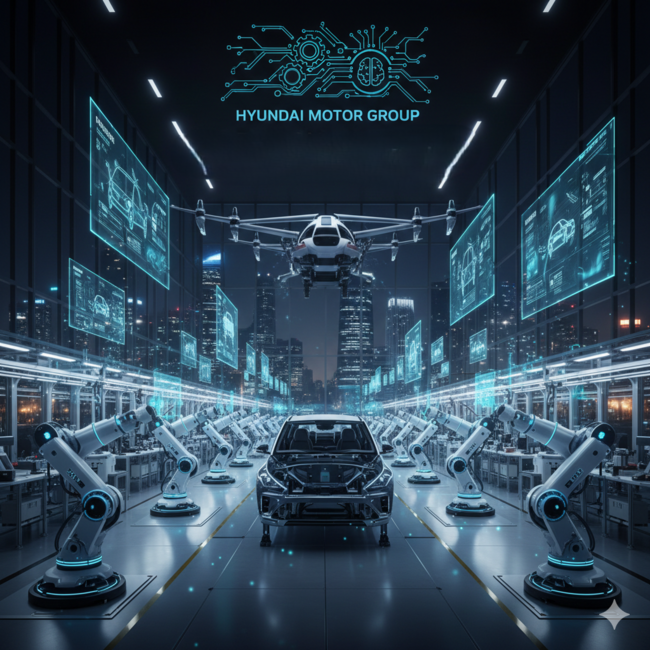
The investment plan is expected to cover research and development, advanced manufacturing facilities and next generation mobility infrastructure. A key component involves expanding the use of AI powered systems and robotics across production lines to enhance efficiency, safety and quality control.
Hyundai has indicated that the funding will support the development of intelligent factories equipped with autonomous robots and data driven process optimisation tools. These facilities are designed to integrate AI into core manufacturing workflows, enabling real time monitoring, predictive maintenance and adaptive production planning.
Industry analysts view the move as part of a broader strategy among global automakers to modernise operations in response to rapid technological shifts. The automotive sector is undergoing structural change driven by electrification, software defined vehicles and autonomous driving research. Investments in AI and robotics are increasingly central to maintaining competitiveness.
In recent years, Hyundai Motor Group has expanded its focus beyond traditional vehicle manufacturing. The company has invested in robotics platforms, urban air mobility concepts and advanced battery technologies. The latest capital allocation signals a continued emphasis on digital transformation within its domestic operations.
The proposed investment will also strengthen South Korea’s position as a hub for advanced manufacturing. By concentrating resources in its home market, Hyundai aims to consolidate research capabilities and foster collaboration between technology teams and production facilities.
Robotics is expected to play a pivotal role in the company’s strategy. Hyundai acquired robotics company Boston Dynamics in 2021, signalling its ambition to integrate robotic solutions into industrial and logistics environments. The new funding may accelerate deployment of robotic systems across assembly plants and supply chains.
Artificial intelligence applications are anticipated to extend beyond factory automation. AI driven analytics can support supply chain forecasting, quality inspection and customer demand prediction. Integrating these systems into production ecosystems may enable faster response to market fluctuations.
From a martech and enterprise technology perspective, the investment illustrates how AI adoption is expanding into core industrial processes. Manufacturing is increasingly data intensive, with sensors and connected devices generating large volumes of information. Leveraging AI to interpret this data can yield efficiency gains and cost optimisation.
Hyundai’s announcement comes amid intensifying competition from electric vehicle manufacturers and technology centric automotive entrants. Companies are investing heavily in software platforms and autonomous driving capabilities. Strengthening AI infrastructure within production systems complements these product side innovations.
The funding package is expected to support job creation in advanced technology roles, even as automation reshapes traditional manufacturing tasks. Training programmes and upskilling initiatives may accompany the deployment of AI driven tools to ensure workforce adaptation.
South Korea’s government has prioritised innovation in semiconductors, AI and advanced manufacturing as part of its national economic strategy. Large corporate investments such as Hyundai’s align with these policy objectives and may contribute to broader industrial competitiveness.
Market observers note that large scale capital commitments reflect long term confidence in AI as a foundational technology. While economic cycles can influence short term spending, strategic investments in automation and robotics are often positioned as multi decade initiatives.
Hyundai’s plan also underscores the convergence between automotive engineering and digital technology. Modern vehicles increasingly incorporate software defined architectures, over the air updates and data connectivity. Building intelligent factories capable of producing such vehicles requires parallel digital infrastructure.
The $63 billion investment represents one of the most substantial commitments by a South Korean industrial group in recent years. It signals Hyundai’s intent to anchor future growth in advanced technologies while reinforcing its domestic manufacturing base.
As global supply chains face geopolitical and economic uncertainties, consolidating high value operations within national borders can enhance resilience. Intelligent automation may further support flexibility in production volumes and model transitions.
The coming years will reveal how effectively Hyundai integrates AI and robotics into its operational ecosystem. Success will likely depend on seamless coordination between research teams, manufacturing units and external technology partners.
For now, the announcement positions Hyundai Motor Group at the forefront of industrial AI adoption within the automotive sector. By directing significant capital toward robotics and intelligent manufacturing, the company is seeking to future proof its operations and maintain competitiveness in an evolving mobility landscape.
Related Articles