
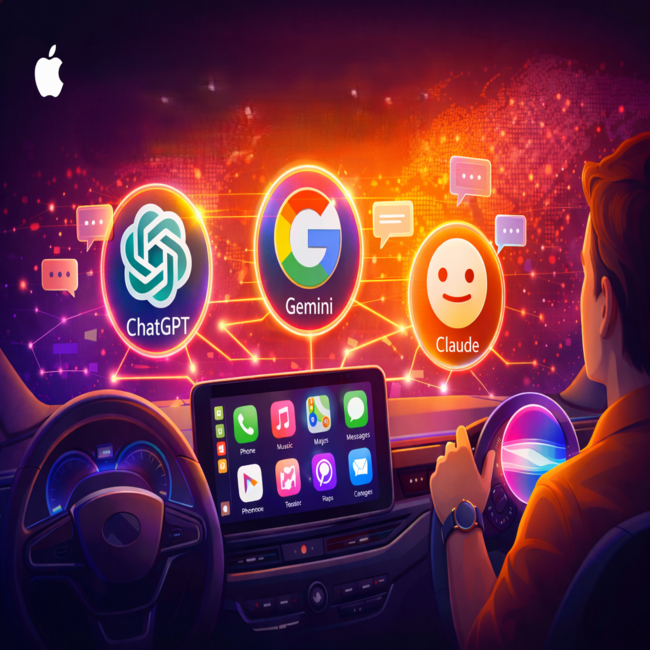

Apple is preparing to expand its CarPlay platform to support third-party artificial intelligence chatbots, marking a significant shift in how voice-based interactions function inside vehicles using Apple’s ecosystem. The move would allow popular AI assistants such as ChatGPT, Google Gemini and Anthropic’s Claude to operate within CarPlay, which has so far remained closely tied to Apple’s own Siri voice assistant.
CarPlay has long served as Apple’s in-car interface, allowing iPhone users to access navigation, communication and media apps through a vehicle’s infotainment system. While it supports a wide range of third-party applications, Apple has historically limited voice control to Siri, keeping a tight grip on how drivers interact with the system hands-free. The planned update would open the door for AI chatbot apps that support voice input and conversational responses.
Under the proposed framework, Siri will continue to remain the default voice assistant on CarPlay. The dedicated voice button and wake word functionality will still activate Siri, preserving Apple’s control over the core user experience. However, users will be able to manually launch compatible AI chatbot apps from the CarPlay dashboard. Once opened, these apps can immediately enter voice mode, allowing drivers to speak queries without additional taps or navigation.
The development reflects Apple’s response to the rapid rise of generative AI tools that offer more advanced conversational abilities than traditional voice assistants. Services such as ChatGPT and Gemini have gained widespread adoption across smartphones, desktops and productivity platforms, raising user expectations around natural language understanding, contextual awareness and task execution. Bringing these capabilities into the car could significantly change how drivers interact with information while on the road.
From a safety and design perspective, Apple appears to be maintaining firm boundaries. By preventing third-party chatbots from replacing Siri entirely or responding to steering wheel controls, the company retains a consistent interaction model. This approach aligns with Apple’s long-standing emphasis on minimising driver distraction and ensuring that in-car experiences remain predictable and controlled.
Industry observers view the move as part of a broader shift across the automotive and technology sectors. Vehicles are increasingly becoming software-driven environments where digital services play a central role in user experience. Automakers and platform providers are experimenting with conversational AI to handle navigation, information retrieval, entertainment and vehicle controls. Allowing third-party AI assistants on CarPlay could make Apple’s platform more competitive as drivers seek richer and more flexible voice interactions.
The timing of the change is also notable as Apple continues to invest in its own artificial intelligence strategy. The company has been enhancing Siri through deeper system integration and large language model capabilities under its broader Apple Intelligence initiative. While Apple has not positioned Siri as a direct competitor to standalone AI chatbots, it has acknowledged the need for more sophisticated AI features across its ecosystem. Opening CarPlay to external AI tools suggests a pragmatic approach that balances internal development with user demand.
For developers, the update could create new opportunities to adapt AI applications for in-car use cases. Voice-first design, concise responses and contextual relevance will be critical for chatbot apps operating within CarPlay. Developers will also need to comply with Apple’s guidelines around safety, privacy and user experience, which are typically stricter for automotive interfaces than for standard mobile apps.
The change could also influence how consumers perceive CarPlay compared to rival platforms. Android Auto already supports deeper integration with Google Assistant and other Google services, giving Android users access to advanced conversational features. By allowing third-party AI chatbots, Apple may be aiming to reduce any perceived gap in AI capability while still preserving its distinct design philosophy.
Despite the potential impact, several details remain unclear. Apple has not publicly announced the feature or confirmed a rollout timeline. It is also not known which AI chatbot providers will be supported at launch or whether access will vary by region or vehicle manufacturer. As with previous CarPlay updates, availability is likely to depend on iOS version compatibility and automaker adoption.
Privacy considerations will also be closely watched. AI chatbots typically rely on cloud-based processing and data exchange to generate responses. Apple has built its brand around privacy protections and user data control, and any third-party AI integration on CarPlay will be expected to meet stringent standards. How Apple enforces these requirements could shape which chatbot services ultimately gain traction on the platform.
If implemented as expected, the update would mark one of the most significant changes to CarPlay since its introduction. It would give drivers greater choice in how they access information and interact with AI while driving, without dismantling Apple’s existing framework. For Apple, the move signals a willingness to adapt as artificial intelligence becomes a central layer in everyday digital experiences.
As generative AI continues to reshape consumer technology, in-car platforms are emerging as the next frontier. Apple’s decision to open CarPlay to third-party AI chatbots reflects the growing importance of conversational intelligence in vehicles and underscores how platform providers are recalibrating their strategies to keep pace with evolving user expectations.