
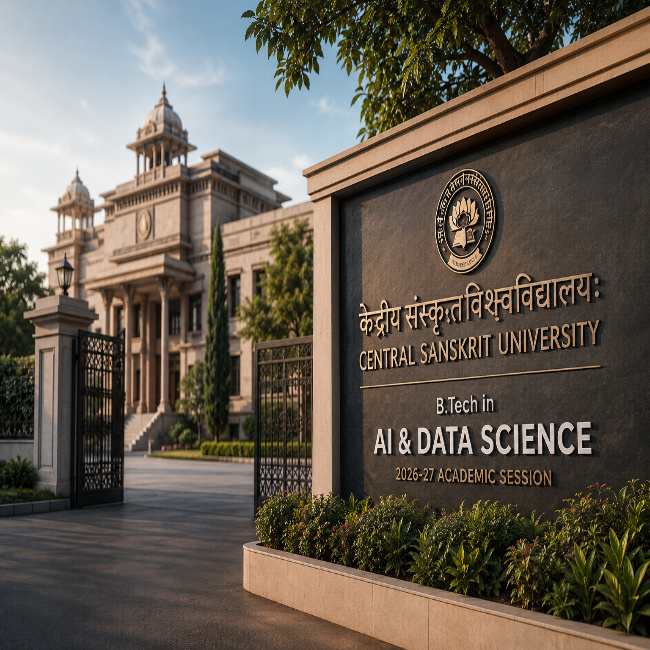

The programme will be offered at the university's Kavi Kulaguru Kalidas Campus in Nashik, Maharashtra, reflecting a broader effort to expand professional and technology-oriented education within institutions traditionally associated with classical studies.
According to the university, admissions for the four-year undergraduate programme will begin for the upcoming academic year after receiving the required regulatory approvals. The curriculum has been designed to combine core engineering subjects with specialised training in artificial intelligence, machine learning, data science, cloud computing and software development, while retaining exposure to Sanskrit and India's knowledge traditions.
The move comes as higher education institutions across India expand AI-focused programmes to address growing demand for skilled professionals. Artificial intelligence has become one of the fastest-growing areas of technical education, with universities introducing dedicated courses in response to increasing industry demand across technology, healthcare, financial services, manufacturing and public sector organisations.
University officials said the programme is intended to prepare students for careers in AI development, data analytics, intelligent automation and digital technologies. Graduates are expected to find opportunities across software companies, research organisations, startups and government agencies that are increasingly integrating AI into their operations.
The introduction of the engineering programme also aligns with the objectives of the National Education Policy 2020, which encourages multidisciplinary learning and greater integration between traditional knowledge systems and modern scientific education. By expanding beyond conventional Sanskrit studies, the university aims to broaden career opportunities while attracting students interested in both technology and India's intellectual heritage.
Officials stated that the curriculum will include practical training, laboratory work, industry exposure and project-based learning to ensure graduates develop hands-on technical skills alongside theoretical knowledge. The programme is also expected to incorporate emerging AI technologies and evolving industry practices as the field continues to advance.
India has witnessed rapid growth in AI education over the past two years, with institutions including the Indian Institutes of Technology, National Institutes of Technology and several private universities introducing specialised undergraduate and postgraduate programmes. Industry demand has been fuelled by increasing adoption of generative AI, automation, predictive analytics and intelligent software systems across businesses.
For employers, the shortage of AI talent remains a significant challenge despite growing interest among students. According to multiple industry reports, demand for professionals with AI and data science expertise continues to outpace supply, prompting educational institutions to expand capacity in specialised technology disciplines.
The decision by Central Sanskrit University also reflects the evolving role of traditional universities as they diversify academic offerings to remain aligned with changing workforce requirements. While Sanskrit education remains central to the institution's identity, the addition of engineering programmes demonstrates how universities are adapting to technological transformation without abandoning their original academic mission.
Education experts note that combining technology education with multidisciplinary learning could help students develop broader perspectives while preparing for careers in emerging industries. As AI increasingly influences sectors ranging from education and healthcare to governance and manufacturing, institutions are exploring new approaches that integrate technical expertise with humanities and social sciences.
The launch of the BTech programme comes amid the government's broader emphasis on strengthening India's AI ecosystem through investments in research, digital infrastructure, semiconductor development and workforce skilling. Universities are expected to play an important role in creating the next generation of AI professionals needed to support these national initiatives.
With admissions expected to begin for the 2026-27 academic year, the university's new engineering programme represents another milestone in India's expanding AI education landscape, highlighting how institutions with diverse academic backgrounds are adapting to meet the country's growing technology talent requirements.