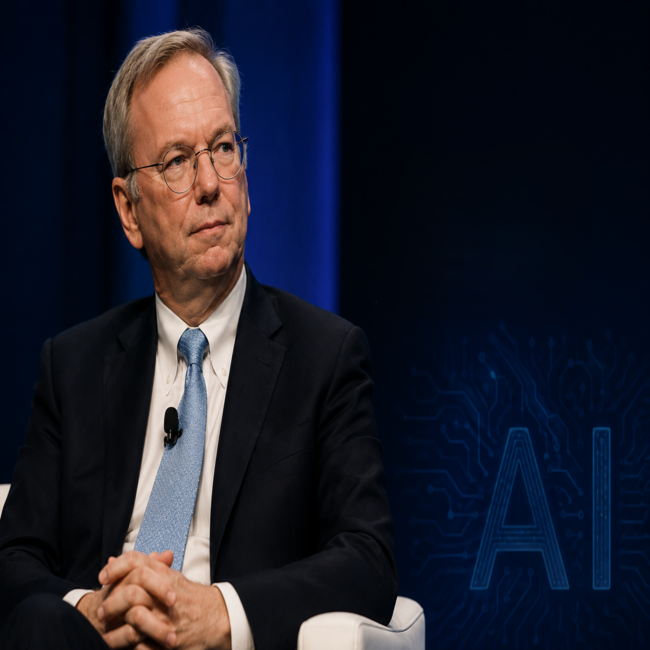
Former Google CEO Eric Schmidt faced criticism and audible backlash during a university graduation event as concerns around artificial intelligence and its impact on jobs continue intensifying across industries.
According to reports, Schmidt encountered negative reactions from sections of the audience while discussing technology and AI-related developments during the ceremony. The incident reflects growing public anxiety surrounding automation, workforce disruption and the long-term implications of generative AI systems.
Industry observers say debates around artificial intelligence have increasingly shifted beyond innovation and productivity toward concerns involving employment stability, workplace transformation and the future of professional skills.
The broader technology sector has witnessed rapid expansion of AI tools over the past two years as businesses accelerate adoption of automation systems, generative AI platforms and machine learning applications. Companies across industries are increasingly integrating AI into workflows involving customer service, coding, analytics, content generation and administrative operations.
Reports suggest growing concerns among students and workers are being fueled by predictions that AI could significantly reshape white-collar employment and entry-level professional roles. Businesses are increasingly exploring ways to automate repetitive and process-driven tasks using intelligent systems.
Industry analysts believe the public response toward technology leaders reflects broader uncertainty surrounding how quickly AI adoption could affect labour markets. While many companies describe AI as a productivity enhancement tool, concerns about workforce restructuring remain widespread.
Schmidt has previously spoken publicly about AI’s transformative potential and the pace at which the technology could alter industries and economic systems. Technology executives globally continue emphasising the need for adaptation and digital skill development as AI capabilities expand.
Reports indicate debates around AI and employment are becoming more visible across universities, professional communities and policy discussions as graduates prepare to enter increasingly technology-driven workplaces. Younger professionals are particularly focused on how automation may affect career stability and hiring trends.
Industry executives say AI is likely to change the nature of work rather than eliminate entire industries outright. However, they also acknowledge that automation could reduce demand for certain repetitive or operational roles across sectors including customer support, media, software development and administration.
The latest incident also highlights rising scrutiny toward technology companies and AI leaders as generative AI adoption accelerates globally. Businesses are facing growing pressure to address ethical concerns, workforce impact and responsible deployment practices.
Analysts believe AI-driven transformation could create new employment opportunities in areas such as AI infrastructure, data science, cybersecurity and digital operations. At the same time, experts warn that workforce transition challenges may emerge faster than reskilling efforts can adapt.
Reports suggest many educational institutions and policymakers are increasingly evaluating how curricula and workforce programs should evolve in response to AI-driven economic shifts. Technology literacy and AI familiarity are becoming more important across industries.
Industry observers note that public opinion around AI remains divided between optimism about innovation and concern over economic displacement. Businesses are continuing to invest heavily in AI despite growing debate around regulation and employment implications.
Technology companies globally have increased spending on AI infrastructure and automation systems as competition intensifies across cloud computing, enterprise software and digital productivity markets. AI development remains one of the largest investment priorities within the technology industry.
Experts believe conversations around AI and employment are likely to intensify further as companies deploy more advanced autonomous systems and automation-led workflows. Public trust and workforce preparedness are emerging as key challenges within broader AI adoption strategies.
The reaction to Schmidt’s appearance underscores how artificial intelligence is becoming not only a technology issue but also a social and economic debate influencing perceptions of work, education and career security. Analysts say balancing innovation with workforce transition planning will remain critical as AI adoption continues expanding across industries and digital ecosystems worldwide.