
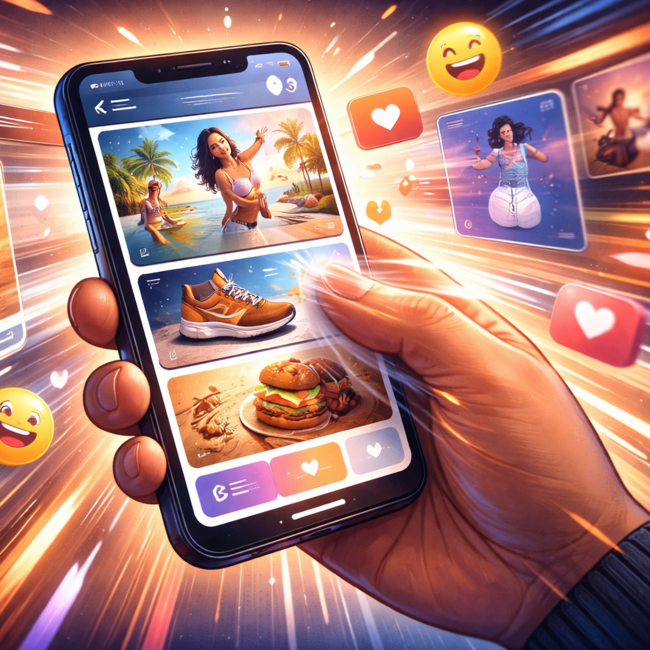

Marketing today is increasingly shaped by speed. Consumers scroll, swipe, and skip faster than brands can react. In this environment, attention has become both the most valuable and the most fragile currency. As a result, marketers are rethinking how they communicate. Long-form brand storytelling is giving way to micro-moments, where a message must land in two seconds or risk being ignored.
This shift is visible across digital platforms. Instagram Reels, YouTube Shorts, Moj, and six-second bumper ads on YouTube have become central to campaign planning. Instead of building narratives over time, brands are now prioritising immediate hooks. The goal is not depth but recall. Not immersion, but interruption.
Industry data reflects this change clearly. Research shows that most digital users decide whether to continue watching a video within the first three seconds. Average attention on ads has dropped to just over two seconds globally. In India, short-form video consumption has become a daily habit for the majority of social media users, with Reels emerging as the most preferred format among urban and affluent audiences.
Marketers see this not as a passing trend, but as a structural change in how content is consumed. Arun Srinivas, Head of Meta India, has previously noted that India is leading global video adoption, with short-form video at the centre of this behaviour shift. According to Meta’s internal studies, ads on Reels deliver significantly higher recall and message association compared to longer video formats.
This has forced brands to redesign creative strategy. The opening frame of an ad now matters more than the ending. Logos appear sooner. Captions are larger and more direct. Visual surprise is prioritised over narrative build-up. Many creative teams now design ads backwards, starting with what can grab attention instantly rather than what can tell a complete story.
Fast-paced ad formats are reinforcing this behaviour. YouTube bumper ads, which are unskippable and limited to six seconds, are increasingly used as reinforcement rather than standalone storytelling units. Studies have shown that a majority of bumper ad campaigns deliver a measurable lift in brand awareness and recall, despite their brevity. For advertisers, this confirms that memorability does not always require time, only clarity.
Indian brands are adapting quickly. Myntra’s short-video feed, Myntra Minis, has become a major driver of engagement and sales. A significant portion of purchases on the platform are now influenced by these short videos, and users spend a large share of their app time watching them. What began as a content experiment has evolved into a commercial engine.
Financial brands, traditionally conservative in tone, are also experimenting. HDFC Bank has publicly shared that a notable share of its digital media spends is now directed toward short-form video platforms. The intent is not to replace long-format communication entirely, but to amplify it. Short videos act as reminders and reinforcements rather than explanations.
Zomato, Swiggy, and several D2C brands have embraced the format even more aggressively. Their social media feeds rely heavily on quick jokes, memes, and culturally relevant snippets that rarely exceed ten seconds. These are not designed to explain the product in detail. They are designed to stay visible in feeds dominated by entertainment.
Creative agencies confirm that clients now ask a different first question. Instead of asking what story the ad tells, they ask whether it will stop the scroll. Shrenik Gandhi, CEO of White Rivers Media, has observed that while short-form video engagement remains strong, the competition for attention is intensifying. According to him, only content that feels native, inventive, and emotionally immediate can break through.
The science behind this behaviour offers some answers. Neuroscience research shows that short-form content activates the brain’s reward system. Each entertaining clip delivers a small dopamine response, encouraging users to continue scrolling in search of the next reward. Over time, this trains the brain to expect constant novelty and rapid gratification.
As a result, users have become quicker at filtering content. The brain makes snap judgements about relevance almost instantly. If nothing interesting happens in the opening moments, attention shifts elsewhere. This phenomenon is amplified by infinite scroll interfaces, which offer no natural stopping point and reward constant switching.
Marketing leaders are increasingly aware of this conditioning. Stanton Ambrose, Chief Business Officer at Havas Media India, has spoken about how users typically decide within a few seconds whether to continue engaging with content. For brands, this means the first impression is no longer a luxury. It is the entire game.
However, the move toward two-second marketing raises concerns. Critics argue that an overreliance on micro-content risks eroding brand meaning. When everything is designed to be instantly consumable, nuance and emotional depth can be lost. There is also concern that audiences may become fatigued by constant stimulation, making it even harder for brands to stand out over time.
Some marketers are responding by redefining storytelling rather than abandoning it. Instead of one long narrative, stories are broken into fragments. Each fragment is designed to work independently while contributing to a larger brand memory. In this model, storytelling becomes cumulative rather than linear.
Creative leaders emphasise that short does not have to mean shallow. The challenge is to compress meaning without losing intent. This requires sharper creative thinking, not less. The best short-form campaigns often rely on strong cultural insight, humour, or visual symbolism that resonates instantly.
There is also a growing recognition that not every message belongs in a two-second format. High-involvement categories like finance, healthcare, and education still require depth and explanation. Short-form content may introduce the brand, but longer formats remain necessary to build trust and understanding.
The current shift, then, is not about eliminating storytelling, but about repositioning it. Storytelling is no longer confined to a single ad film. It is distributed across moments, formats, and platforms. Each moment must earn attention on its own terms.
For marketers, the implication is clear. Attention must be designed for, not assumed. Creative work must respect the realities of how people consume content today. That does not mean abandoning ambition. It means recognising that ambition now has to operate within a much smaller window.
In an environment of attention whiplash, success belongs to brands that can say something meaningful quickly and consistently. Two seconds may not be enough to tell a story, but they are enough to start one.
Disclaimer: All data points and statistics are attributed to published research studies and verified market research. All quotes are either sourced directly or attributed to public statements.