
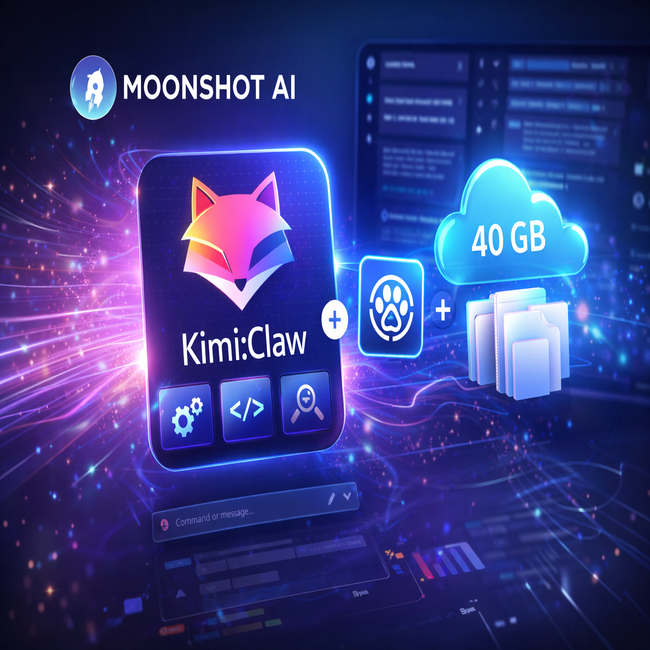

Moonshot AI has launched Kimi-Claw, a new capability on its Kimi platform that introduces native OpenClaw support alongside expanded cloud storage and a growing ecosystem of community built skills. The update reflects the company’s effort to strengthen its AI agent platform by enabling more structured task execution and deeper user customisation.
Kimi-Claw is positioned as a native implementation of OpenClaw within Kimi.com, allowing users to access a broader range of tools and workflows without relying on external integrations. By embedding OpenClaw directly into the platform, Moonshot AI aims to simplify how users create, manage and deploy AI driven tasks.
The launch includes access to more than 5000 community contributed skills, enabling users to extend Kimi’s capabilities across diverse use cases. These skills cover functions such as content generation, data analysis, automation and information retrieval, reflecting a growing interest in modular AI agent systems.
In addition to OpenClaw integration, Moonshot AI has expanded cloud storage for users, offering up to 40GB of space. This enhancement is designed to support persistent workflows, document management and long term task execution. As AI platforms move beyond single prompt interactions, storage has become an increasingly important feature.
Moonshot AI’s update highlights a shift toward AI systems that can perform multi step tasks and maintain context over time. Rather than responding to isolated prompts, platforms like Kimi are evolving into environments where users can organise projects, store resources and build repeatable workflows.
The native integration of OpenClaw allows Kimi-Claw to interact more deeply with platform level functions. This can enable tasks such as file handling, structured output generation and chained operations, reducing friction for users who want more control over AI behaviour.
Industry observers note that AI agent frameworks are becoming a key area of innovation. As generative AI matures, developers and users are increasingly focused on orchestration and automation rather than raw text generation. Tools that support structured execution may offer greater practical value.
Moonshot AI has emphasised community involvement as part of its strategy. By opening the platform to community built skills, the company encourages experimentation and collaborative development. This approach mirrors trends seen in other AI ecosystems where third party contributions accelerate feature growth.
The availability of thousands of skills at launch suggests that Moonshot AI is prioritising breadth of functionality. Users can choose from existing tools or adapt them to specific needs, reducing the need to build workflows from scratch.
The expanded cloud storage feature supports this ecosystem by allowing users to retain files, intermediate outputs and project data. Persistent storage can enable more complex use cases such as research projects, document drafting and long running automation.
Kimi-Claw’s release comes amid increasing competition among AI platforms seeking to differentiate through usability and extensibility. While large language models remain central, platform design and workflow support are becoming key differentiators.
Moonshot AI’s focus on native integration may appeal to users seeking streamlined experiences. External plugins and connectors can introduce complexity and reliability challenges. Embedding functionality directly into the platform can improve performance and consistency.
The move also reflects growing demand for AI tools that can handle real world tasks. Users are increasingly looking for systems that assist with planning, execution and iteration rather than one off responses.
Moonshot AI has not disclosed detailed pricing changes associated with the new features. However, expanded storage and platform capabilities often factor into tiered subscription models. How these features are monetised may influence adoption.
From a technical perspective, native OpenClaw support enables tighter coupling between AI reasoning and action. This alignment can improve task accuracy and reduce errors caused by misinterpreted instructions.
The community skills model may also encourage rapid innovation. As users contribute tools and workflows, the platform’s capabilities can expand organically. This decentralised approach can help surface niche use cases.
However, managing quality and security becomes increasingly important as ecosystems grow. Ensuring that community skills function reliably and safely will be essential to maintaining trust.
Moonshot AI’s announcement reflects broader momentum around AI agents as a category. Platforms across the industry are exploring ways to enable AI systems that act autonomously within defined boundaries.
The integration of storage, skills and execution frameworks suggests a move toward more holistic AI environments. Rather than separate tools for chat, files and automation, platforms are converging these functions.
For users, the immediate benefit lies in reduced friction. Tasks that previously required manual coordination can be handled within a single interface. This can improve productivity and encourage deeper engagement.
The launch of Kimi-Claw also positions Moonshot AI as an active participant in the evolving AI platform landscape. As competition intensifies, feature completeness and ecosystem strength will influence user choice.
While the long term impact of Kimi-Claw will depend on adoption and execution, the update signals Moonshot AI’s intent to move beyond basic conversational AI.
As AI platforms continue to evolve, the ability to support persistent, structured and extensible workflows may define the next phase of growth. Moonshot AI’s latest release reflects this shift toward practical, agent driven systems.
The combination of native OpenClaw support, community skills and expanded storage suggests a strategy focused on flexibility and scale. Whether this approach resonates widely will become clearer as users explore the new capabilities.
Moonshot AI’s launch of Kimi-Claw underscores how AI platforms are transitioning from experimental tools to operational systems. By enabling users to build and manage complex tasks, the company is aligning its platform with emerging expectations around AI utility.
As generative AI adoption matures, platforms that prioritise execution and persistence may gain an advantage. Kimi-Claw represents Moonshot AI’s step in that direction, highlighting how the AI ecosystem continues to evolve beyond simple prompt response models.