
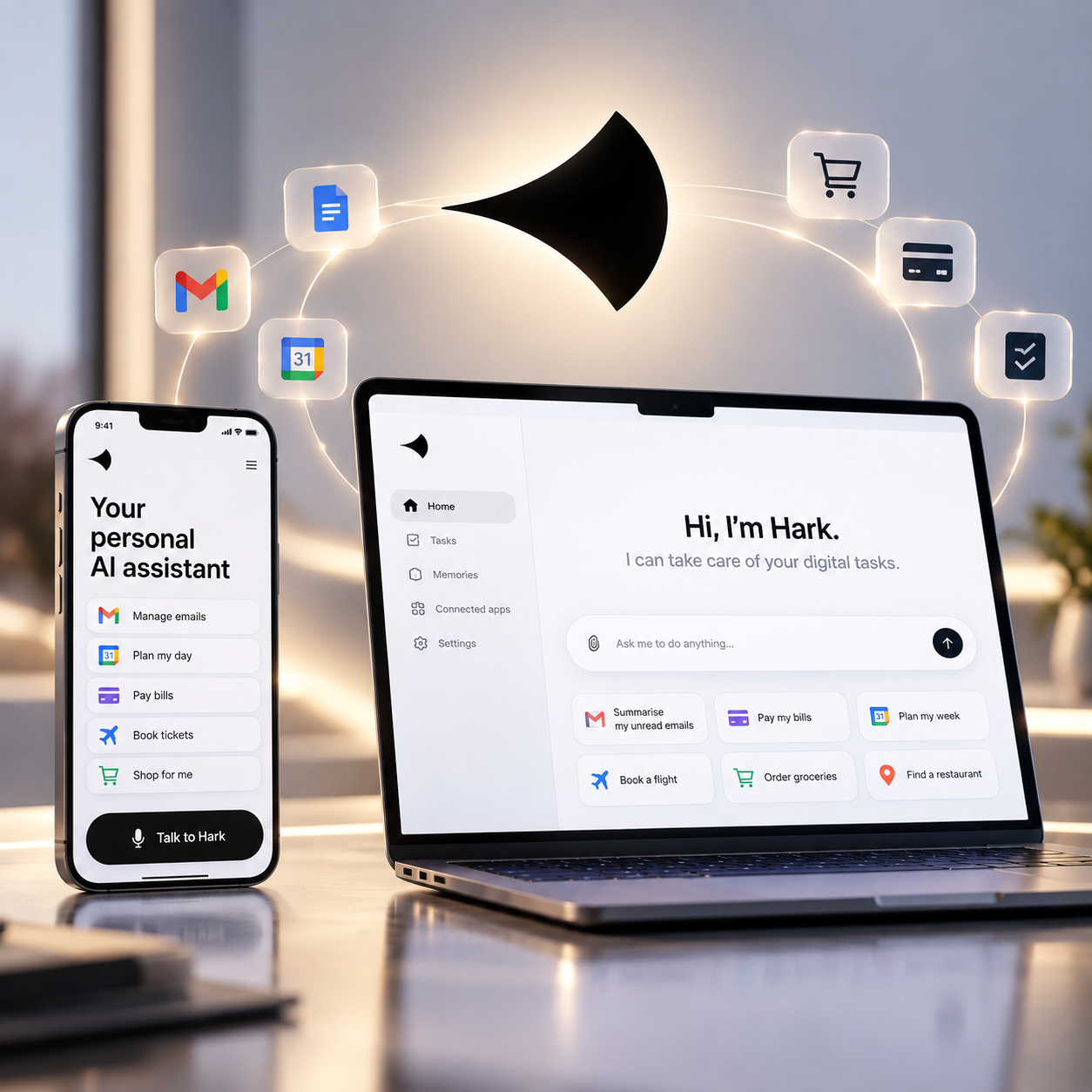

AI startup Hark has launched Hark Pro, a personal AI assistant designed to carry out digital tasks on behalf of users while placing privacy and user control at the centre of its product strategy.
Founded less than a year ago by serial entrepreneur Brett Adcock, Hark is positioning Hark Pro as more than a conventional chatbot. The platform is built around an AI model trained specifically for computer use, allowing it to navigate websites and complete tasks across a user's digital services.
Hark Pro is available across iOS, Android and the web. The company is offering its full feature set for free, with paid tiers available for users requiring higher usage limits.
Users can connect services including email, calendars, documents and other digital tools. Hark can then perform actions such as responding to emails, managing schedules, paying bills, purchasing groceries or tickets and completing tasks through websites. The platform can also remember information shared by users to provide more contextual assistance over time.
The interface includes a central conversational window alongside personalised prompts and visual panels that surface information or tasks requiring attention. Hark can proactively identify actions a user may need to complete instead of waiting for individual instructions.
One design feature allows users to watch the AI agent navigate websites through a small browser window. Hark says this is intended to provide greater visibility into how the system is carrying out actions rather than keeping its activity entirely in the background.
Privacy forms a central part of the company's positioning. Hark says it does not sell user data or share it with advertisers. Sensitive information, including payment details and website credentials, is stored in an encrypted vault. According to the company, these credentials are only detokenised on the website where they are required.
However, using an AI assistant capable of acting across a person's digital life requires users to grant access to potentially sensitive services and information. Hark's privacy policy states that, with permission, the platform can remember user context and interact with connected third-party tools. The company also cautions that its AI system can make mistakes and advises users to review its outputs and actions.
Hark is ultimately aiming to develop what it describes as an operating system for personal AI computing, rather than limiting the product to a standalone assistant application.
The company is also working on an AI-native hardware device scheduled for 2027. It has not disclosed the device's form factor, positioning Hark Pro as the software foundation ahead of its move into dedicated AI hardware.
Disclaimer: This article may include information derived from interviews, press releases, public statements, research, company communications and other publicly available or third-party sources. Such material may be summarised, paraphrased or contextualised for journalistic and editorial purposes. All rights in third-party content remain with their respective owners.