

ai News
Ford Rehires 350 Engineers After AI Quality Control Challenges
" Ford has rehired 350 quality engineers after AI-led manufacturing inspections exposed the continued need for human expertise. "
- by Martech Desk
- Jun 30, 2026
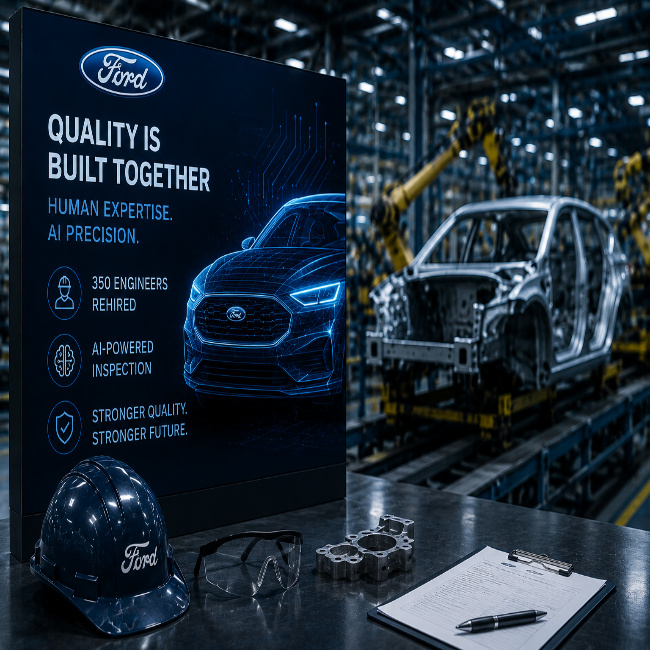
Ford Motor Company has rehired approximately 350 quality engineers after relying more heavily on artificial intelligence and automation exposed limitations in identifying manufacturing defects, highlighting the continued need for human expertise in modern production systems.
The move comes as manufacturers across industries accelerate AI adoption to improve efficiency, reduce costs and automate quality control. While AI has transformed production planning, predictive maintenance and visual inspection, Ford's latest decision underscores that human oversight remains essential for complex quality assurance processes.
According to reports, the company had previously reduced the number of quality engineers as it expanded the use of AI-enabled inspection systems and automated manufacturing processes. However, experience on production lines revealed that certain defects and quality issues continued to require human judgement, prompting Ford to restore hundreds of engineering roles.
The rehired employees will focus on vehicle quality inspections, manufacturing processes, issue identification and defect prevention across Ford's production operations. The company believes the combination of experienced engineers and AI-powered inspection systems will strengthen product quality while improving operational efficiency.
The development reflects a broader trend emerging across manufacturing industries, where companies are shifting from replacing workers with AI to building collaborative human and AI workflows. Rather than functioning as a substitute for experienced professionals, artificial intelligence is increasingly being positioned as a tool that supports faster decision-making, anomaly detection and predictive analysis.
Ford has been investing heavily in digital manufacturing technologies over the past several years, including AI-powered visual inspection systems, industrial automation, connected factories and advanced analytics. These technologies have helped manufacturers identify production issues earlier, reduce downtime and optimise assembly operations. However, experts note that AI models can still struggle with edge cases, unexpected variations and subjective quality assessments that experienced engineers identify through practical knowledge.
The decision is particularly relevant as automakers increase production of software-defined and electric vehicles, where manufacturing quality has become more complex. Modern vehicles combine mechanical engineering with sophisticated electronics, sensors, connectivity and software, increasing the number of variables that require quality monitoring during production.
Industry analysts say Ford's decision highlights an important shift in enterprise AI strategy. Companies are increasingly recognising that AI delivers the greatest value when combined with skilled human workers rather than deployed as a fully autonomous replacement. This approach is becoming common across sectors including manufacturing, healthcare, financial services and customer support, where AI assists professionals instead of eliminating critical roles.
The announcement also comes amid wider conversations about AI's impact on employment. While automation continues to reshape workforce requirements, many organisations are discovering that new technologies create demand for different skills rather than simply reducing headcount. Engineers, analysts and domain specialists are increasingly expected to work alongside AI systems, validating outputs and making complex operational decisions.
For manufacturers, product quality remains directly linked to customer trust, warranty costs and brand reputation. AI can rapidly process production data and identify patterns, but experienced engineers continue to play a central role in interpreting findings, investigating root causes and implementing corrective actions.
The development offers another example of how enterprises are refining their AI strategies after initial deployment. Rather than pursuing full automation, organisations are placing greater emphasis on balancing efficiency with reliability, particularly in business functions where quality and safety are critical.
As AI adoption continues across global manufacturing, Ford's decision suggests that the future of industrial operations will depend less on replacing human expertise and more on strengthening collaboration between intelligent systems and experienced professionals. The company's move reinforces the view that while AI can improve speed and consistency, human judgement remains indispensable for maintaining product quality in increasingly sophisticated manufacturing environments.
For the broader enterprise technology industry, the episode illustrates that successful AI adoption is increasingly measured not only by automation gains but also by how effectively organisations integrate technology with human expertise to deliver better business outcomes.