
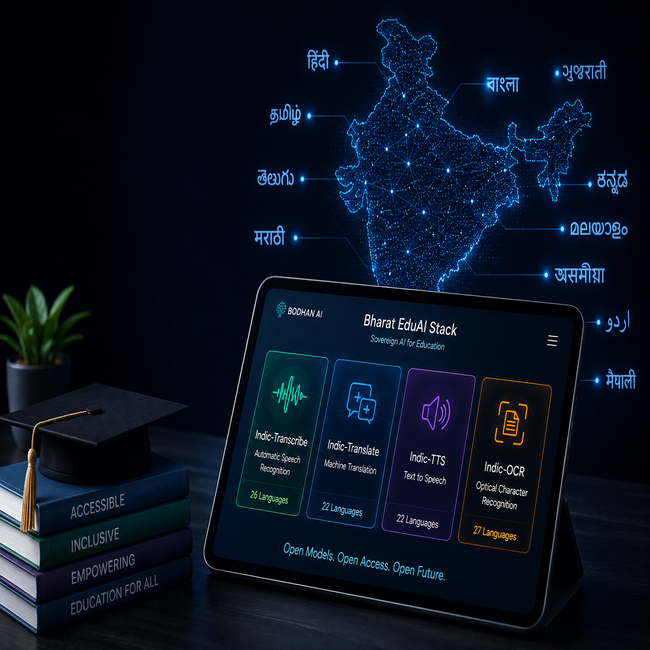

Bodhan AI, the Centre of Excellence in Artificial Intelligence for Education incubated at IIT Madras, has launched four foundational AI models for Indian languages, aimed at building a common technology layer for multilingual education applications in India.
Developed in partnership with AI4Bharat, the models cover automatic speech recognition, text-to-speech, machine translation and optical character recognition. They support between 22 and 27 Indian languages, depending on the model, and are being released as digital public goods through open-weight models and hosted application programming interfaces on sovereign digital infrastructure.
The initiative is designed to allow educational institutions, startups, researchers and developers to build multilingual AI applications without having to develop foundational language models independently.
The speech recognition model, Indic-Transcribe, supports 26 Indian languages and English and has been trained on 1.3 million hours of data. Bodhan AI said the model has been designed to work with diverse accents, code-mixed conversations and children's speech.
Indic-Translate, the machine translation model, supports translation between English and all 22 scheduled Indian languages in both directions. It can process documents of up to 32,000 tokens while retaining elements such as tables, equations, bullet points and document structure.
The other models address optical character recognition and speech generation, extending the technology stack across text, voice and document-based educational use cases.
Alongside the foundational models, Bodhan AI is developing applications for students and teachers. TutorBot is designed to provide students with curriculum-linked academic assistance through text and voice interactions, while Teacher Assistant Bot is intended to help educators prepare lesson plans, worksheets and assessments. AI-generated educational material remains subject to teacher review.
The models form part of the broader Bharat EduAI Stack, which Bodhan AI is developing as sovereign digital public infrastructure for education. The initiative is supported by the Ministry of Education and focuses on building AI systems that can be adopted and extended across public education systems.
The launch comes as India increases its focus on domestic AI infrastructure capable of supporting its linguistic diversity. For Bodhan AI, making the models open-weight creates a foundation that other organisations can build upon for education-focused applications, while retaining a focus on Indian languages and classroom use cases.
Disclaimer: This article may include information derived from interviews, press releases, public statements, research, company communications and other publicly available or third-party sources. Such material may be summarised, paraphrased or contextualised for journalistic and editorial purposes. All rights in third-party content remain with their respective owners.