
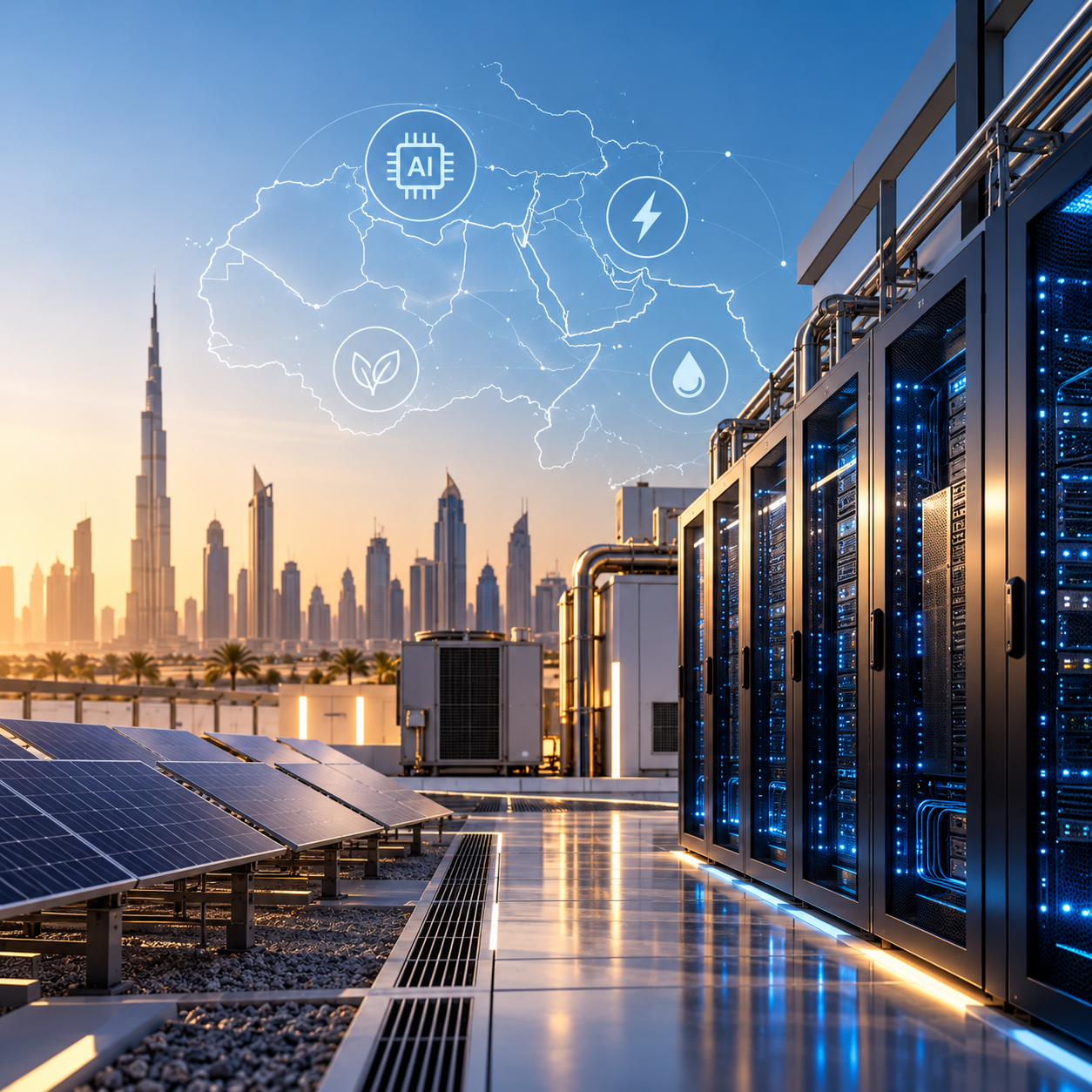

The World Economic Forum (WEF) has urged governments across the Middle East and North Africa (MENA) to classify artificial intelligence data centres as "critical dynamic loads" in electricity planning, citing rising power demand, water scarcity and extreme temperatures as challenges to the region's expanding AI infrastructure.
The recommendation calls for a different approach to managing AI-related electricity consumption, as data centres require significantly more power and cooling capacity than conventional computing facilities.
According to the WEF report, electricity capacity across MENA needs to increase by 40% by 2030 to meet projected requirements. However, current forecasts indicate growth of approximately 15%, creating a potential gap between available capacity and future demand.
The report highlights the difference in energy consumption between AI infrastructure and traditional computing systems. AI server racks typically require between 30 and 100 kilowatts of electricity, compared with 3 to 10 kilowatts for conventional web workloads.
Cooling requirements present another challenge. In MENA, cooling systems account for more than 40% of data centre electricity consumption, with high ambient temperatures and limited freshwater resources adding to operational costs.
To address these constraints, the WEF has recommended that governments distinguish AI data centres from conventional industrial and commercial electricity consumers when planning energy infrastructure.
The proposed classification would allow utilities and regulators to account for the scale and changing electricity requirements of AI computing facilities.
The report also recommends mandatory electricity-demand forecasts for large data centre developments. Projects exceeding 10 megawatts of IT load would be required to submit detailed projections when applying for grid connections.
Greater coordination between data centre developers, electricity providers, grid operators and regulators has also been proposed to improve infrastructure planning and reduce delays.
According to the report, on-site electricity generation, also known as behind-the-meter generation, could accelerate data centre deployment by 12 to 36 months by reducing dependence on conventional grid connections.
The WEF identified four areas for action: infrastructure design, integrated energy systems, cooling and water management, and regulatory planning.
Its recommendations include expanding solar energy installations supported by battery storage, adopting AI-based energy management systems and developing alternative electricity generation arrangements.
For cooling, the report suggests closed-loop systems and the use of treated wastewater to reduce pressure on freshwater supplies.
It also identifies small modular nuclear reactors and enhanced geothermal systems as possible longer-term energy sources, while acknowledging that commercial viability remains a limitation.
The WEF has additionally called for harmonised regulatory standards and greater cross-border cooperation to support infrastructure development and investment across the region.
The recommendations come as governments and technology companies expand AI computing capacity, increasing the importance of reliable electricity supplies and resource-efficient data centre operations.
The report positions coordinated energy planning, cooling infrastructure and regulation as central considerations for supporting AI data centre development across MENA.
Disclaimer: This article may include information derived from interviews, press releases, public statements, research, company communications and other publicly available or third-party sources. Such material may be summarised, paraphrased or contextualised for journalistic and editorial purposes. All rights in third-party content remain with their respective owners.