
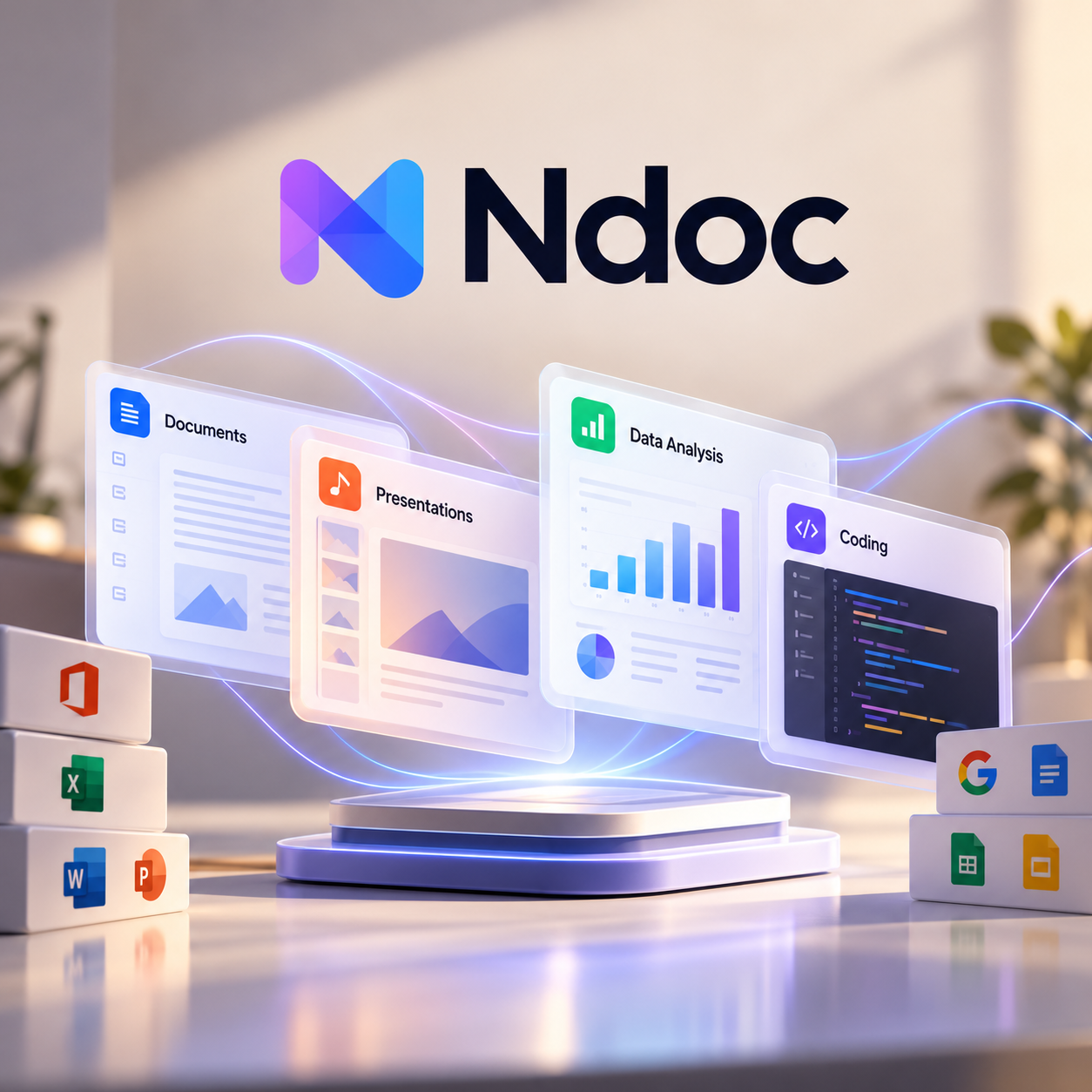

Former Meta AI Director Rohit Patel has launched Ndoc, an artificial intelligence-powered workplace productivity platform positioned as an alternative to Microsoft Office and Google Workspace. The startup aims to bring document creation, presentations, data analysis and coding into a single AI-native workspace.
Patel, who spent approximately eight years at Meta and most recently served as a director at Meta Superintelligence Labs, has left the company to develop the platform independently.
Unlike conventional productivity software that incorporates AI assistants into existing applications, Ndoc has been designed around AI-assisted workflows from the outset. The platform seeks to reduce the need for users to move between spreadsheets, presentation software, documents and separate AI chat interfaces.
Ndoc combines three components within one workspace: Stage, Narrative and Model. Stage supports presentations, dashboards, simulations and interactive applications, while Narrative provides written analysis, charts, citations and explanations. Model contains the underlying datasets and Python scripts used to produce the results.
The platform also allows users to examine the calculations behind AI-generated outputs. Its integrated AI assistant can explain Python scripts and identify formulas, enabling users without programming experience to review how results were produced.
Speaking to TechCrunch, Patel said, "There's nothing hidden behind the curtain here."
Users can upload datasets and ask Ndoc to conduct analyses, prepare reports and generate presentations. The system can also retain contextual information associated with individual users, documents, teams and organisations.
Patel has criticised the approach of adding AI features to conventional productivity applications without reconsidering their underlying structure.
"Companies are basically attaching AI to spreadsheets and it fills your cells for you," he told TechCrunch, describing the approach as insufficient for changing how workplace tasks are performed.
Ndoc also supports exporting work as a single .ndoc.html file that can be opened through a web browser. Patel plans to make the format open-source, allowing other developers to build compatible applications.
The startup is developing integrations to help users import information from existing workplace tools. According to Patel, Ndoc uses a combination of open-source AI models, which he believes can reduce operating costs compared with systems relying on more expensive models.
The company currently operates with a three-member team and has not raised external funding. Patel said he intends to establish customer demand before pursuing investment.
Ndoc is conducting an enterprise pilot and offering an alpha version to a limited number of users through a waiting list. Registration is free, while charges will be based on usage and tokens.
A beta release is expected in the coming weeks, with a broader launch planned for 2027.
The startup enters a market where Microsoft, Google and other technology companies are expanding AI capabilities across workplace productivity applications. Ndoc's proposed alternative remains at an early testing stage, with wider availability and commercial adoption yet to be established.
Disclaimer: This article may include information derived from interviews, press releases, public statements, research, company communications and other publicly available or third-party sources. Such material may be summarised, paraphrased or contextualised for journalistic and editorial purposes. All rights in third-party content remain with their respective owners.