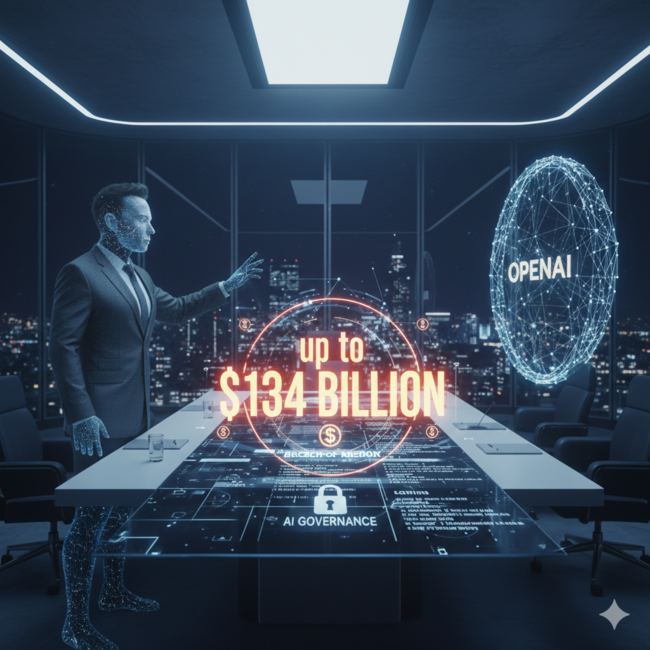

Elon Musk has escalated his legal battle with OpenAI by seeking damages that could reach as high as $134 billion, intensifying a dispute that has drawn attention across the global technology and artificial intelligence sectors. The lawsuit represents one of the most high profile legal confrontations involving the governance and commercial direction of a leading AI organisation.
Musk, who co founded OpenAI in its early years, has argued that the organisation has departed from its original mission of developing artificial intelligence for the benefit of humanity. The damages claim is notable not only for its size but also for the broader implications it raises around control, accountability, and transparency in AI development.
The lawsuit comes despite Musk’s personal fortune being estimated at around $700 billion, underscoring that the case is less about personal financial gain and more about principle, influence, and precedent. Legal experts note that such a high damages figure is unusual but strategically significant.
OpenAI was originally established as a nonprofit research organisation with a mission to advance AI responsibly. Over time, it adopted a capped profit structure and entered commercial partnerships that enabled rapid scaling. This evolution has sparked debate about whether the organisation has drifted from its founding values.
Musk has been vocal in his criticism of OpenAI’s current trajectory, particularly its close ties with major technology partners and its growing commercial ambitions. The lawsuit seeks to challenge what Musk describes as a fundamental breach of the organisation’s original commitments.
From OpenAI’s perspective, the transition toward commercialisation has been framed as necessary to fund increasingly expensive research and infrastructure. Training and deploying advanced AI models requires substantial capital, and revenue generating partnerships are seen as a practical solution.
The legal dispute highlights a broader tension within the AI industry. Many organisations face pressure to balance ethical considerations with financial sustainability. As AI capabilities advance, the cost of development continues to rise, forcing difficult choices.
The case also raises questions about governance structures in AI organisations. Unlike traditional startups, AI companies often begin with public interest missions that later intersect with private capital. Managing this transition without undermining trust is a growing challenge.
For the martech and enterprise technology ecosystem, the lawsuit serves as a reminder that AI innovation does not exist in a vacuum. Legal and governance frameworks shape how technology is developed, deployed, and monetised.
Industry observers note that the outcome of the case could influence how future AI ventures are structured. Clearer boundaries between nonprofit missions and commercial operations may become more important.
The damages figure sought by Musk is likely intended to reflect the perceived value created by OpenAI’s technologies and the scale of its commercial success. Whether courts will view this figure as realistic remains uncertain.
Legal proceedings of this nature are often lengthy and complex. The case is expected to involve detailed examination of founding agreements, governance decisions, and public statements made over several years.
The dispute also reflects Musk’s broader engagement with AI policy and safety debates. He has consistently warned about the risks of unchecked AI development and has advocated for stronger oversight.
At the same time, Musk is involved in other AI ventures, adding layers of complexity to public perception. Critics argue that competitive dynamics may influence his stance, while supporters view his actions as principled.
OpenAI has maintained that its decisions align with its mission to ensure AI benefits society. The organisation has emphasised its commitment to safety research and responsible deployment.
The lawsuit has sparked discussion among regulators and policymakers. As AI becomes more influential, disputes over governance may prompt calls for clearer regulatory standards.
For businesses that rely on AI tools, the case introduces uncertainty. Legal battles can affect strategy, partnerships, and long term planning.
From a market perspective, the dispute underscores the growing economic significance of AI. The size of the damages claim reflects how central AI technologies have become to modern digital economies.
The case also highlights the personal dimension of technology leadership. Founders often carry strong visions, and disagreements over direction can escalate when stakes are high.
Public reaction has been mixed. Some view the lawsuit as a necessary challenge to corporate consolidation in AI, while others see it as a distraction from innovation.
Regardless of outcome, the legal battle draws attention to unresolved questions about who should control powerful AI systems and under what conditions.
For martech professionals, the case reinforces the importance of understanding the governance of platforms that increasingly influence marketing, data, and communication.
As AI tools become embedded in everyday business processes, trust in their stewardship becomes critical. Legal disputes can shape that trust.
The lawsuit also serves as a signal to investors. Governance disputes can affect valuation and risk perception in AI companies.
While the damages figure is striking, legal experts caution that courts often focus on contractual obligations rather than symbolic numbers.
The case may ultimately be settled or narrowed, but its broader impact will persist. It highlights the need for clear frameworks in AI development.
As AI continues to evolve, conflicts between vision, profit, and responsibility are likely to intensify.
Musk’s lawsuit against OpenAI is emblematic of this tension. It places questions of mission and control at the centre of a rapidly advancing industry.
The outcome will be closely watched by founders, investors, regulators, and users alike. It may help define norms for the next generation of AI organisations.
Related Articles