

industry-trends News
COBOL and Generative AI: Why Legacy Code Is Back in the Spotlight
" A blog linked to Anthropic’s Claude AI revived debate around COBOL, triggering market volatility and impacting IBM’s valuation. "
- by Martech Desk
- Feb 26, 2026
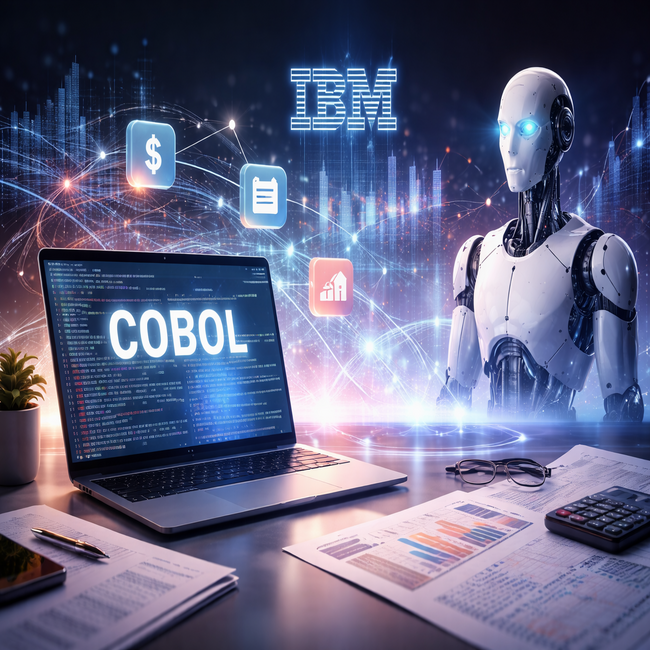
A recent blog post linked to Anthropic’s Claude AI has brought renewed attention to COBOL, the decades old programming language that continues to power critical global systems. The discussion triggered sharp market reactions, reportedly wiping nearly $30 billion off IBM’s market value in a single trading session, as investors reassessed the future of legacy enterprise technology in the age of generative artificial intelligence.
COBOL, short for Common Business Oriented Language, was developed in 1959 to process large volumes of financial and administrative data. Despite being more than six decades old, it remains deeply embedded in banking, insurance, government and airline systems worldwide. Industry estimates suggest that billions of lines of COBOL code are still in active use, handling transactions worth trillions of dollars each day.
The renewed spotlight came after a blog post associated with Anthropic’s Claude model discussed the relevance of COBOL in the context of modern AI tools. The post reportedly explored how large language models can interpret, generate and even help modernise legacy codebases. However, the tone and framing of the piece led to investor anxiety over whether traditional enterprise technology providers could face disruption from AI driven code automation.
IBM, which has long been associated with mainframe computing and COBOL based enterprise systems, saw its shares decline sharply following the circulation of the post. Market analysts attributed the reaction to concerns that generative AI tools may reduce the reliance on legacy systems or diminish the value of specialised enterprise services tied to older programming environments.
COBOL has historically been criticised for its dated syntax and shrinking developer base. Many universities no longer prioritise it in their curriculum, leading to a talent gap as experienced programmers retire. However, enterprises have struggled to replace COBOL systems because they remain stable, secure and deeply integrated into core operations. Rewriting these systems from scratch can take years and cost billions of dollars, often introducing operational risks.
In recent years, the conversation around COBOL has shifted from replacement to modernisation. Technology vendors, including IBM, have promoted hybrid approaches that allow legacy code to run alongside cloud native applications. The rise of artificial intelligence has added a new dimension to this strategy. Large language models trained on programming languages can assist developers in understanding complex codebases, documenting them and suggesting updates.
The Anthropic Claude related blog post reportedly highlighted how AI systems can interpret COBOL code and translate it into more contemporary languages. While such capabilities are still evolving, they have sparked debate over whether AI could accelerate migration away from mainframe dependent infrastructure. For investors, this raised questions about the long term revenue streams of companies that maintain and service these legacy environments.
Market volatility around technology stocks is not uncommon when new AI developments emerge. Over the past two years, generative AI announcements have influenced valuations across software, semiconductor and cloud computing sectors. The IBM episode underscores how even discussions around legacy programming languages can have financial consequences when framed within the broader AI narrative.
Industry experts caution that replacing COBOL is not as straightforward as generating new code through AI. Large enterprises operate under strict regulatory and compliance requirements, particularly in banking and public sector domains. Any system migration must undergo rigorous testing and validation. AI tools can assist in documentation and analysis, but human oversight remains essential.
IBM has invested heavily in integrating AI into its own enterprise offerings. The company has positioned itself as a provider of hybrid cloud and AI driven solutions, seeking to modernise mainframe capabilities rather than abandon them. Analysts note that mainframes continue to process a significant share of global financial transactions, making them critical infrastructure rather than obsolete technology.
The broader debate reflects a tension between innovation and operational continuity. Generative AI promises faster development cycles and code transformation at scale. At the same time, mission critical systems cannot be disrupted without careful planning. For many organisations, the likely path forward involves incremental modernisation supported by AI tools rather than wholesale replacement.
The incident also illustrates how public discourse around AI can influence investor sentiment. A single blog post discussing the intersection of generative AI and legacy programming was enough to trigger significant market reaction. This highlights the sensitivity of technology valuations to narratives about disruption and transformation.
For the martech and enterprise technology ecosystem, the episode serves as a reminder that foundational systems still underpin much of the digital economy. While AI is reshaping software development and automation, the transition from legacy infrastructure will be gradual. Companies operating in this space are expected to balance innovation with reliability, ensuring that critical systems remain functional even as new tools are adopted.
As generative AI platforms continue to evolve, their ability to interpret and assist with older programming languages will likely improve. Whether this leads to accelerated modernisation or strengthens the case for hybrid architectures remains to be seen. What is clear is that legacy technologies such as COBOL are not disappearing overnight. Instead, they are being re examined through the lens of artificial intelligence, prompting both strategic reassessment and market volatility.
The recent reaction around IBM reflects this evolving dynamic. While short term market movements can be influenced by perception, long term technology transitions tend to unfold over extended periods. For now, COBOL remains a critical component of global enterprise infrastructure, even as AI tools begin to reshape how it is understood and maintained.