

industry-trends News
Alibaba Unveils New AI Chip as Competition with Nvidia Intensifies
" Alibaba has launched a new AI chip aimed at strengthening its AI infrastructure and competing with Nvidia in the fast-growing AI market. "
- by Martech Desk
- May 21, 2026
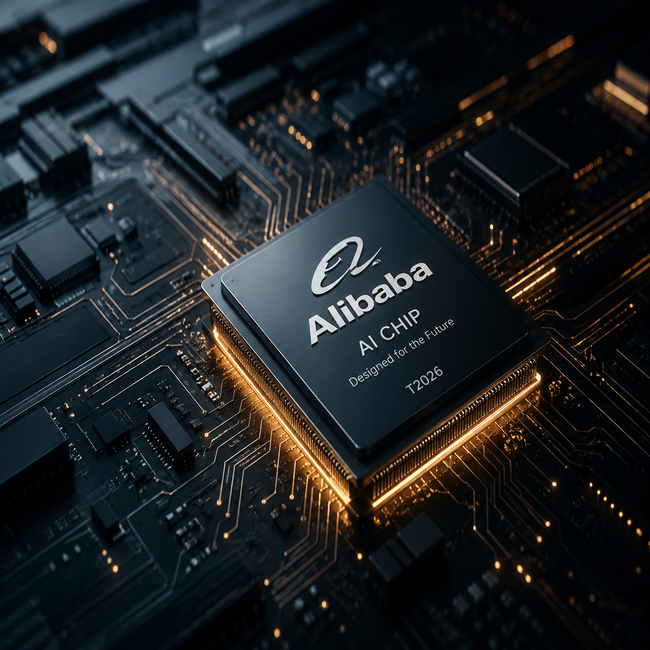
Alibaba has unveiled a new artificial intelligence chip as the Chinese technology company intensifies efforts to strengthen its AI infrastructure and reduce dependence on external semiconductor providers amid rising global competition in the AI hardware market.
The company introduced the processor through its cloud computing division, Alibaba Cloud, positioning it as part of a broader strategy to support large language models, AI training workloads, and enterprise cloud services. The launch comes as technology firms worldwide increase investments in AI infrastructure to meet growing demand for generative AI applications.
Alibaba said the chip has been designed to improve computing performance for AI-related tasks including model training, inference, and data processing. The processor is expected to support the company’s cloud ecosystem and AI-powered services across enterprise and consumer applications.
The move places Alibaba in more direct competition with Nvidia, which currently dominates the global AI chip market through its graphics processing units widely used for training advanced AI systems. Demand for Nvidia’s chips has surged significantly over the past two years due to the rapid adoption of generative AI technologies.
Industry analysts believe Alibaba’s latest chip reflects the increasing importance of developing domestic AI infrastructure capabilities, particularly as technology companies seek greater control over computing resources and supply chains. Chinese technology firms have been accelerating semiconductor development amid ongoing geopolitical and trade-related restrictions affecting access to advanced chips.
Alibaba has been expanding its AI investments across cloud services, large language models, and enterprise AI tools. The company previously introduced its Tongyi Qianwen AI model family and has continued integrating AI features into its e-commerce, cloud, and productivity ecosystems.
The launch also highlights the growing convergence between cloud computing and artificial intelligence. Technology companies are increasingly building proprietary hardware to optimise AI workloads, improve efficiency, and reduce operating costs associated with large-scale model deployment.
Global competition within the AI semiconductor industry has intensified as companies race to secure computing capacity required for training increasingly sophisticated AI systems. In addition to Nvidia, firms including AMD, Intel, Google, Amazon, and Microsoft are investing heavily in AI-focused hardware and infrastructure development.
Industry experts say AI chips are becoming a strategic asset for technology companies as generative AI adoption expands across industries including marketing, healthcare, finance, retail, and software development. The ability to control both software and hardware ecosystems is increasingly viewed as a competitive advantage.
Alibaba Cloud remains one of China’s largest cloud computing providers and has been positioning AI services as a major growth area for its business. The company is expected to use the new chip to strengthen enterprise offerings and improve AI processing capabilities for customers using its cloud infrastructure.
The broader AI hardware race has also triggered increased investments in semiconductor manufacturing, data centres, and energy-efficient computing systems globally. Companies are under pressure to build scalable infrastructure capable of supporting rising AI workloads and commercial deployment demands.
Analysts believe Alibaba’s latest move reflects how Chinese technology firms are prioritising self-reliance in critical technology sectors including AI chips and cloud infrastructure. Domestic AI hardware development has become increasingly important as global competition over advanced semiconductor technologies intensifies.
While Alibaba has not disclosed detailed benchmark comparisons against competing chips, the announcement signals the company’s continued commitment to expanding its AI ecosystem and cloud computing capabilities.
The development comes as AI infrastructure spending continues to rise globally, with companies across the technology sector investing heavily in processors, data centres, and AI platforms to support the next phase of generative AI growth and enterprise adoption.