

For years, smart glasses have lived in a familiar cycle inside enterprise technology. A promising pilot in a warehouse, a successful test in field service, a controlled rollout in manufacturing, followed by hesitation when it comes to scaling. The barriers were consistent. Devices were uncomfortable, software ecosystems were fragmented, and the return on investment was not always predictable across roles.
In 2026, that cycle is shifting. Not because hardware has suddenly become perfect, but because artificial intelligence is changing how these devices are used and evaluated.
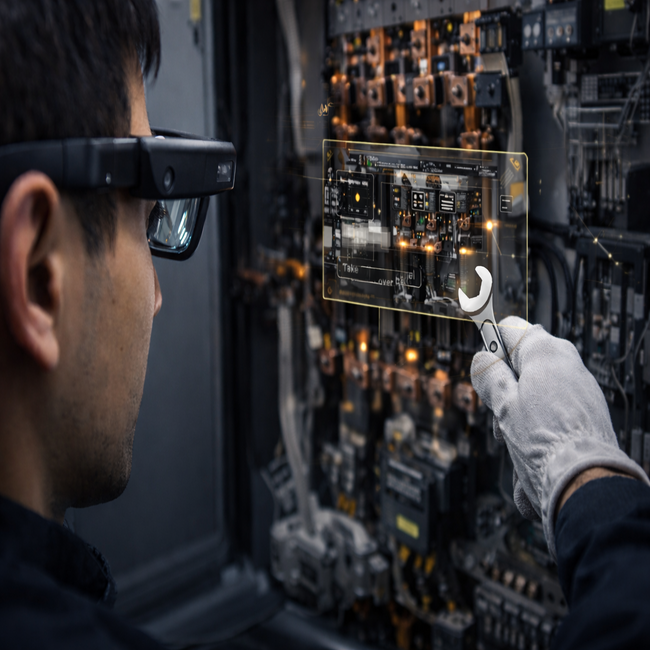
The current generation of AI smart glasses is not positioned as a futuristic augmented reality device. It is being positioned as a practical interface for work. Voice, vision, and contextual intelligence are being combined to support workers in real time, without requiring them to stop, switch devices, or navigate complex systems. The core proposition is simple. In environments where work happens on the move, with tools, safety equipment, or time pressure, traditional screens are inefficient. Smart glasses aim to bring instructions, support, and documentation directly into the line of sight.
The shift is not universal. It is specific. Evidence from deployments and market data suggests that AI smart glasses are becoming viable productivity tools in roles where hands-free access, visual validation, and immediate expert guidance are essential.
Recent data signals show why this conversation has returned with more urgency.
The global extended reality market rebounded strongly in 2025, with shipments growing by over 44 percent year on year, driven largely by smart glasses rather than traditional VR headsets. Growth is expected to continue in 2026, with projections pointing to more than 30 percent expansion, and a longer-term trajectory suggesting sustained adoption across enterprise use cases.
Shipment trends reinforce this shift. Smart glasses shipments grew by over 130 percent in the second half of 2025, with AI-enabled devices accounting for the majority of that growth. This indicates that demand is not just for wearable displays, but for intelligent systems that can interpret context and assist users in real time.
Procurement behaviour is also evolving. Vendors have begun reporting follow-on orders and expansion deployments rather than one-off pilots. In one instance, a large retail enterprise expanded its deployment of smart glasses across multiple regions after initial testing, indicating that the value proposition can hold beyond controlled environments.
More importantly, productivity outcomes are becoming measurable. Case studies from enterprise deployments show significant improvements in operational efficiency. In one automotive service deployment, repair efficiency improved by over 90 percent when technicians used smart glasses combined with remote expert support. In another deployment across service centres, repair times were reduced by up to 75 percent.
Pricing is also stabilising, which is often a sign of category maturity. Enterprise-grade smart glasses are now typically priced in the range of $2,000 to $2,500 per device, allowing organisations to model cost against measurable productivity gains rather than treating the technology as experimental.
Taken together, these signals suggest that smart glasses are moving from curiosity to consideration in B2B environments.
The meaning of “AI smart glasses” in enterprise productivity is also becoming clearer. The distinction is no longer between augmented reality and virtual reality. It is between immersive devices and assisted reality tools. Most deployments that scale focus on lightweight, work-oriented devices that provide audio, camera, and minimal display capabilities rather than immersive overlays.
In practice, a smart glasses deployment is not just a device. It is a system. It typically includes a collaboration layer for remote support, a knowledge layer for step-by-step guidance, a workflow layer connected to enterprise systems, and a governance layer that controls access and data usage.
This is where AI changes the experience. Earlier devices relied on menus or rigid voice commands. AI allows more natural interaction. Workers can ask questions, receive contextual prompts, and even get assistance based on what the device camera captures. The interface becomes conversational rather than procedural.
Dr Chris Parkinson, President of Enterprise Solutions at Vuzix, explained this shift, saying, “With Vuzix Solutions, we are removing complexity from that initial rollout and creating a fast, predictable path to value.”
This focus on reducing deployment complexity reflects a key lesson from earlier failures. The hardware was not the only barrier. Integration and usability were equally critical.
The most successful deployments are concentrated in specific workflows.
The first is remote expert support. In industries such as automotive, manufacturing, and utilities, delays often occur because expertise is not immediately available on site. Smart glasses enable real-time visual collaboration, allowing experts to guide technicians remotely.
Paul Anderson, Service Operations Manager at Volkswagen Commercial Vehicles, described the experience, saying, “It is as close as possible to the agent being in the centre.”
This ability to reduce wait time and eliminate unnecessary travel has a direct impact on operational efficiency.
The second major use case is warehouse and logistics operations. These environments involve repetitive tasks where small inefficiencies accumulate over time. Smart glasses can combine voice commands with visual confirmation, enabling faster picking, scanning, and verification.
Paul Travers, CEO of Vuzix, noted, “Supply chain customers are looking for alternatives to their traditional pick-by-voice options.”
The shift here is not dramatic innovation, but incremental improvement at scale. Reducing seconds per task can translate into significant gains across shifts and facilities.
The third use case is inspection and compliance. Many industries require visual checks and documentation for safety and regulatory reasons. Smart glasses allow workers to capture images, annotate findings, and update records without interrupting their workflow.
AI enhances this further by enabling visual recognition and summarisation. It can guide users through checklists, flag anomalies, and generate structured reports automatically.
Despite these advantages, adoption challenges remain.
One of the most persistent issues is knowledge quality. Smart glasses rely on accurate, structured information. If underlying documentation is outdated or inconsistent, the device becomes less useful. AI does not solve this problem. It can amplify it.
Another challenge is workflow integration. A device that provides guidance but cannot update systems creates additional work rather than reducing it. Enterprises are increasingly focusing on end-to-end integration to ensure that actions taken through the device are reflected in core systems.
Governance is also a critical concern. Smart glasses often include cameras and recording capabilities, which raises questions about privacy and data usage. Organisations must establish clear policies to ensure worker trust and compliance.
Cost remains a factor, but it is now evaluated differently. Instead of focusing only on device price, organisations are measuring return on investment in terms of time saved, errors reduced, travel avoided, and training efficiency improved.
Ziad Asghar, Senior Vice President at Qualcomm Technologies, highlighted the broader industry view, saying, “We are a strong believer in the smart glasses segment for enterprise.”
This confidence is based not on novelty, but on practical use cases where the technology addresses real constraints.
The key learning from recent deployments is that success depends on targeting the right workflows. Smart glasses are not a general-purpose productivity tool. They are most effective in environments where hands-free operation, real-time guidance, and visual context are essential.
This also explains why earlier attempts struggled. Organisations often tried to apply the technology broadly rather than focusing on high-friction, high-value tasks.
In 2026, the narrative is more grounded. Smart glasses are being treated as part of a workflow system rather than a standalone device. AI enhances their value by making interaction more natural and context-aware, but it does not eliminate the need for strong underlying processes.
The broader question is whether smart glasses represent the next major enterprise device.
The answer appears to be conditional.
Smart glasses are unlikely to replace smartphones or laptops across the workforce. However, they are becoming a credible “next interface” for specific roles where traditional devices are inefficient.
The market data supports this view. Growth is being driven by smart glasses rather than immersive headsets. AI-enabled devices are dominating shipments. Vendors are reporting expansion beyond pilot programmes. And enterprise case studies are demonstrating measurable productivity gains.
At the same time, adoption remains selective. The technology works best when it aligns with the nature of the work.
The practical takeaway for B2B leaders is clear. Smart glasses should not be evaluated as a general innovation initiative. They should be assessed as a targeted productivity tool for specific workflows.
When implemented correctly, they can reduce friction at the point of work, improve speed and accuracy, and enable better collaboration. When implemented without integration and governance, they risk becoming another underused device.
The role of AI is to make the interface more usable and responsive. It allows workers to interact with systems more naturally and reduces the cognitive load of navigating complex processes.
In 2026, the future of smart glasses in enterprise is not about widespread adoption. It is about precise deployment. The most realistic scenario is not that everyone will wear smart glasses. It is that the right roles will use them, supported by AI, to work more efficiently and with fewer interruptions.
In that context, smart glasses are not replacing existing devices. They are filling a gap that those devices were never designed to address. And that is where their productivity value is beginning to hold.
Disclaimer: All data points and statistics are attributed to published research studies and verified market research.