
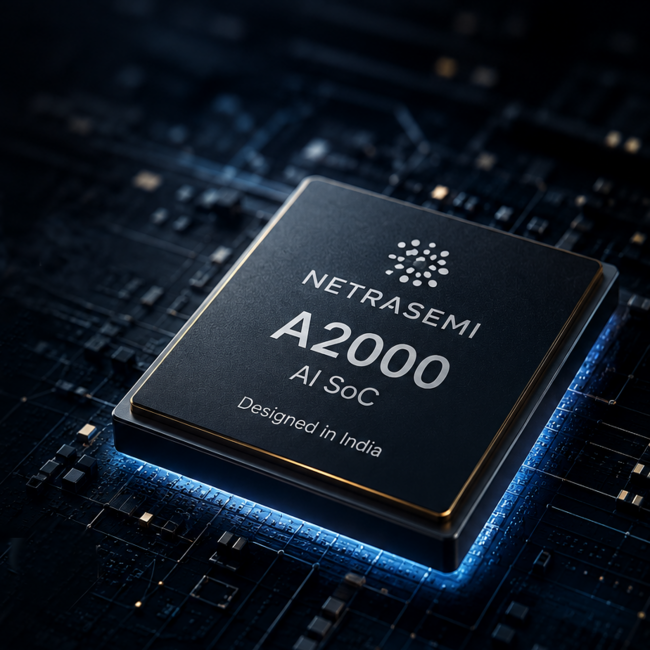

Zoho-backed semiconductor startup Netrasemi has launched its first artificial intelligence chip, A2000, and has begun customer trials, marking a step forward for India’s emerging AI hardware ecosystem.
The Kerala-based fabless chip company said the A2000 system-on-chip has completed testing and is now production-ready. The chip is designed for edge AI devices, where data is processed locally rather than being sent to cloud servers. Early customer trials are underway in sectors such as surveillance and automotive technology, where real-time processing, low latency and power efficiency are critical.
Netrasemi is backed by Zoho Corporation and Unicorn India Ventures, which led its Rs 107 crore Series A funding round last year. The funding was aimed at scaling research and development, strengthening manufacturing and marketing capabilities, and bringing multiple system-on-chip variants into production. The company has been building chips for intelligent computing in smart IoT devices, with use cases spanning video analytics, smart cameras, industrial automation, robotics and connected infrastructure.
The A2000 has been designed in India and is being fabricated using Taiwan Semiconductor Manufacturing Company’s 12 nanometre process. The company expects commercial production to begin by mid-2027, subject to the outcome of customer trials and market validation. According to reports, the chip is among the first AI and machine learning-focused system-on-chips designed by an Indian startup for edge applications.
Edge AI has become a key area of interest as businesses look to reduce dependence on cloud-based computing for time-sensitive applications. By processing data on the device, edge AI chips can help improve response times, lower bandwidth use and support better data privacy. These capabilities are particularly relevant for surveillance cameras, automotive systems, industrial equipment and smart city infrastructure.
For India’s technology sector, the development comes at a time when semiconductor design and domestic chip capabilities are receiving greater policy and investor attention. The government has been pushing semiconductor manufacturing, chip design and electronics self-reliance through incentive schemes and industry partnerships. Startups such as Netrasemi are seeking to address gaps in specialised chips for AI-led applications, even as large-scale semiconductor fabrication remains capital intensive and globally competitive.
Founded in 2020 by Jyothis Indirabhai, Sreejith Varma and Deepa Geetha, Netrasemi operates as a fabless semiconductor company, focusing on chip design while relying on global foundry partners for manufacturing. The company has described its focus as building intelligent system-on-chips and chiplet-based architectures for edge computing. Its platforms are aimed at enabling real-time AI-driven decisions at the device level.
The launch also reflects the growing role of Indian enterprise technology companies in supporting deeptech startups. Zoho’s backing of Netrasemi is significant at a time when Indian software and SaaS firms are exploring opportunities in hardware, AI infrastructure and local technology supply chains. The investment gives Netrasemi financial support as it moves from chip design and prototyping to customer testing and commercial readiness.
Industry observers believe edge AI chips could see rising demand as enterprises adopt more connected devices across factories, transport systems, retail spaces and public infrastructure. However, commercial success will depend on performance, cost competitiveness, supply reliability and the ability to meet sector-specific requirements.
Netrasemi’s customer trials will be closely watched by India’s semiconductor and AI ecosystem. If the A2000 moves successfully into commercial production, it could strengthen India’s position in AI chip design and offer a domestic option for companies building intelligent edge devices.
The milestone also adds momentum to the country’s broader ambition to participate more actively in the global semiconductor value chain. While India continues to depend on overseas foundries for advanced manufacturing, design-led startups are beginning to build intellectual property that can serve domestic as well as international markets over time too.