
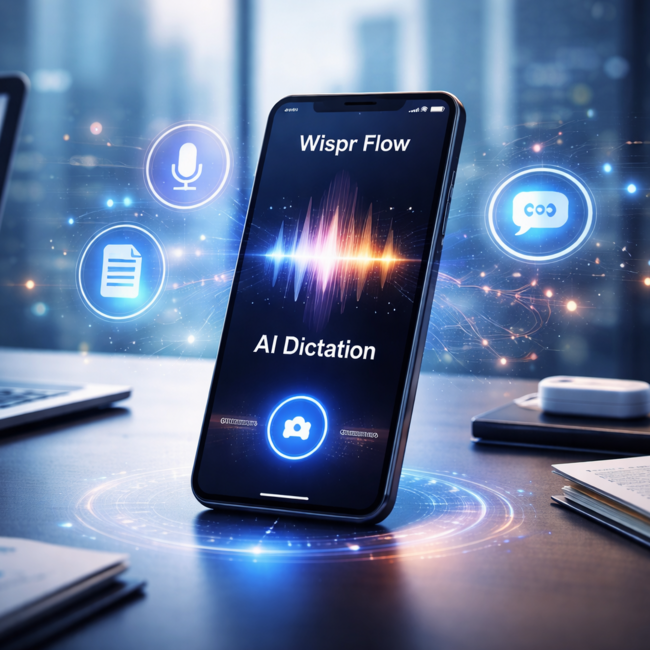

Voice productivity startup Wispr Flow has launched its Android application, extending its AI-powered dictation tool to a broader mobile user base. The move marks a significant step in the company’s expansion strategy as it seeks to compete in the growing market for voice-driven productivity software.
Wispr Flow initially gained attention for its desktop-based dictation solution, which uses artificial intelligence to convert spoken language into structured written text. The Android launch allows users to access the tool directly from their smartphones, reflecting increasing demand for mobile-first productivity solutions.
The app is designed to transcribe speech in real time while adapting to individual speaking patterns. By leveraging advanced language models, Wispr Flow aims to provide context-aware transcription that captures not only words but also punctuation and formatting. This reduces the need for manual editing after dictation.
Voice-based input systems have become increasingly relevant as generative AI tools reshape workflows. Professionals across sectors are seeking faster ways to draft emails, documents, and notes. AI-powered dictation tools address this demand by offering hands-free content creation, particularly useful in mobile environments.
Wispr Flow’s Android app integrates with various applications, enabling users to dictate text across messaging platforms, email clients, and document editors. Such cross-platform compatibility is critical in a fragmented mobile ecosystem where users rely on multiple productivity tools.
Industry analysts note that the dictation software market has evolved from basic speech-to-text utilities to AI-enhanced systems capable of contextual refinement. Traditional voice recognition tools often struggled with accents, background noise, and natural speech flow. Advances in machine learning have significantly improved accuracy and adaptability.
The Android rollout positions Wispr Flow in direct competition with established technology firms that offer voice assistants and transcription features embedded within operating systems. However, the company differentiates itself by focusing specifically on productivity and document-quality outputs rather than general voice assistance.
The app reportedly supports continuous dictation, enabling users to speak naturally without pausing for command cues. AI processing refines sentence structure and grammar, delivering polished drafts that require minimal correction. This capability may appeal to professionals who prioritise efficiency.
Mobile productivity tools have seen rising adoption as remote and hybrid work models persist. Employees and entrepreneurs often draft communications on smartphones, increasing demand for reliable voice input systems. AI-driven dictation reduces typing time and may enhance accessibility for users with mobility challenges.
Wispr Flow’s expansion into Android reflects the platform’s global scale. Android devices account for a substantial share of smartphone usage worldwide, particularly in emerging markets. By entering this ecosystem, the company can potentially tap into a larger and more diverse user base.
The launch also highlights broader trends in AI application development. Startups are increasingly targeting niche productivity segments rather than building general-purpose chatbots. Focused use cases such as dictation, summarisation, and workflow automation are gaining traction.
Security and privacy considerations remain central to voice technology adoption. Dictation apps process spoken content that may contain sensitive information. Companies operating in this space must ensure encryption standards and transparent data policies to build user trust.
Wispr Flow’s Android app is expected to offer subscription-based access, aligning with the software-as-a-service model prevalent in AI productivity tools. Tiered pricing structures may differentiate between individual users and enterprise customers.
Market observers suggest that voice-driven tools could become more embedded in everyday workflows as AI accuracy improves. Real-time correction and contextual understanding reduce friction, making speech a viable alternative to typing for longer content formats.
The competitive landscape for AI dictation includes both startup innovators and major platform providers. Success may depend on accuracy benchmarks, user experience design, and seamless integration with existing applications.
Wispr Flow’s emphasis on document-ready outputs could provide an advantage in professional settings where clarity and structure are critical. Unlike basic transcription services, AI-enhanced dictation can interpret intent and refine phrasing.
As generative AI continues to influence productivity software, specialised tools are carving out dedicated user communities. Dictation technology may see renewed interest among content creators, journalists, executives, and students seeking faster drafting methods.
The Android launch signals Wispr Flow’s ambition to scale beyond its initial desktop audience. Expanding into mobile platforms broadens accessibility while responding to changing work patterns.
While it remains to be seen how the app performs in competitive app stores, the move underscores sustained investor and developer confidence in AI-powered voice tools. Adoption metrics and user reviews will likely shape subsequent updates.
Wispr Flow’s entry into Android represents another milestone in the evolution of AI productivity solutions. As speech recognition technology matures, mobile dictation tools may become standard features within digital workflows.
The company’s focus on refining natural language input reflects a wider industry shift toward intuitive human-computer interaction. By enabling users to speak and instantly generate structured text, Wispr Flow contributes to ongoing transformation in how content is created and shared.