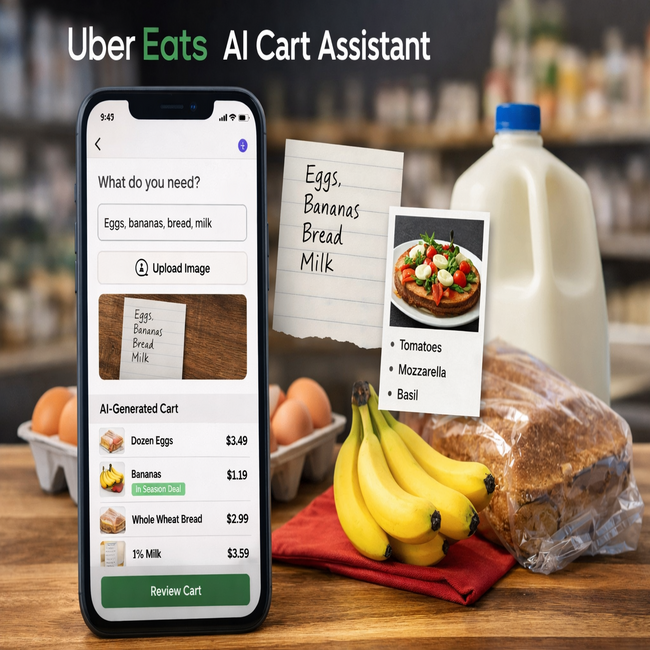

Uber Eats has introduced a new artificial intelligence-powered feature designed to streamline grocery shopping and reduce the effort involved in selecting items before checkout.
The feature, called Cart Assistant, is now available in beta within the Uber Eats app in the United States. It allows users to generate a draft grocery cart from simple text instructions or images such as photos of handwritten lists or screenshots of recipe ingredients. The tool is intended to cut through the repetitive tasks associated with online grocery shopping and offer a faster route from planning to purchase.
To use the feature, customers open the Uber Eats app and search for a participating grocery store. A purple Cart Assistant icon appears on the store’s page. Tapping the icon launches the assistant, which then prompts users to enter their shopping needs either by typing out a list or by uploading an image of the list. The AI analyses the input and populates a grocery cart with relevant items from that store’s inventory.
Cart Assistant automatically takes store availability into account, showing details such as item prices and any applicable promotions. After the initial draft cart is created, users retain full control to modify their basket by adding, removing or swapping items according to preference.
Uber Eats said the assistant also builds on prior order history to prioritise familiar products. For instance, if a customer consistently orders a particular brand of milk or favourite type of oatmeal, the Cart Assistant may include those first in the generated list in future sessions. This personalisation is designed to reduce time spent searching for repeat items and make weekly or routine shopping trips more efficient.
In a statement, Praveen Neppalli Naga, chief technology officer at Uber, said the company built the Cart Assistant in response to user feedback seeking a quicker way to shop. He noted that saving time on routine tasks was “a real customer need,” and Uber aimed to start with practical solutions within the app. Uber also described the launch as an early step in applying what it calls agentic AI, a type of AI capable of carrying out multi-step tasks and helping to execute user-defined actions.
The rollout currently includes dozens of grocery retailers across the United States, such as Albertsons, Aldi, CVS, Kroger, Safeway, Sprouts, Walgreens and Wegmans. Uber Eats said more retailers will be added over time, and future enhancements to the Cart Assistant are planned, including features like full recipe inspiration, personalised meal plans and the ability to answer follow-up questions from users.
The launch signals Uber Eats’ broader push into artificial intelligence across its consumer platforms. Over the past year, the company has introduced several AI-driven tools within its apps, including AI-generated menu descriptions, AI-enhanced food images, automated summaries of restaurant reviews and integration with conversational AI systems. Last year, Uber Eats and rival delivery platforms integrated with external AI services to streamline various aspects of meal ordering, indicating a competitive trend towards embedding AI more deeply into everyday tasks.
Industry analysts view the move as part of an ongoing effort by delivery companies to retain and grow their user base as competition intensifies in the online grocery and retail delivery markets. With consumer demand for convenience rising, firms like Uber Eats are investing in technologies that can shorten and simplify digital shopping journeys. Competitors, including major grocery-focused services, have also deployed AI tools aimed at improving search, recommendations and cart creation within their own platforms.
The emergence of AI tools like Cart Assistant comes at a time when many consumers are already using mobile apps to manage regular grocery shopping. The added ability to transform handwritten lists or recipe screenshots into digital carts could appeal to users who find typing out lists or navigating inventory menus manually to be time-consuming. Proponents of the technology say such features can reduce friction that might otherwise deter users from completing purchases.
However, the tool is not without limitations. Since the Cart Assistant is currently in beta, users may experience occasional inaccuracies, especially when interpreting handwritten notes or recognising specific ingredient types. Uber has advised customers to review the assistant’s suggestions carefully and adjust as needed before placing an order. The company emphasised that the feature is primarily designed to assist and expedite shopping but not to fully replace user oversight.
The use of AI in consumer apps continues to expand, and the introduction of features like Cart Assistant highlights the evolving role of generative and agentic technologies in everyday commerce. While initial adoption in the United States focuses on grocery retail, experts suggest similar capabilities could eventually be applied to broader categories of digital shopping and lifestyle services.
Uber Eats’ latest innovation reflects how technology companies are seeking to embed more intelligent assistance within routine tasks, bridging the gap between planning and execution. For users, the new Cart Assistant could offer measurable convenience, though its long-term success will depend on accuracy, usability and the breadth of retail partners that adopt the technology in coming months.
Related Articles