

ai News
Telangana Farmers Save Up to $560 Using AI Weather Forecasts: World Bank
" AI-powered weather forecasts helped some Telangana farmers record net savings of up to $560, as the World Bank highlights the potential of low-cost AI in agriculture. "
- by Martech Desk
- Aug 10, 2026
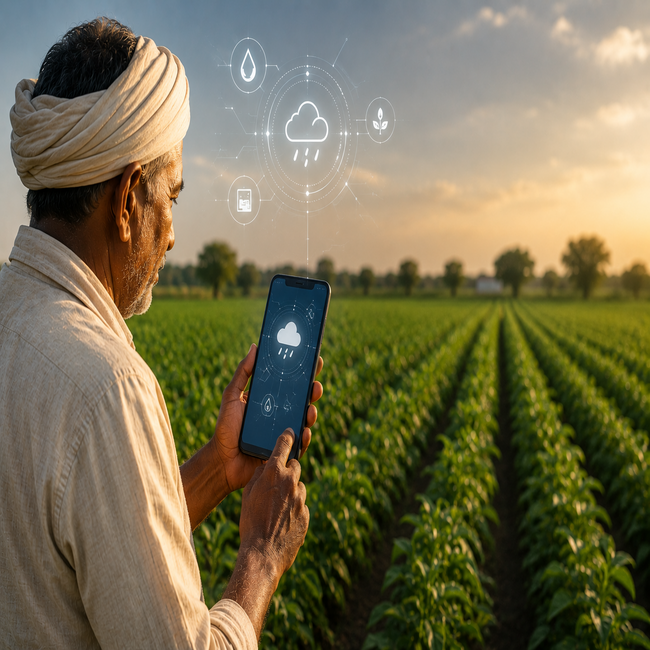
Artificial intelligence-powered weather forecasts helped some smallholder farmers in Telangana record net savings of as much as $560 per farmer by enabling them to adjust farming decisions in response to specific risks, according to the World Bank’s World Development Report 2026.
The report highlights the Telangana example as part of a wider assessment of how relatively small and affordable AI applications could improve productivity and decision-making across developing economies.
The findings draw on a 2025 study conducted in Telangana’s Medak and Mahbubnagar districts. Farmers who received AI-generated weather information changed their behaviour based on anticipated weather conditions, allowing them to make more informed decisions about agricultural spending and production.
The economic impact differed among farmers. According to the World Bank, some increased their farm expenditure by as much as one-third in response to the information, while others recorded net savings of up to $560 per farmer.
The report noted that farmers participating in the initiative had previously relied relatively little on information provided by government agencies and agricultural extension workers. AI-generated forecasts provided an additional source of information that could be used when making production and investment decisions.
The Telangana case forms part of the World Bank’s broader argument for greater adoption of what it describes as “small AI” in developing countries.
Instead of concentrating investment primarily on developing large language models and other compute-intensive systems, the report recommends wider deployment of lower-cost AI applications designed to address specific economic and social problems.
Agriculture is emerging as one area where such tools are being tested. AI can combine weather data, satellite imagery, crop information and historical records to generate localised recommendations for farmers. Applications can include weather forecasting, pest detection, irrigation planning, crop monitoring and advisory services.
A separate Telangana agricultural initiative highlighted by the World Bank illustrates other potential applications. Under the Saagu Baagu programme, AI-enabled advisory services were associated with a 21% increase in chilli yields, a 9% reduction in pesticide use and a 5% reduction in fertiliser use. The World Bank said farmer income in that initiative doubled to $800 per acre.
The World Development Report extends the potential applications of AI beyond agriculture. It identifies predictive analytics and AI-assisted decision support as tools that governments could use across areas including tax administration, social programmes, disaster response, healthcare and education.
However, wider AI adoption in agriculture faces practical constraints. The World Bank has identified gaps in rural internet connectivity, access to devices, digital skills and locally relevant agricultural data as barriers, particularly for smallholder farmers.
Data privacy, trust in AI-generated recommendations and the ability of different digital systems to work together are also among the challenges associated with expanding agricultural AI.
For developing economies, the report argues that the potential benefits of AI will depend not only on access to advanced models but on whether technology can be adapted to local problems and made accessible at scale.
The Telangana example provides an early indication of that approach, using AI not to replace farmers’ decision-making but to provide more timely information around weather-related risks. As AI adoption expands across agriculture, its broader impact will depend on whether such tools can deliver measurable benefits while remaining affordable and accessible to small farmers.