
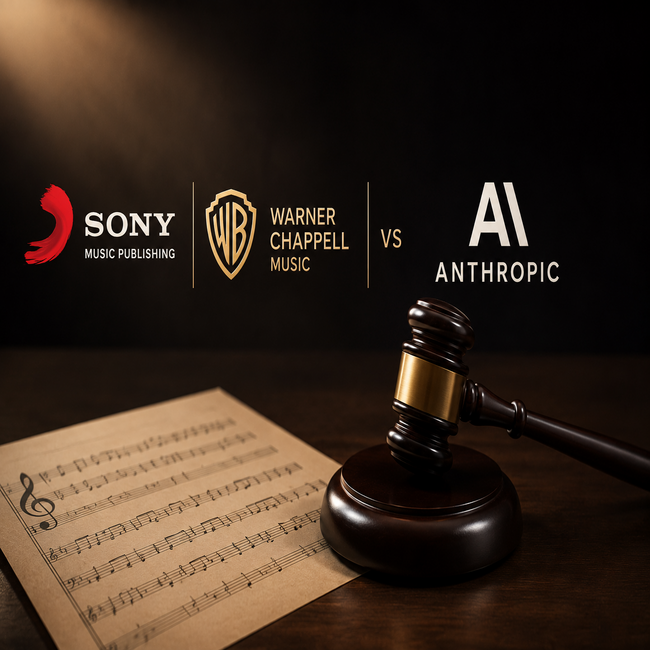

Sony Music Publishing, Warner Chappell Music and a group of other music publishers have sued Anthropic and two of its co-founders, alleging that the artificial intelligence company illegally obtained copyrighted material to train its Claude AI models.
The complaint was filed in the U.S. District Court for the Northern District of California and names Anthropic CEO Dario Amodei and co-founder Benjamin Mann alongside the company as defendants. The publishers accuse Anthropic of illegally torrenting, scraping and downloading copyrighted works as part of the development of its AI systems.
According to the lawsuit, Anthropic allegedly obtained thousands of copyrighted musical works without authorisation and incorporated material into datasets used for training Claude. The publishers allege that the activity included copyrighted lyrics and sheet music contained within books and other sources acquired online.
The allegations remain claims made by the plaintiffs and have not been established by the court.
Anthropic has rejected the publishers' claims. "We disagree with the publishers' claims and we intend to defend ourselves robustly in court," a company spokesperson told TechCrunch.
The publishers are seeking statutory damages of up to $150,000 for each work they allege was infringed. The case could therefore carry substantial financial implications depending on the number of works ultimately considered by the court and whether infringement is established.
The lawsuit adds to a growing series of copyright disputes involving generative AI companies and the datasets used to train their models. Anthropic has previously faced litigation from authors who alleged that copyrighted books were obtained and used in the development of Claude.
In the Bartz case, a federal judge previously distinguished between using copyrighted books for AI training and the way those books were acquired. The court found that training AI models using lawfully obtained books could qualify as fair use, while acquiring books through pirated sources was not protected on that basis. The case subsequently resulted in a $1.5 billion settlement.
The latest complaint builds on that distinction by focusing heavily on how Anthropic allegedly sourced copyrighted material.
The dispute arrives as music companies, publishers, authors, news organisations and other rights holders continue to challenge AI developers over the use of copyrighted content. These cases are increasingly examining not only whether copyrighted material can be used for model training, but also how training data was obtained and whether AI-generated outputs infringe existing works.
Disclaimer: This article may include information derived from interviews, press releases, public statements, research, company communications and other publicly available or third-party sources. Such material may be summarised, paraphrased or contextualised for journalistic and editorial purposes. All rights in third-party content remain with their respective owners.