
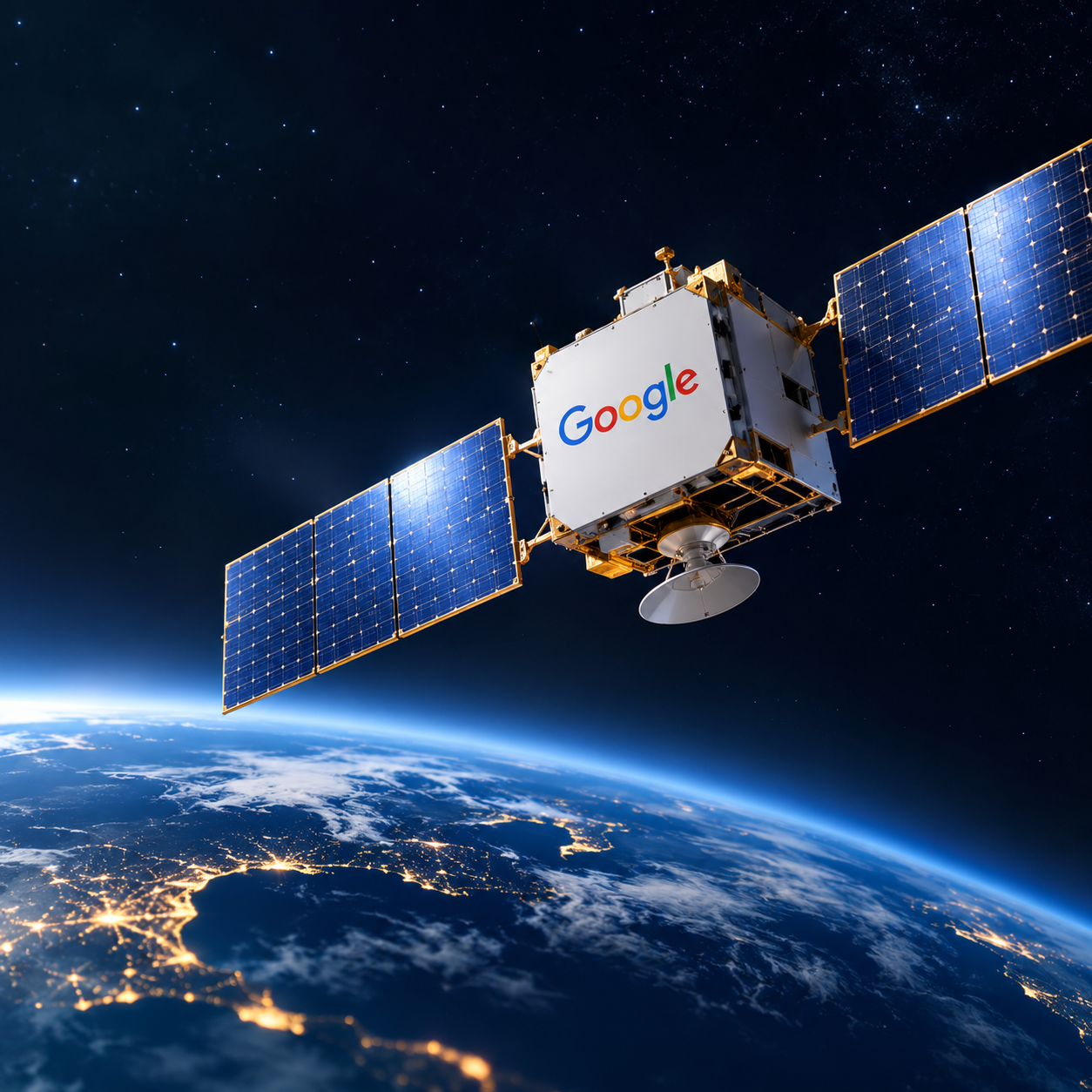

Google has successfully operated an artificial intelligence model aboard a satellite in orbit, marking an early milestone in its efforts to explore space-based data centres. The prototype satellite, developed under Google's Project Suncatcher, transmitted its first AI-generated response to Earth after completing initial system tests.
The satellite was launched on October 1, 2026, aboard a SpaceX Falcon 9 rocket alongside more than 100 other spacecraft. It carries four Google Tensor Processing Units (TPUs), the company's specialised processors designed for AI workloads, and can generate up to one kilowatt of electricity.
Following approximately three weeks of commissioning, engineers activated the satellite's computing systems and tested Google DeepMind's Gemma 4 model, which had been installed onboard.
For its first task, the team instructed the model to generate a short poem about space. The satellite successfully processed the request and transmitted the response to a ground station as it passed over Svalbard, Norway.
Google described the achievement as its first successful AI response from a data-centre-class TPU operating in orbit.
The company subsequently tested the model with additional poetry prompts and requests for information about the satellite's operating conditions.
According to Google, the spacecraft is functioning as expected, although significant technical challenges remain before orbital computing systems can support larger AI workloads.
Power availability is one of the immediate constraints. While the satellite carries four TPUs, its limited electricity supply allows only one processor to operate at a time, for approximately 20 minutes.
Google is also examining how its processors respond to extreme temperature variations and radiation exposure in space.
Radiation can affect computer memory by changing stored data values, potentially causing processing errors. Although Google previously conducted radiation testing on Earth, the satellite will allow researchers to evaluate processor performance under actual orbital conditions.
Initial testing suggested that radiation-related disruptions could have a smaller impact on AI inference, where trained models generate responses, than on the computationally intensive process of training models.
If the current testing programme succeeds, Google plans to launch two additional satellites in 2027. These spacecraft are expected to offer greater power-generation capacity and demonstrate optical communication links between satellites.
Such connections could eventually allow multiple spacecraft to operate together on larger computing tasks.
Project Suncatcher is part of Google's longer-term research into whether space-based computing infrastructure could become economically viable during the 2030s.
However, developing operational orbital data centres would require improvements in power generation, thermal management, communications and launch economics.
The latest demonstration establishes that Google's AI hardware can execute a model and return results from orbit, but the project remains experimental, with large-scale commercial deployment still some years away.
Disclaimer: This article may include information derived from interviews, press releases, public statements, research, company communications and other publicly available or third-party sources. Such material may be summarised, paraphrased or contextualised for journalistic and editorial purposes. All rights in third-party content remain with their respective owners.