
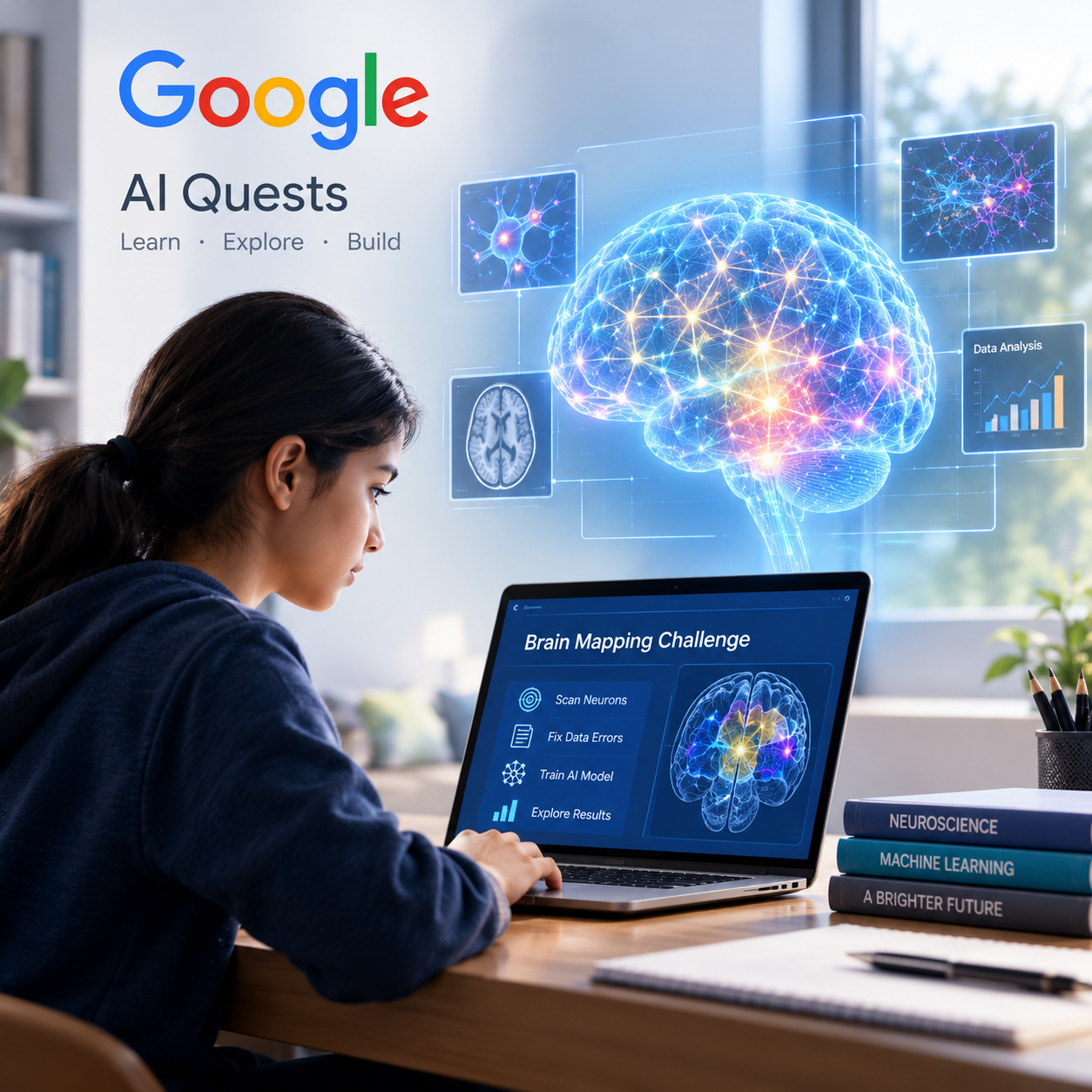

Google Research, in collaboration with the Stanford Accelerator for Learning, has introduced a new brain-mapping challenge called Polar Peaks under its AI Quests educational programme. The interactive lesson is designed to help students understand how artificial intelligence can be used in neuroscience research while introducing concepts such as data quality, machine learning and responsible AI development.
The latest addition is the third instalment of AI Quests, a game-based learning programme primarily developed for students aged 11 to 14. According to Google, more than 400,000 quests have been completed across the programme, which is currently available in 10 languages. The figure represents completed activities rather than the number of individual students.
Polar Peaks places participants in a simulated neuroscience research environment where they investigate a fictional character's memory loss. Students are required to scan and map neurons in the brain, identify errors in datasets, correct inaccurate labels and train AI models to evaluate their performance.
The activities are intended to demonstrate how researchers use artificial intelligence to examine scientific problems and why human supervision remains important when interpreting information generated by AI systems.
The new lesson draws on Google's research in connectomics, a field focused on understanding connections between neurons in the brain. This includes the company's involvement in research to map the complete brain of a fruit fly.
After completing the challenge, students are introduced to two researchers involved in Google's neuroscience projects, connecting the simulated exercises with practical scientific research.
AI Quests was developed with the Stanford Accelerator for Learning and received the Best Global K-12 Learning Solution award at the ETIH Innovation Awards 2026.
The programme's earlier lessons focused on flood forecasting and the use of AI to detect diabetic retinopathy, an eye condition associated with diabetes. Together, the three activities introduce students to different scientific applications of artificial intelligence.
Alongside the latest release, Google is expanding teacher training resources through its Google AI Educator Series. Training modules for the first two lessons are already available, while a dedicated module for Polar Peaks is expected in November 2026.
The programme does not require students to have coding experience or create an account. Google says the platform does not collect personally identifiable information, although anonymised and aggregated gameplay data is recorded to assess usage.
Despite teaching AI concepts, the game itself does not use generative AI. Its activities are designed around structured simulations that can be incorporated into classroom teaching.
Google is also providing lesson guides, presentation materials, classroom activities and student reflection resources to support educators.
The resources are available free of charge and can be integrated into subjects including science and geography, expanding the use of interactive learning tools to introduce students to AI research and its applications.
Disclaimer: This article may include information derived from interviews, press releases, public statements, research, company communications and other publicly available or third-party sources. Such material may be summarised, paraphrased or contextualised for journalistic and editorial purposes. All rights in third-party content remain with their respective owners.