
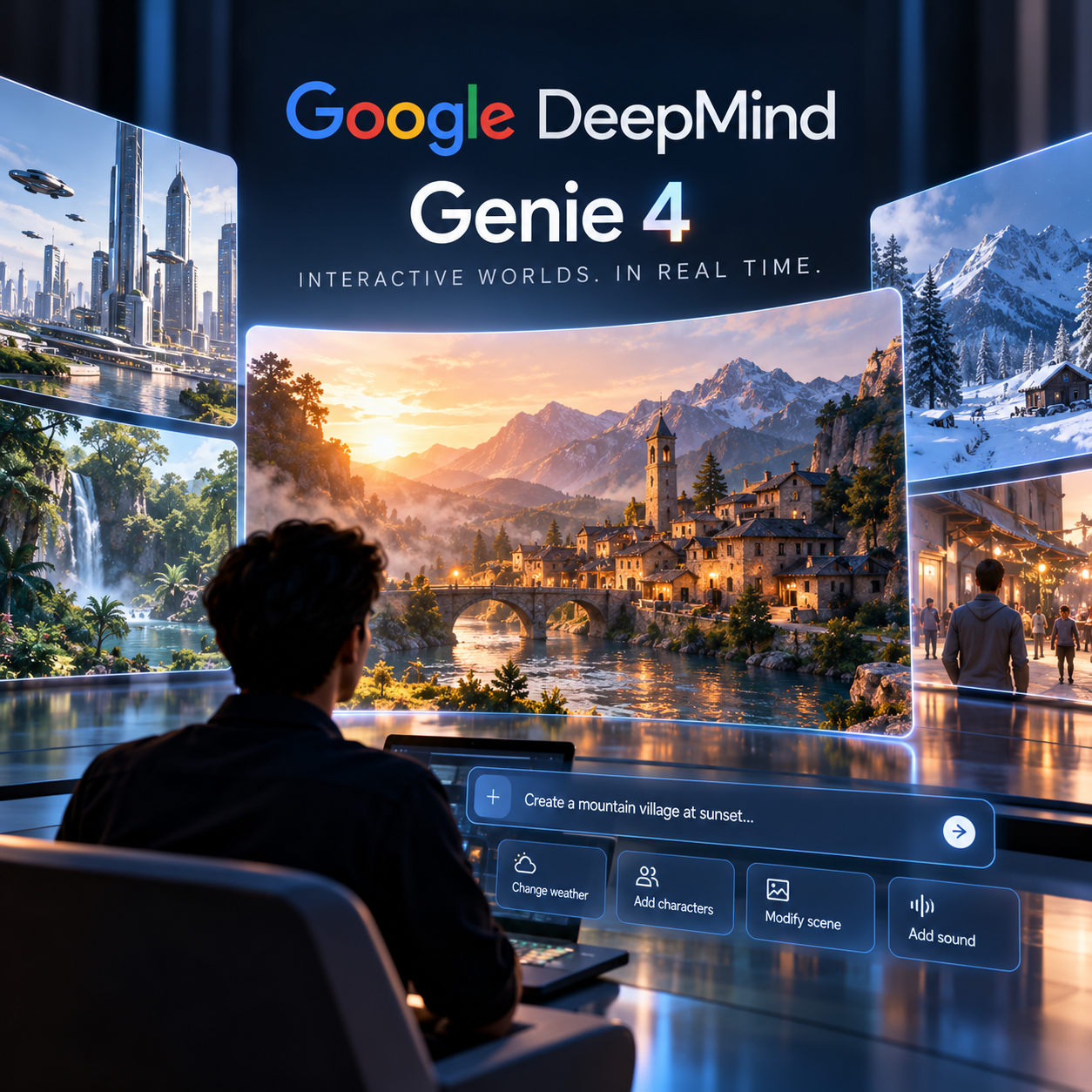

Google DeepMind has introduced Genie 4, a new artificial intelligence world model capable of generating interactive three-dimensional environments with realistic visuals, sound and dialogue in real time.
Announced on October 27, the model allows users to create and modify simulated environments using natural-language instructions. It is currently being introduced as a research preview for selected testers, with broader access planned through Google's AI products and developer platforms.
Unlike conventional AI video generation tools that produce fixed sequences, Genie 4 allows users to interact with a simulated environment as it develops. Users can change weather conditions, adjust camera movements or introduce new characters and objects while the simulation continues.
The model also generates audio alongside visuals, including environmental sounds, music and interactive conversations. According to Google DeepMind, characters can respond to events and user instructions within the simulated environment.
Genie 4 incorporates capabilities from Google's Gemini family of AI models. Gemini Omni supports the visual appearance and behaviour of simulated environments, while other Gemini models contribute reasoning capabilities intended to maintain consistency across interactions.
For more complex simulations, Gemini 3.8 Flash functions as a guiding system that monitors the environment, breaks tasks into individual steps and evaluates their progress. It can also adjust instructions when users intervene or conditions change.
Google DeepMind is exploring the technology for applications across robotics, gaming, filmmaking, journalism and industrial simulation.
In robotics, the model could provide virtual environments where AI systems are tested before being deployed in physical settings. Such simulations may allow researchers to examine how machines respond to changing conditions and complete multiple tasks.
For filmmakers, Genie 4 could support early-stage scene development by allowing creative teams to experiment with lighting, camera angles, dialogue and character movements.
Game developers could use natural-language prompts to create interactive prototypes before developing complete game environments.
The company is also examining applications in journalism, including the transformation of archival photographs into interactive historical simulations and the visualisation of events such as floods and wildfires.
Google DeepMind said it is experimenting with Genie 4 alongside Gemini 4 Argon and its robotics research. One demonstration involved simulating an Apptronik Apollo humanoid robot playing checkers.
However, the company acknowledged that the technology remains experimental. Visual details, object consistency, spatial accuracy and physical interactions can become less reliable during longer or more complex simulations.
Google said generated video and audio will incorporate SynthID, its digital watermarking technology designed to help identify AI-generated material.
Genie 4 is initially available to trusted testers. Google plans to extend access to Google AI Ultra subscribers through Project Genie, followed by early-access partners using the Gemini API and Google AI Studio.
Disclaimer: This article may include information derived from interviews, press releases, public statements, research, company communications and other publicly available or third-party sources. Such material may be summarised, paraphrased or contextualised for journalistic and editorial purposes. All rights in third-party content remain with their respective owners.