
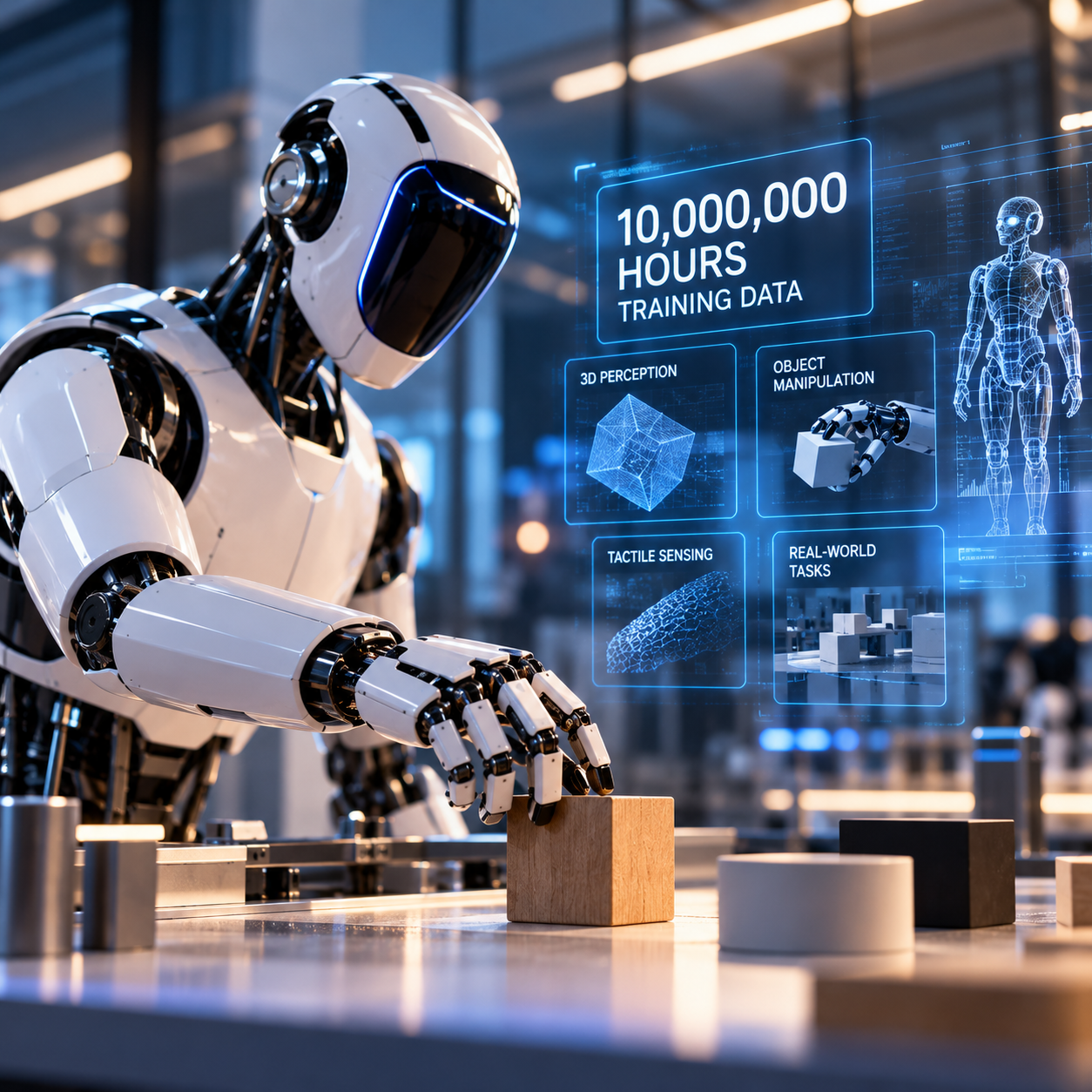

Artificial intelligence-powered robots may require as much as 10 million hours of high-quality interaction data before they can reliably perform real-world tasks, according to a new Goldman Sachs report. The assessment highlights the technical challenges facing the development of robots capable of operating beyond controlled research environments.
The report, cited by NewsBytes on October 30, 2026, identifies access to accurate and diverse training data as an important requirement for improving robotic performance. Unlike AI systems designed primarily to process text or images, robots must interpret their physical surroundings and respond through movement and manipulation.
According to the report, existing robotic systems continue to face limitations in understanding three-dimensional environments and responding quickly to changing conditions. These capabilities are necessary for machines expected to interact with objects, navigate spaces and complete tasks that require physical coordination.
The findings suggest that improvements in AI models alone may not be sufficient to make robots dependable in everyday settings. Progress will also depend on the quality of the information collected during physical interactions, alongside advances in robotic hardware and control systems.
Goldman Sachs identifies dexterous Universal Manipulation Interface (UMI) systems as one potential approach to improving robotic capabilities. Such systems are designed to support the collection and use of manipulation data, helping machines learn how objects can be handled in different situations.
The report also points to high-resolution tactile sensing as an important area of development. Tactile sensors can provide information about physical contact, enabling robots to better assess how they interact with objects and surfaces.
These technologies could contribute to improving robotic manipulation, particularly in tasks where visual information alone does not provide sufficient detail.
The assessment also distinguishes between different categories of robots and their potential readiness for deployment.
According to Goldman Sachs, collaborative and industrial robots could become useful in practical applications sooner than humanoid robots. Industrial systems generally operate within more structured environments, where tasks and operating conditions can be defined more precisely.
Humanoid robots, by comparison, are being developed to perform a wider range of activities in environments designed for people. This requires coordination across perception, movement, object handling and real-time decision-making.
The report indicates that hardware capabilities and responsive control systems will remain important factors in determining how quickly robotic technologies can move from laboratory demonstrations to wider commercial applications.
The findings come as artificial intelligence is increasingly being integrated into physical machines, expanding its applications beyond software-based tasks.
While the estimated training requirement highlights the scale of the development challenge, the report does not establish a universal deployment timeline for AI-powered robots.
The assessment instead points to the need for continued progress in training data, sensing technologies, physical manipulation and real-time controls before more advanced robotic systems can be deployed reliably across varied environments.
Disclaimer: This article may include information derived from interviews, press releases, public statements, research, company communications and other publicly available or third-party sources. Such material may be summarised, paraphrased or contextualised for journalistic and editorial purposes. All rights in third-party content remain with their respective owners.