

ai News
Figma Launches AI Assistant for Collaborative Design Workflows
" Figma has introduced an AI assistant for its collaborative canvas platform to improve design workflows and team productivity. "
- by Martech Desk
- May 21, 2026
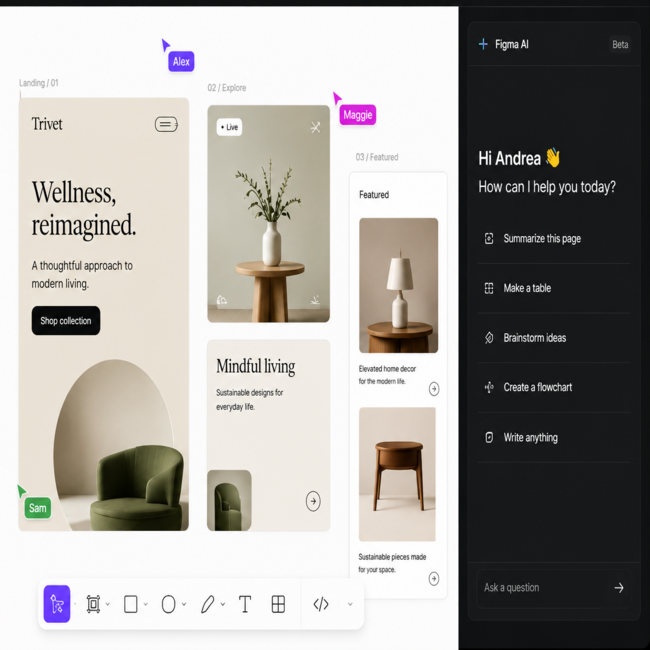
Figma has introduced a new artificial intelligence assistant for its collaborative canvas platform as the company expands AI-powered productivity tools across its design and workplace ecosystem.
The feature has been designed to help users organise projects, generate content, automate workflows, and improve collaboration within Figma’s shared digital workspace environment. The rollout comes as technology companies increasingly integrate generative AI into productivity and creative software platforms.
According to Figma, the AI assistant will operate directly inside the collaborative canvas, enabling users to interact with the platform through natural language prompts. Teams can use the assistant to summarise information, structure ideas, automate repetitive actions, and generate content within collaborative workspaces.
The company said the addition is aimed at improving efficiency for designers, marketers, developers, and business teams using Figma for brainstorming, planning, and project collaboration. AI-powered assistants are increasingly being positioned as workflow tools that reduce manual effort while improving speed across digital operations.
The launch reflects the broader shift toward AI-enabled workplace platforms as companies compete to integrate automation and conversational interfaces into enterprise software. Productivity and collaboration tools have become a major focus area for generative AI adoption over the past year.
Figma has steadily expanded beyond its core design software business into broader workplace collaboration and digital whiteboarding categories. The company’s collaborative canvas platform is increasingly being used for product planning, marketing discussions, campaign workflows, and cross-functional team coordination.
Industry analysts believe AI assistants integrated into collaborative environments could significantly reshape how teams manage information and creative workflows. Businesses are increasingly seeking tools that can centralise communication, automate documentation, and accelerate decision-making processes.
The AI assistant can reportedly support content organisation, idea clustering, workflow recommendations, and quick information retrieval across shared canvases. Such features are becoming increasingly important as remote and hybrid work environments continue driving demand for collaborative digital platforms.
The broader software industry has witnessed intensified competition around AI integration following rapid adoption of generative AI technologies across enterprise and consumer applications. Companies including Microsoft, Google, Adobe, Notion, and Canva have all introduced AI-powered features focused on productivity and content generation.
Figma’s latest AI rollout also highlights the growing overlap between design technology and workplace productivity software. Creative platforms are increasingly evolving into broader operational ecosystems that support collaboration across marketing, development, strategy, and business functions.
Industry observers say AI-powered collaboration tools may also influence marketing and advertising workflows, particularly as brands seek faster campaign ideation and content production capabilities. AI-generated summaries, structured brainstorming, and automated project organisation are becoming increasingly valuable for distributed creative teams.
The company has stated that the AI assistant is intended to enhance collaboration rather than replace human creative input. Many technology firms have similarly positioned AI features as productivity enhancers that support ideation and execution instead of fully automating creative work.
The launch comes amid rising enterprise demand for integrated AI systems capable of supporting multiple workflow functions inside a single platform. Businesses are increasingly prioritising unified ecosystems that combine communication, design, planning, and automation capabilities.
Analysts believe collaborative AI assistants are likely to become standard features across workplace software platforms as generative AI adoption continues expanding globally. Companies are investing heavily in AI-enabled interfaces aimed at simplifying complex workflows and improving team coordination.
Figma’s expansion into AI-powered collaboration tools further strengthens competition within the digital productivity software market, where platforms are increasingly differentiating themselves through automation, conversational AI, and integrated workflow management features for enterprise and creative users.