
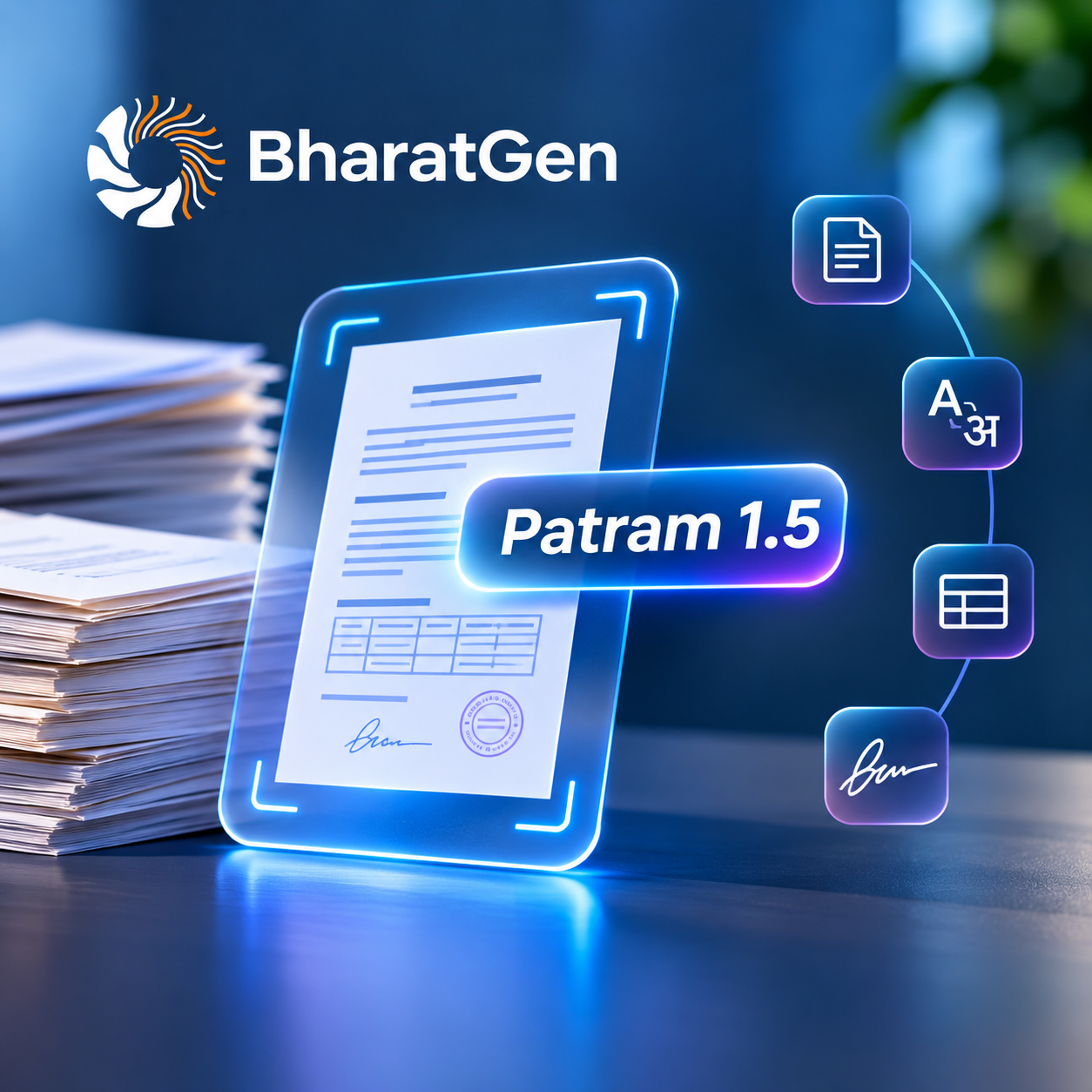

Indian artificial intelligence company BharatGen has launched Patram 1.5, a seven-billion-parameter-class vision-language model (VLM) designed to read, interpret and process complex documents. Announced on November 26, the model targets enterprises across banking, insurance, healthcare and government services, where document-intensive operations often involve handwritten records, poor-quality scans and multilingual content.
Unlike conventional optical character recognition (OCR) systems, which convert scanned documents into text for subsequent processing, Patram 1.5 analyses documents directly as images. This enables the model to interpret visual elements such as tables, charts, signatures, stamps and handwritten annotations alongside textual information, while retaining the structural context of a document.
The model introduces what BharatGen calls OCR 3.0, a capability that allows users to specify the information they require through natural language instructions. Instead of extracting the entire contents of a document, businesses can retrieve selected information in structured formats such as JSON, HTML and Markdown for integration with existing enterprise systems.
Another feature introduced with Patram 1.5 is abstention, which enables the model to flag missing, ambiguous or illegible information rather than generate potentially inaccurate responses. Where the model provides an estimated interpretation, it can indicate uncertainty and recommend human verification.
This capability is particularly relevant for regulated industries, where inaccuracies in processing financial records, medical reports or customer identification documents could have operational and compliance implications.
According to BharatGen, Patram 1.5 achieved an overall score of 83 in an evaluation covering 49 tests, including 34 public benchmarks and 15 tests from its proprietary PatramBench dataset. The evaluation involved 21 vision-language models and seven specialised OCR systems.
PatramBench comprises 11,828 test items derived from 8,773 pages of Indian documents. BharatGen said its model matched the overall scores of significantly larger models, including Qwen3.5-397B and DeepSeek-V4.1-Flash, in the company's evaluation.
The model is available on Hugging Face under the Apache 2.0 licence and through the BharatGen Playground, which offers tools for document classification, information extraction, parsing and document segmentation. Organisations can combine these capabilities to develop workflows for invoice processing, customer verification and insurance claims.
Rishi Bal, CEO of BharatGen, highlighted the importance of combining AI models with practical tools and workflows to address enterprise document-processing requirements.
For marketing technology and customer experience teams, document intelligence could support customer onboarding, CRM data enrichment, service request processing and the digitisation of customer records. The availability of open model weights also enables organisations to deploy the technology within their own infrastructure, offering greater control over sensitive information.
Anchored at IIT Bombay, BharatGen is supported by the Department of Science and Technology and the IndiaAI Mission, with participation from a consortium of nine academic institutions.
Patram 1.5 is the latest addition to BharatGen's portfolio of indigenous AI models, which includes Param for text processing, Shrutam for speech recognition and Sooktam for speech generation.