
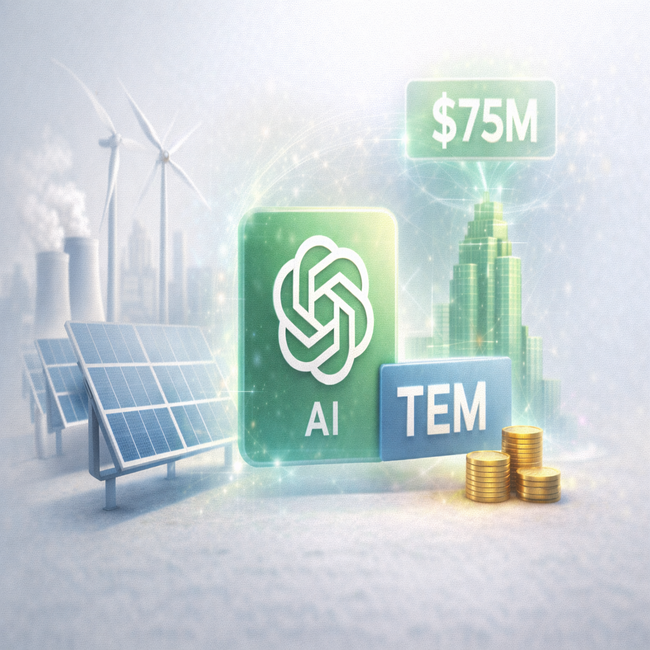

AI powered energy startup TEM has secured $75 million in a Series B funding round, marking a significant milestone for the company as it looks to scale its technology and expand its presence in the global energy market. The funding reflects growing investor interest in artificial intelligence driven solutions aimed at improving efficiency, sustainability and reliability across energy systems.
TEM operates at the intersection of artificial intelligence and energy management, focusing on software platforms that help utilities, grid operators and energy intensive enterprises optimise consumption and reduce operational inefficiencies. The company’s technology uses machine learning models to analyse real time data, forecast demand and support decision making across complex energy networks.
According to the company, the latest funding will be used to accelerate product development, expand commercial operations and strengthen its engineering and data science teams. TEM also plans to invest in international expansion as demand grows for AI based energy solutions amid rising electricity costs and increasing pressure to decarbonise infrastructure.
The Series B round was led by a group of global investors with participation from existing backers, signalling continued confidence in TEM’s business model and growth trajectory. While the company has not disclosed its valuation, the size of the round positions TEM among a growing group of AI driven energy startups attracting large scale capital as the sector matures.
Energy systems worldwide are undergoing structural changes driven by renewable integration, electrification and decentralised generation. These shifts have increased the complexity of managing supply and demand, creating opportunities for software platforms that can process vast amounts of data and deliver actionable insights. TEM’s approach is designed to address these challenges by applying predictive analytics and automation across energy operations.
The company says its platform can help customers reduce energy waste, manage peak loads and improve grid stability. By analysing historical and real time data, the system identifies patterns and anomalies that may not be visible through traditional monitoring tools. This enables operators to respond more quickly to disruptions and optimise performance under changing conditions.
Investors have increasingly focused on energy technology startups that combine AI with sustainability goals. As governments and corporations commit to emissions reduction targets, tools that improve efficiency and support renewable adoption are becoming strategically important. TEM’s positioning aligns with this trend, placing it at the convergence of climate priorities and digital transformation.
The funding comes at a time when AI adoption in the energy sector is moving beyond pilot projects toward scaled deployments. Utilities and large energy consumers are under pressure to modernise legacy systems while maintaining reliability. AI based platforms offer a way to enhance existing infrastructure without the need for extensive physical upgrades.
TEM has indicated that customer demand has been driven by both cost pressures and regulatory requirements. Rising energy prices have pushed businesses to seek better visibility into consumption, while policy frameworks increasingly require detailed reporting and optimisation. AI tools that automate analysis and compliance tasks can reduce administrative burdens alongside operational costs.
The company’s leadership has emphasised that the platform is designed to work across different energy markets and regulatory environments. This flexibility is expected to support international growth as TEM enters new regions with varying grid structures and policy regimes. The fresh capital is intended to support these localisation efforts.
Competition in the AI energy space is intensifying as startups and established technology firms invest in similar capabilities. Large cloud providers and industrial software companies are expanding their energy analytics offerings, while startups differentiate through specialised models and domain expertise. TEM’s ability to scale while maintaining performance will be critical as the market evolves.
Industry analysts note that energy is one of the most data rich sectors, making it well suited for AI driven optimisation. However, integration challenges remain, particularly when dealing with legacy systems and fragmented data sources. Startups that can demonstrate reliability and measurable impact are more likely to secure long term contracts.
TEM’s Series B funding suggests that investors see potential for sustained growth as energy systems become more digitised. The company’s focus on predictive and adaptive intelligence aligns with broader trends toward autonomous operations and real time optimisation across industrial sectors.
The round also highlights how venture capital interest in AI has broadened beyond consumer applications. While generative AI tools have attracted significant attention, applied AI in sectors such as energy, manufacturing and logistics is increasingly viewed as a source of durable value creation.
For TEM, the challenge now will be to translate capital into execution. Scaling enterprise software in the energy sector requires long sales cycles, regulatory engagement and strong customer support. Maintaining product performance as deployments grow will be essential to sustaining momentum.
The company has stated that it plans to deepen partnerships with utilities and energy providers while exploring opportunities with large enterprises seeking to manage energy usage more effectively. These partnerships could play a key role in driving adoption and refining the platform based on real world use cases.
As the energy transition accelerates, AI driven tools are expected to play a larger role in balancing supply, managing demand and integrating renewable sources. Funding rounds such as this indicate that investors believe software will be as important as physical infrastructure in shaping the future energy landscape.
TEM’s $75 million Series B marks an important step in its development and reflects broader confidence in AI powered energy management. As the company moves into its next phase of growth, its progress will be watched closely by industry players and investors looking to understand how artificial intelligence can reshape energy systems at scale.