
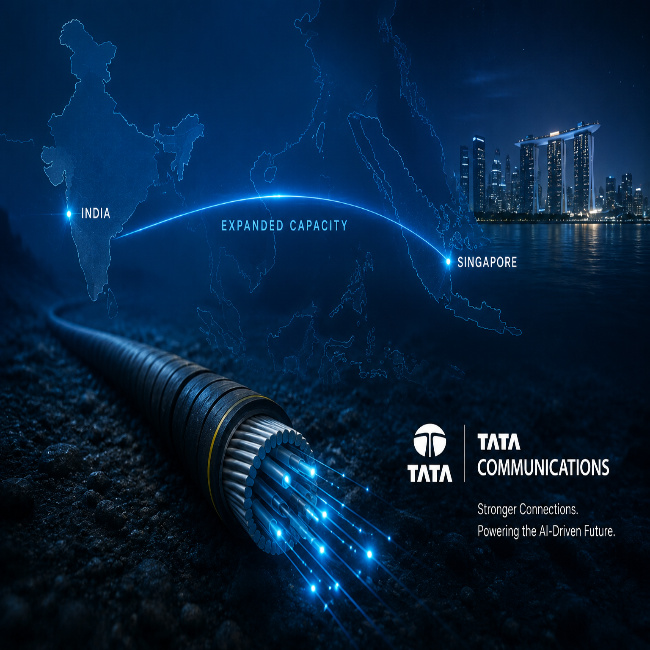

Tata Communications has expanded the capacity of its India-Singapore subsea cable network, strengthening digital connectivity between two of Asia's key technology hubs as artificial intelligence, cloud computing and data-intensive enterprise workloads continue to accelerate.
The expansion comes as businesses worldwide increase investments in AI infrastructure, driving unprecedented demand for high-speed, low-latency international data transmission. Subsea cable networks have become critical infrastructure supporting AI model training, cloud services, financial transactions, enterprise applications and cross-border digital operations.
According to Tata Communications, the enhanced capacity on its India-Singapore route is intended to support growing customer demand for international bandwidth while improving resilience and network performance. The upgraded connectivity will benefit enterprises, hyperscalers, cloud providers, digital platforms and telecommunications operators that rely on seamless global data movement.
The company said the expansion reflects changing enterprise requirements as organisations adopt AI-powered applications, migrate workloads to the cloud and process increasingly large volumes of data across geographically distributed infrastructure. Modern AI services require continuous, high-capacity connectivity between data centres, making subsea cable investments an important part of digital infrastructure development.
The India-Singapore corridor has emerged as one of the region's busiest international connectivity routes, linking Indian enterprises to major cloud regions, financial centres and digital ecosystems across Southeast Asia and beyond. Singapore continues to serve as a strategic gateway for international internet traffic, cloud infrastructure and hyperscale data centres, making reliable connectivity increasingly important for businesses operating across multiple markets.
Industry analysts note that artificial intelligence is reshaping infrastructure priorities beyond computing hardware alone. While graphics processing units and AI accelerators have received considerable attention, network capacity, storage systems and subsea connectivity are becoming equally essential components of enterprise AI infrastructure. Large language models, real-time analytics and distributed AI applications depend on reliable, low-latency international networks to deliver consistent performance.
Tata Communications has continued expanding its global digital infrastructure portfolio through investments in subsea cable systems, terrestrial fibre networks, cloud connectivity and managed network services. The company operates one of the world's largest subsea cable ecosystems, connecting businesses across multiple continents through integrated global infrastructure.
The latest capacity enhancement also aligns with India's growing role in the global digital economy. As multinational companies establish global capability centres, AI research hubs and cloud operations in the country, demand for international connectivity continues to increase. High-capacity subsea networks enable enterprises to transfer data securely between global offices, cloud platforms and regional data centres while supporting increasingly sophisticated AI workloads.
For marketers and digital businesses, enhanced international connectivity can improve customer experiences by reducing latency across digital platforms, accelerating content delivery and enabling AI-powered services that rely on real-time access to distributed data. Faster and more resilient networks also support ecommerce, streaming, financial technology and cloud-based customer engagement platforms operating across international markets.
The investment reflects a broader trend within the telecommunications industry, where operators are strengthening international infrastructure to accommodate rapid growth in AI traffic. As enterprises adopt generative AI, autonomous systems and advanced analytics, data volumes moving across global networks are expected to rise significantly over the coming years.
Subsea cable infrastructure is increasingly being viewed as strategic national and commercial infrastructure rather than simply telecommunications assets. Governments and enterprises alike are investing in diversified international connectivity to strengthen digital resilience, improve network redundancy and support long-term economic growth.
Tata Communications' latest expansion underscores how AI is influencing infrastructure investment beyond software and computing. As artificial intelligence becomes embedded across industries, demand for reliable global connectivity is expected to grow alongside investments in cloud computing, enterprise data centres and digital transformation.
The enhanced India-Singapore capacity positions Tata Communications to support the next phase of AI-led enterprise growth, reinforcing the importance of international network infrastructure in enabling future digital innovation across Asia and global markets.