
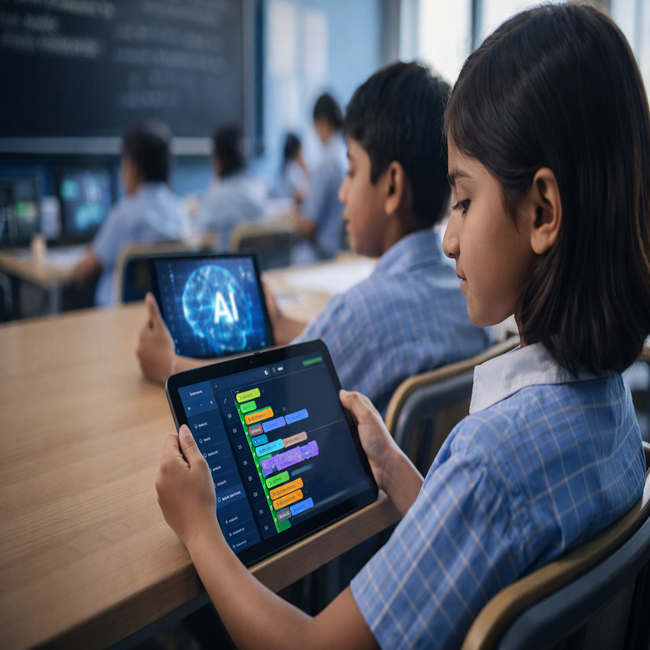

The Central Board of Secondary Education is set to introduce a curriculum focused on computational thinking and artificial intelligence for students from Classes 3 to 8, as part of efforts to strengthen early digital literacy in schools. The initiative was announced by Union Education Minister Dharmendra Pradhan and reflects a broader push to integrate technology education into foundational learning.
The new curriculum is designed to familiarise students with concepts related to coding, problem-solving and AI at an early stage. By introducing these subjects in primary and middle school, the programme aims to build foundational skills that are increasingly relevant in a technology-driven environment.
According to officials, the curriculum will focus on age-appropriate learning, ensuring that students are introduced to complex concepts in a simplified and engaging manner. The approach is expected to emphasise logical reasoning, creativity and practical application rather than technical complexity.
The inclusion of computational thinking is intended to help students develop problem-solving skills that can be applied across disciplines. By breaking down problems into smaller components and identifying patterns, students can learn structured approaches to thinking. This is seen as a key skill in both academic and real-world contexts.
The AI component of the curriculum will introduce students to basic concepts related to artificial intelligence and its applications. This may include understanding how AI systems work and exploring their use in everyday life. The goal is to create awareness and familiarity rather than technical expertise at this stage.
The move aligns with national efforts to prepare students for a digital future. As technology continues to evolve, there is growing recognition of the need to equip learners with relevant skills from an early age. Education systems are adapting to ensure that students are prepared for emerging opportunities and challenges.
Industry observers note that early exposure to coding and AI can help build confidence and interest in technology-related fields. By introducing these subjects at a young age, students may be more likely to pursue further learning and careers in these areas. This can contribute to the development of a skilled workforce.
The initiative also reflects global trends where education systems are incorporating digital skills into school curricula. Countries are increasingly recognising the importance of computational thinking and AI literacy as essential competencies. India’s move is part of this broader shift.
From an implementation perspective, schools will need to ensure that teachers are equipped to deliver the new curriculum effectively. Training and support will be critical in enabling educators to introduce these concepts in a meaningful way. The success of the programme will depend on how well it is integrated into existing teaching practices.
The curriculum is expected to be flexible, allowing schools to adapt it to their specific contexts. This can help ensure that learning remains relevant and accessible to students across different regions. The focus on inclusivity is an important aspect of the initiative.
Analysts suggest that the introduction of AI education at the school level could have long-term benefits for the country’s technology ecosystem. By building skills early, students can be better prepared to contribute to innovation and economic growth. Education plays a key role in shaping future capabilities.
At the same time, there are considerations around balancing traditional subjects with new areas of learning. Ensuring that students receive a well-rounded education remains important. Integrating new content without overloading students will be a key challenge.
The move also highlights the increasing role of policy in shaping education systems. Government initiatives can drive change by setting priorities and providing direction. The introduction of AI and coding in schools reflects a strategic focus on digital transformation.
The development underscores the evolving nature of education in a technology-driven world. As new skills become essential, curricula are being updated to reflect these changes. The emphasis on early learning is intended to build a strong foundation.
The introduction of coding and AI education for Classes 3 to 8 marks a step toward aligning the education system with future needs. By focusing on foundational skills, the initiative aims to prepare students for a rapidly changing environment where technology plays a central role.