
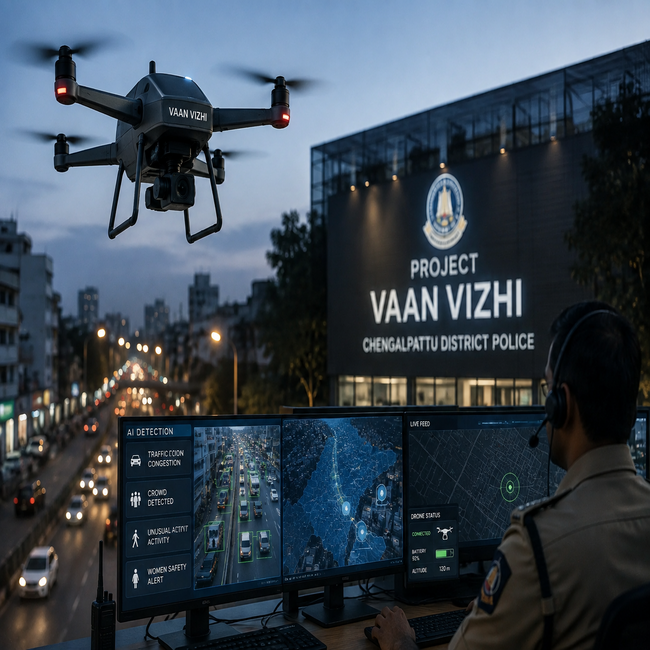

Chengalpattu district administration and police have launched an artificial intelligence-enabled drone surveillance initiative aimed at strengthening public safety and enabling faster responses to incidents across the Tamil Nadu district.
Called Project Vaan Vizhi, the pilot will deploy autonomous drones equipped with AI capabilities and real-time aerial intelligence to monitor incidents and provide information to police teams on the ground.
The project was unveiled during Independence Day celebrations by Chengalpattu District Collector M Veerappan and Superintendent of Police Ayman Jamal. Official district records confirm that Veerappan currently serves as Collector and Jamal as Superintendent of Police.
Under the initiative, drones will be used across multiple public-safety scenarios, including women and child safety, anti-social activities, illegal liquor sales, traffic congestion and crowd management.
The system will be integrated with the emergency 112 control room, which will operate as the central command unit. When the technology detects an incident, it is designed to identify its location, generate an alert and help authorities coordinate a response. Officials said the process could enable response coordination within seconds.
The use of AI adds an automated intelligence layer to conventional aerial surveillance. Rather than relying only on operators to continuously observe drone footage, AI-enabled systems can assist in identifying predefined events or patterns that may require attention.
Project Vaan Vizhi is currently limited to Chengalpattu as a pilot. Its effectiveness will be assessed before authorities consider expanding the initiative further.
A senior police official also clarified that the drone project associated with the Singappen Adhiradipadai, or Singappen Special Force, is expected to be taken up during a second phase. The current pilot is being implemented specifically in Chengalpattu.
The Singappen Special Force was launched in Tamil Nadu earlier this year as a dedicated police initiative focused on preventing and responding to crimes against women. The first phase involved 2,500 personnel and an allocation of ₹354 crore.
According to officials, Project Vaan Vizhi uses indigenous drone and AI technology. The objective is to strengthen preventive policing by combining continuous aerial visibility with faster detection and communication between surveillance systems and police teams.
The deployment also reflects a wider adoption of AI, computer vision and autonomous systems across public-safety operations. Law-enforcement agencies are increasingly evaluating such technologies for surveillance, incident response and situational awareness.
In March, the Centre for Development of Telematics signed an agreement with Delhi Police covering indigenous technologies including facial recognition, surveillance, secure communications and cybersecurity. The collaboration was positioned around technology-driven policing and emergency response.
For Chengalpattu, however, Vaan Vizhi remains an experimental deployment rather than a district-wide permanent surveillance system.
The pilot's performance will determine whether the model is suitable for wider implementation. Its immediate focus remains on testing whether AI-enabled autonomous drones can improve real-time monitoring and help police respond more quickly to public-safety situations across the district.