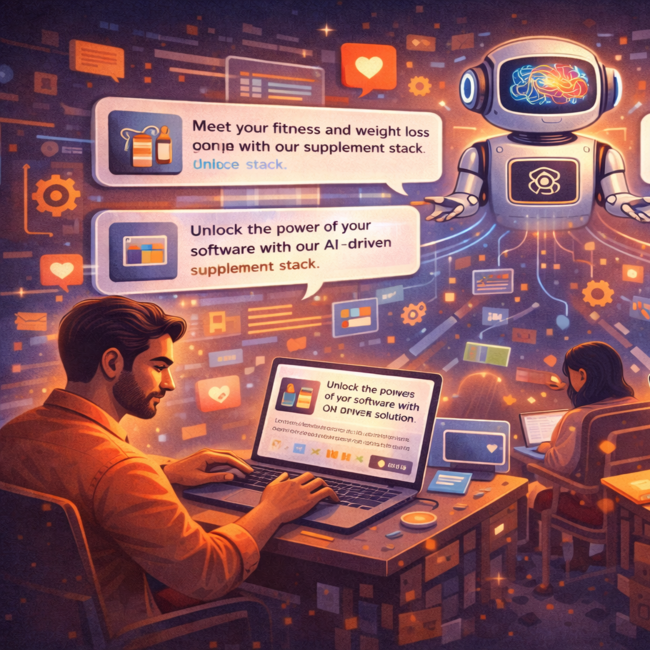

It’s a new quirk of the AI era in marketing: brands that have nothing to do with each other suddenly sound oddly similar. Take a recent example from social media – three competing fitness supplement brands all ran campaigns with nearly identical Instagram captions, each promising followers they could “meet your fitness and weight loss goals with our supplement stack” . In another case, multiple B2B software companies ended up using the exact same tagline on their websites: “unlock the power of [product] with our AI-driven solution” . None of these companies copied one another deliberately. Instead, marketers say it’s the rise of AI-generated content and common formulas that is blurring the lines between brand voices. As one industry consultant terms it, an “AI homogenization” of brand messaging is underway – an unintended side effect of teams relying on the same tools and similar prompts to churn out marketing copy.
Widespread AI adoption in content creation is the backdrop to this trend. In India, 42% of marketers are already experimenting with generative AI for campaigns, and about 21.5% say AI is now highly integrated into their marketing strategy . Globally, nearly 90% of professional marketers use AI tools on the job – whether for drafting social media captions, blog posts or ad copy . Many turn to AI writing assistants like ChatGPT: about 62% of marketers report using chatbot platforms for content generation, and 71% use generative AI at least once a week . The appeal is clear – these tools promise speed and scale. In one industry survey (AMA, 2025), 85% of marketers said AI made their content creation more productive, and about half even claimed it improved the quality and quantity of content they produce . Another study found 80% of marketers believe AI-generated captions have boosted their social media engagement, and 60% observed an uptick in followers after adopting AI-assisted posts . In short, AI is now deeply embedded in marketing workflows, valued for cranking out content efficiently and, often, effectively.
But this very success is creating a new challenge: sameness. Marketers and experts are noticing that as more brands lean on similar AI models, their voices risk losing distinction. “Welcome to the new reality of brand marketing, where AI tools have democratized content creation but inadvertently created a crisis of brand distinctiveness,” writes Pablo Cordoba, a branding consultant, after witnessing multiple clients’ content start to sound alike . The root cause isn’t hard to understand. Many teams use the same popular AI platforms and feed them very similar instructions. Often, prompts are kept broad and safe to get generally appealing copy. The result? Generic outputs. If every social media manager types “Write a professional, friendly post about our new sustainability initiative” into ChatGPT, they will all get back polished yet formulaic text. As Cordoba observes, the AI will return “professional, friendly copy that could belong to literally any brand.” The subtle quirks, cultural nuances, or witty tones that a human copywriter might deploy to set a brand apart often get sanded down. In the rush to scale up content, differentiating details can disappear. One creative director at a major agency even admitted, “We’ve gone from spending days crafting a distinctive voice to spending minutes generating a generic one. And the worst part is, the KPIs don’t immediately punish us for it.” In other words, a bland AI-written post might still get decent clicks or likes, so the lack of originality isn’t immediately flagged by short-term metrics – but it slowly erodes brand identity.
Marketing leaders in India are increasingly conscious of this risk. Many emphasize that while AI can amplify productivity, it must be guided by human creativity and brand insight to avoid a content monoculture. “AI is reshaping how brands connect with buyers. Younger audiences, in particular, want authenticity and relatability, and B2B marketers know that trust comes from real voices people can identify with,” says Sachin Sharma, Head of LinkedIn Marketing Solutions, India . A new LinkedIn report this year found that a striking 84% of Indian B2B marketing leaders believe authenticity and trusted perspectives matter more than ever amid the rise of AI-generated content . In practice, that means brands are now trying to put more human voice back into their messaging – featuring employees, customers, and influencers to add personal flavor that an algorithm can’t mimic. The same study noted 86% of marketing heads are investing more in such human-centric content to build credibility .
Advertisers are also wary of losing consumer trust by over-automating their communications. A vivid example came from the food delivery industry. Zomato, a popular Indian tech brand, experimented with AI-generated images and text for restaurant menus – only to face backlash. The company’s CEO, Deepinder Goyal, ended up banning AI-generated food photos from the platform after diners complained the pictures looked too perfect to be true. “AI-generated dish images are misleading,” Goyal publicly remarked, noting that customers felt such visuals “lead to breach of trust” when the real food didn’t match the AI’s glossy depiction . In the realm of copy and captions, the stakes may be lower than food imagery, but the principle holds: content that appears inauthentic or cookie-cutter can undermine audience confidence. If every brand starts tweeting the same cheeky one-liner or using the same trendy catchphrase, consumers will tune out. A distinct voice – with genuine character – remains vital for long-term brand loyalty, even if AI is part of the content engine.
To avoid the trap of interchangeable content, many companies are learning to pair AI with deeper brand strategy. This involves training AI models on proprietary data, tone guides, and product knowledge – essentially teaching the machine to speak in a specific brand’s voice. Marketers are also getting more sophisticated with prompts. Instead of the simplistic “write me a caption about X,” they are providing rich context and creative direction to the AI. For example, rather than asking for a generic “friendly post about our eco-friendly packaging,” a team might specify their brand’s quirky humor, mention a local cultural reference, or highlight a unique detail only their company would say. By tweaking the instructions, the AI’s output can come out more distinctive. Consultants have even devised frameworks (like the “CRAFt” method – Context, Role, Action, Format) to help brands craft AI prompts that yield original-sounding content rather than boilerplate . Early adopters of these techniques report positive results: content that aligns better with their brand personality and stands out from what everyone else is posting .
Crucially, the human touch isn’t being written out of the process. On the contrary, top marketers insist it’s more important than ever. “CMOs must use strategic thinking to infuse human elements into marketing with AI creatively. Precise personalization requires agility and an understanding of the target audience,” advises Alok Arya, Chief Marketing Officer at Research & Ranking, an Indian investment advisory firm . In his view, AI can crunch data and generate drafts, but human insight is needed to give those outputs meaning, context and emotional resonance with consumers. It’s a sentiment echoed across the industry. Nalin Jain, CMO of Godrej Capital, noted that bringing technical and creative teams together is key – a marketing head working closely with a dedicated AI officer can “bridge the gap between the technical aspects of AI and the human touch required in marketing.” Ultimately, marketers are learning that AI is a powerful amplifier: it will take whatever tone and approach you feed it and produce content at scale. If that input is generic, the output will be too – but if the input is rich with brand personality and human creativity, the results can be both efficient and unique.
For now, the “AI caption culture” is a double-edged sword. On one side, marketers celebrate the boosts in efficiency and engagement that generative AI provides – an essential advantage in the fast-paced world of digital campaigns. On the other side, they are waking up to the new mandate of differentiation in an AI-saturated content environment. The playing field is leveling: when anyone can produce polished captions and clever taglines with a few keystrokes, simply having good content is no longer enough. Brands are realizing they must fight for originality and genuine connection in how they communicate. As the novelty of auto-generated content wears off, experts predict authenticity will become a premium. “When anyone can generate visually or verbally appealing content in seconds, distinctiveness stops being a given,” observed one recent industry report on AI in marketing . In 2025, that became evident as feeds flooded with competent but lookalike posts. The brands that cut through the noise were the ones with a strong, consistent voice – often one with a human face or a creative twist behind it.
In the coming year, expect to see marketers strike a more careful balance: AI where it adds value, human creativity where it adds soul. The consensus in India’s marketing circles is that AI is here to stay, but it must be managed thoughtfully. Companies are investing in training their teams on AI best practices, setting guidelines for its use, and even forming cross-functional committees to ensure automation doesn’t steamroll originality. The end goal is to harness AI’s strengths – data-driven suggestions, speed, scale – without losing the spark of what makes each brand unique. As Sachin Sharma and other leaders hint, trust and relatability are the new currency, and those come from being real with your audience.
For brands, the lesson of the moment is clear: sounding like everyone else is a risk no AI can justify. The technology that helps write our captions can also, inadvertently, make them all read the same – unless humans step in to steer the narrative. In a landscape suddenly crowded with competent AI-crafted content, the standout brands will be those that reclaim their voice, marrying artificial intelligence with authentic imagination.
Disclaimer: All data points and statistics are attributed to published research studies and verified market research. All quotes are either sourced directly or attributed to public statements.
Related Articles