
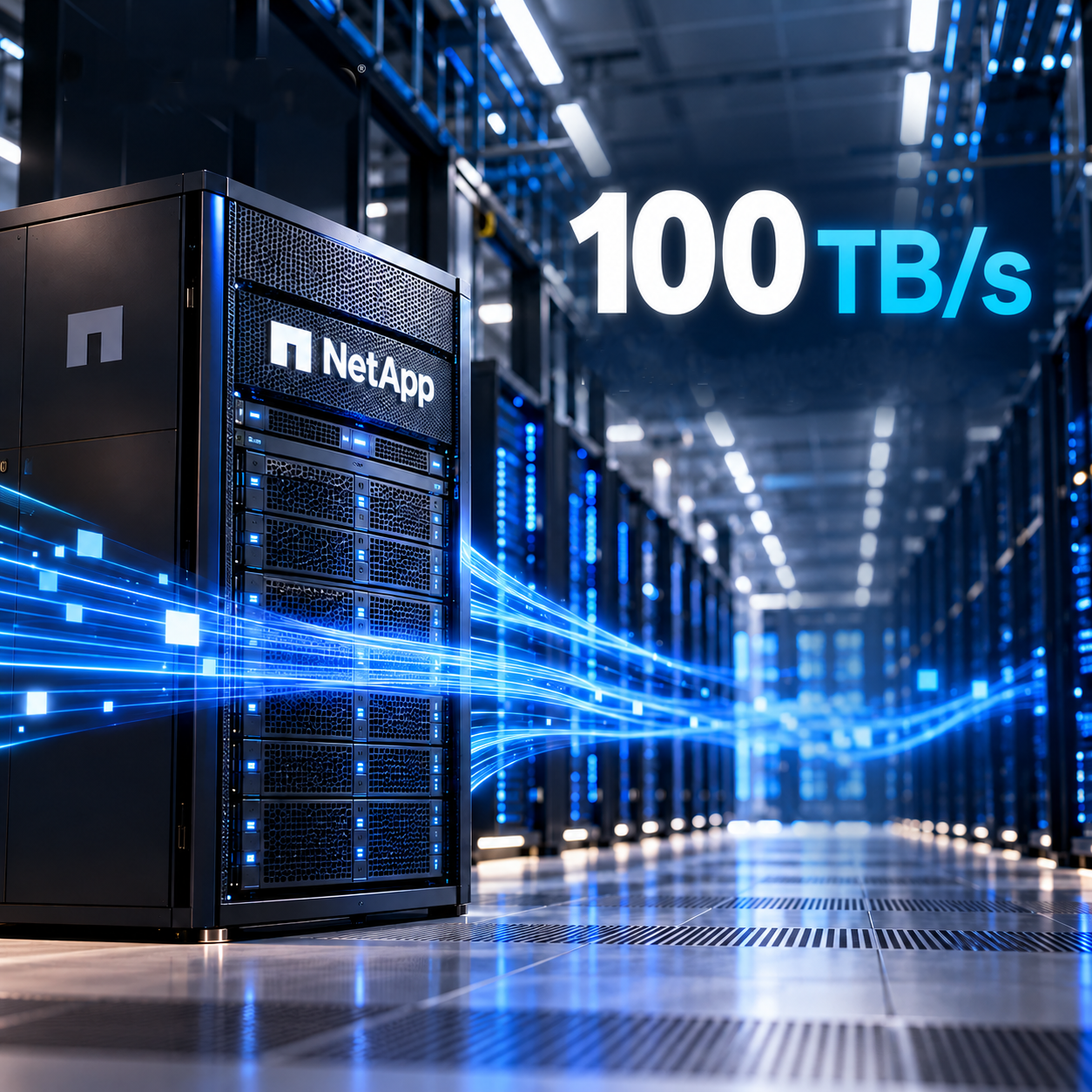

NetApp has unveiled Novus, a new storage architecture designed to deliver more than 100 terabytes per second of aggregate throughput as AI infrastructure expands to larger GPU clusters and increasingly data-intensive workloads.
Announced at NetApp INSIGHT 2026, Novus is being positioned for gigawatt-scale AI factories, neocloud operators, hyperscalers, large enterprises building GPU clouds and GPU-as-a-Service providers. The architecture is designed to support zettabyte-scale capacity while keeping large numbers of GPUs supplied with data during AI processing.
A central feature of Novus is the separation of metadata and data into independently scalable planes. NetApp said this approach allows organisations to expand metadata services and storage capacity separately instead of scaling both together. Thousands of storage nodes can then operate through a single namespace.
The company is targeting a growing infrastructure challenge created by large GPU deployments. NetApp estimates that a single GPU can require as much as 2 GB/s of throughput to remain fully utilised. At a scale of 50,000 GPUs, that could translate into cumulative bandwidth requirements of around 100 TB/s.
Traditional storage arrays, by comparison, can deliver roughly 40 GB/s to 80 GB/s, according to NetApp. Reaching the same level of aggregate throughput using conventional systems could therefore require more than 100 separate arrays, introducing additional namespaces, failure domains and management requirements.
Novus uses standards-based parallel Network File System, or pNFS, access. This is intended to allow GPU servers to connect without requiring proprietary storage clients, while reducing the need to manage specialised client software as GPU generations and operating environments change.
The architecture also brings elements of NetApp's ONTAP technology into its AI infrastructure strategy, including resilience, security and multi-tenancy capabilities. The company said the design is intended to reduce data-related GPU stalls and improve infrastructure utilisation by allowing storage performance to scale alongside computing requirements.
NetApp's Novus announcement follows its plan to acquire UK-based AI storage company PEAK:AIO, disclosed on September 25. PEAK:AIO develops high-performance parallel file systems and metadata technology designed for large-scale AI workloads. NetApp said the planned acquisition would strengthen its work around scalable metadata services and parallel namespace technology.
The launch reflects a broader shift in enterprise AI infrastructure as organisations move from experimental AI deployments towards production systems involving larger models, more data and increasingly expensive GPU clusters. For infrastructure providers, that is putting greater emphasis on storage performance alongside computing capacity, networking and data management.
Disclaimer: This article may include information derived from interviews, press releases, public statements, research, company communications and other publicly available or third-party sources. Such material may be summarised, paraphrased or contextualised for journalistic and editorial purposes. All rights in third-party content remain with their respective owners.